Monday, 1 May 2006


Sunday, 23 April 2006
MPSA joy
Last day at the Midwestern Political Science Association conference. This is the first time I've been to one of these big ones - more than 4000 presenters. It's like a polisci geek Glastonbury: you can run around trying to see all the cool bands, or you can sit in your tent smoking dope and occasionally wandering down to the stage to see what's on. I'm here with Laurence, another Essex PhD student. I have taken the blue-arsed fly approach, while he's been more on the spliff-rolling side of things, metaphorically. I've missed two sessions out of the 14 - 8.30 today and yesterday - and seen some really great papers. Highlights: John [?] Londregan, v interesting sort of leftfield paper about voting as a signal of willingness to fight in wars; Ethan Bueno de Mesquita, presenting a formal model of bureaucratic oversight with great clarity; James Fowler talking about how mono- and dizygotic twins vote - this man is obviously very smart; wandering into a more-or-less random session and getting, quite by chance and from a completely different field, a potential method for my next paper; and (heh) watching Vera Troeger discuss some papers. (Surgical.)
Hopefully will meet up with Robert Klemmensen today (w00t! I have another reader!) and try to come up with something clever for this amusing diversion, listed on POLMETH. (Everyone has a pet "really simple guaranteed winner" for this.) I see James Fowler is also behind this. Yikes.
Hopefully will meet up with Robert Klemmensen today (w00t! I have another reader!) and try to come up with something clever for this amusing diversion, listed on POLMETH. (Everyone has a pet "really simple guaranteed winner" for this.) I see James Fowler is also behind this. Yikes.
Saturday, 22 April 2006
Sonnet VII
How soon hath Time the suttle theef of youth,
Stoln on his wing my three and twentith yeer!
My hasting dayes flie on with full career,
But my late spring no bud or blossom shew’th.
Perhaps my semblance might deceive the truth,
That I to manhood am arriv’d so near,
And inward ripeness doth much less appear,
That som more timely-happy spirits indu’th.
Yet be it less or more, or soon or slow,
It shall be still in strictest measure eev’n,
To that same lot, however mean, or high,
Toward which Time leads me, and the will of Heav’n;
All is, if I have grace to use it so,
As ever in my great task Masters eye.
Milton
He revisited this theme with greater power in On His Blindness.
Wednesday, 5 April 2006
Tuesday, 14 March 2006

Tuesday, 28 February 2006
Torture in US "black prisons"
http://www.democracynow.org/article.pl?sid=06/02/27/1519239
(via http://www.jordanplanet.net/)
(via http://www.jordanplanet.net/)
CLIVE STAFFORD SMITH: Yeah, you know, Hussein Mustafa, I met with him in Jordan, and he was an incredibly credible person. He is a dignified older gentleman, about now 50 years old, and he wanted to talk about what had happened to him, but he really didn’t want to talk about that sexual stuff, and in the end, you know, I said to him, “Look, you don’t have to, but it’s very important if things happened, that the story get out, so they don't happen to other people,” and in the end he did, and it was in front of half a dozen people who were just transfixed as he described how four soldiers took him, one on each shoulder, one bent down his head and then the fourth of them took this broomstick and shoved it up his rectum.
Now there was no one in that room -- and they were from a variety of places -- who didn't believe that what this man was saying was true, but I am afraid, I’ve got to tell you, that that’s far from the worst that’s happened. When you talk about Bagram, when you talk about Kandahar, those aren’t the worst places the U.S. has run in Afghanistan. The dark prison, sometimes called “Salt Pit,” in Kabul itself, which is separate from Bagram, has been far worse than that, and I can tell you stories from there that just make your skin crawl.
Monday, 6 February 2006
Iraq demo
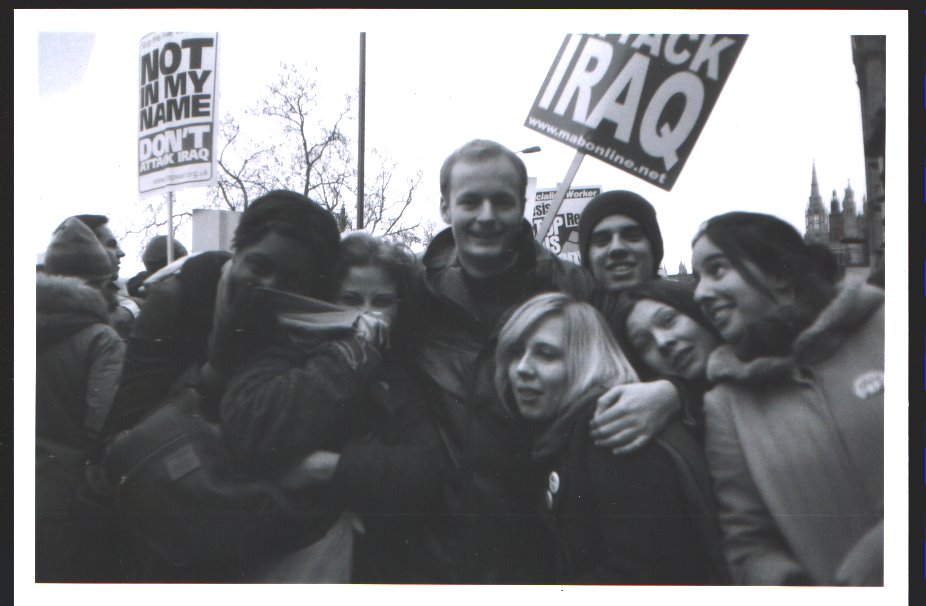
Cica took this photo at the big one. Left to right: Elisabeth, Mel, me, Clemency, Cica's cousin, Natasha, Elodie. Heh. It lends me some wholly undeserved glamour. What a great day that was. Pity we didn't win.
Thursday, 2 February 2006
Fast social science


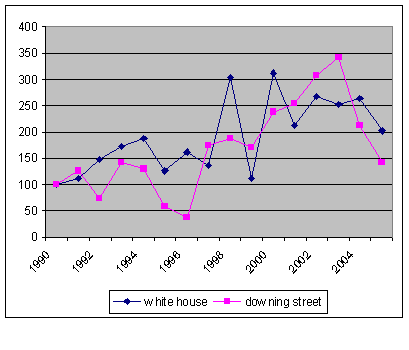
So on the subject of media attention to US and UK politics, these show the number of articles from the Times, FT and Guardian with different words in their headlines, 1990-2005. I rebased so that 1990=100, a dubious procedure because if 1990 was a very high or low year, that will make the subsequent pattern look better or worse. (In particular, take the White House/Downing Street comparison with a grain of salt.) Still, the trends are real enough. As far as I can see the story here is actually that Presidents and Prime Ministers have got more media attention, legislatures less. Country differences are pretty speculative.
Wednesday, 1 February 2006
Papers I would like to write
Whenever I get an idea I scribble it down on a sheet of paper and draw a little thought bubble at the top. This is an ongoing post with a list of papers I would like to write. Some of them are actual viable political or social science ideas. Others are things way out of my field, or ideas that might not be quite worth my time.
- Use "Blink"-style analysis of interviewers' posture, voice etc. when talking to politicians from different parties to provide an objective test of media bias.
- Why do human parents seek to control their children's sexual behaviour? This is AFAIK unique among animals. It is quite hard to understand from a genetic point of view: your children's interest in maximizing fitness is identical to your own (apart from the issue of degrees of relatedness, which might conceivably make a difference e.g. in cultures where people marry their cousins). Is the parental behaviour cultural or is there a genetic component? How did it arise?
- Hobbes' theory of the church in Leviathan Chapter XII seems to foreshadow modern economic theories of religion. He actually mentions the church before he gets to the state. It would be an interesting topic in intellectual history.
- Modelling how a city's size is affected by the size of other nearby cities. You might expect big cities to "drain" the population of near neighbours. The model could be applicable to other phenomena - firms in markets, even countries.
- How to extend formal models of elections to include the spread of information about policy through the population.
- Small churches and political parties seem to suffer more splits than large ones. Why? A formal model invoking control over resources and the ability to buy off potential splitters might help.
- Media analysis of how reporting of US politics has increased in non-US countries. A simple hit count for "senator" and "president" versus "MP" and "Prime Minister" would be a start.
I'll keep posting these as I remember them. There are a lot more!
Wednesday, 4 January 2006
edge.org asked a bunch of scientists for their "dangerous idea"
Not surprisingly, there are a lot of ones about science and religion. Also a lot of ones about minds, brains and genes. Cognitive science is "hot". These ideas are interesting but not so new, at least to me personally. Quite a lot of physicists talk about the idea of a "multiverse". A more political trend is a worry about American decline - there are a lot of grumbles about the lack of US science students.
Here are some of the ones I liked:
Sherry Turkle on the end of authenticity
http://www.edge.org/q2006/q06_8.html#turkle
Steven Strogatz on the end of insight
http://www.edge.org/q2006/q06_8.html#strogatz
Jaron Lanier on homuncular flexibility
http://www.edge.org/q2006/q06_7.html#lanier
Richard Nisbett on not knowing ourselves
http://www.edge.org/q2006/q06_3.html#nisbett
Jeremy Bernstein: the idea that we understand plutonium
http://www.edge.org/q2006/q06_3.html#bernstein
Frank Tipler on antimatter
http://www.edge.org/q2006/q06_4.html#tipler
Gregory Cochran: evolution has taken place within recorded history
http://www.edge.org/q2006/q06_4.html#cochran
Alison Gopnik: the idea of "dangerous ideas"
http://www.edge.org/q2006/q06_4.html#gopnik
Brian Greene on the multiverse (several physicists mention this theme):
http://www.edge.org/q2006/q06_5.html#greene
Diane F. Halpern on choosing your child's sex
http://www.edge.org/q2006/q06_7.html#halpern
Daniel Dennett: not enough minds for our memes
http://www.edge.org/q2006/q06_8.html#dennett
Robert Shapiro on monomers and the search for the origin of life
http://www.edge.org/q2006/q06_9.html#shapiro
Geoffrey Miller: aliens are too busy playing their Xboxes
http://www.edge.org/q2006/q06_9.html#miller
Bart Kosko: we're all using the wrong Bell Curve!
http://www.edge.org/q2006/q06_11.html#kosko
Marco Iacoboni: media violence induces imitative violence
http://www.edge.org/q2006/q06_11.html#iacaboni
Leo Chalupa: give me peace and quiet!
http://www.edge.org/q2006/q06_12.html#chalupa
Here are some of the ones I liked:
Sherry Turkle on the end of authenticity
http://www.edge.org/q2006/q06_8.html#turkle
Steven Strogatz on the end of insight
http://www.edge.org/q2006/q06_8.html#strogatz
Jaron Lanier on homuncular flexibility
http://www.edge.org/q2006/q06_7.html#lanier
Richard Nisbett on not knowing ourselves
http://www.edge.org/q2006/q06_3.html#nisbett
Jeremy Bernstein: the idea that we understand plutonium
http://www.edge.org/q2006/q06_3.html#bernstein
Frank Tipler on antimatter
http://www.edge.org/q2006/q06_4.html#tipler
Gregory Cochran: evolution has taken place within recorded history
http://www.edge.org/q2006/q06_4.html#cochran
Alison Gopnik: the idea of "dangerous ideas"
http://www.edge.org/q2006/q06_4.html#gopnik
Brian Greene on the multiverse (several physicists mention this theme):
http://www.edge.org/q2006/q06_5.html#greene
Diane F. Halpern on choosing your child's sex
http://www.edge.org/q2006/q06_7.html#halpern
Daniel Dennett: not enough minds for our memes
http://www.edge.org/q2006/q06_8.html#dennett
Robert Shapiro on monomers and the search for the origin of life
http://www.edge.org/q2006/q06_9.html#shapiro
Geoffrey Miller: aliens are too busy playing their Xboxes
http://www.edge.org/q2006/q06_9.html#miller
Bart Kosko: we're all using the wrong Bell Curve!
http://www.edge.org/q2006/q06_11.html#kosko
Marco Iacoboni: media violence induces imitative violence
http://www.edge.org/q2006/q06_11.html#iacaboni
Leo Chalupa: give me peace and quiet!
http://www.edge.org/q2006/q06_12.html#chalupa
Tuesday, 20 December 2005
More phone photos





I've had to use my phone since my camera got nicked. The constraints of a tiny image size can be liberating. These are mostly of the Colne estuary, which I walk along regularly. Actually the dog is here too.






Thursday, 8 December 2005
If you believe in expert judgment
... more than mechanical statistical predictions, as I tend to do, this might be interesting.
Monday, 5 December 2005


Wednesday, 16 November 2005
planet Iraq
Whole load more bloggers added to planet Iraq, mostly via an excellent history of Iraqi blogging (available from the main page). The typography is still a bit of a mess - unfortunately the software I am using doesn't deal very well with the rather messy XML feeds coming off all these blogs.
There are getting to be so many of these people that a single page can't really do justice. Which is nice. If only all the news from Iraq were so cheerful.
There are getting to be so many of these people that a single page can't really do justice. Which is nice. If only all the news from Iraq were so cheerful.
Friday, 11 November 2005
just one more thing...
Had to share this very cool link - a flash diagram of the world income distribution, 1970-2000. You can run it forward or backward, and examine different countries. It's based on Xavier-Sala-i-Martin's figures - I seem to recall, there is some controversy about his claims - but still very interesting.
(Update: you should also check out the Prof's website. For a Columbia economics professor, it's pretty funny.)
(Update: you should also check out the Prof's website. For a Columbia economics professor, it's pretty funny.)
More on income
I was wandering around the library in my usual Friday haze when I noticed the DSS's publication Households on Below Average Income 1979-1996/7. Aha. Just the place to find more detailed data on the effect of Evil Thatch on incomes.
The basic picture is straightforward: inequality rose markedly under Thatch. From 1979 to 1995/6, the proportion of people below half average income more or less doubled.
Of course, partly that is because average incomes rose markedly (by about 40% adjusted for inflation). But the appendices have information on the percentages of groups below various fractions of 1979 average income, held constant. In 1979, 8% of people were living below half 1979 average income. In 1995/6, 5% of people were living below half 1979 average income (adjusted for inflation). The figures for 60% of 1979 average income are similar: 18% and 10% respectively.
However, the AHC figures are much less cheerful, with the proportions of individuals living below these thresholds remaining almost constant. And the very poor do badly. There were about as many people below 40% of 1979 average income in 1995/6 as there were in 1979, whether Before or After Housing Costs.
End of brief statistical lecture. Everything is much more complex than this - for example, what about the experience of different groups? Families with children? Pensioners? What about the persistence of inequality over time? What's the right way to define or even conceptualise poverty? Despite being a Sinister Rightwinger, I believe that relative poverty is very important. Being poor, and specifically being poorer than other people, is horrible. Of course absolute poverty is bad too. Oddly enough these ideas tend to be backed up by the (stereotypically, right-wing) Darwinian approach to society: beyond satisfaction of our basic needs, we care about our relative position rather than our absolute wealth.
Corrections from the people at ISER (who do this kind of thing seriously) are of course welcome. Perhaps I should now stop reading DSS statistics on Friday night.
Just one further thought. The distribution of "talent" of many kinds is probably normal, like most things that rely on many different factors (if you add a lot of random variables together, you approach a normal distribution - the famous bell curve). The distribution of income is not normal. It looks much more like a lognormal distribution, such as the lefthand picture below
The basic picture is straightforward: inequality rose markedly under Thatch. From 1979 to 1995/6, the proportion of people below half average income more or less doubled.
Of course, partly that is because average incomes rose markedly (by about 40% adjusted for inflation). But the appendices have information on the percentages of groups below various fractions of 1979 average income, held constant. In 1979, 8% of people were living below half 1979 average income. In 1995/6, 5% of people were living below half 1979 average income (adjusted for inflation). The figures for 60% of 1979 average income are similar: 18% and 10% respectively.
However, the AHC figures are much less cheerful, with the proportions of individuals living below these thresholds remaining almost constant. And the very poor do badly. There were about as many people below 40% of 1979 average income in 1995/6 as there were in 1979, whether Before or After Housing Costs.
End of brief statistical lecture. Everything is much more complex than this - for example, what about the experience of different groups? Families with children? Pensioners? What about the persistence of inequality over time? What's the right way to define or even conceptualise poverty? Despite being a Sinister Rightwinger, I believe that relative poverty is very important. Being poor, and specifically being poorer than other people, is horrible. Of course absolute poverty is bad too. Oddly enough these ideas tend to be backed up by the (stereotypically, right-wing) Darwinian approach to society: beyond satisfaction of our basic needs, we care about our relative position rather than our absolute wealth.
Corrections from the people at ISER (who do this kind of thing seriously) are of course welcome. Perhaps I should now stop reading DSS statistics on Friday night.
Just one further thought. The distribution of "talent" of many kinds is probably normal, like most things that rely on many different factors (if you add a lot of random variables together, you approach a normal distribution - the famous bell curve). The distribution of income is not normal. It looks much more like a lognormal distribution, such as the lefthand picture below
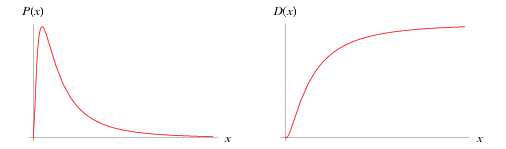
- pictures filched from http://mathworld.wolfram.com/LogNormalDistribution.html
Why? I am sure there are many extant answers to this question. My guess, keeping with the Darwinian theme, is that overachievers tend both to hang out with each other, and to compete with each other for income (or various correlates of income). This makes for a "long tail" distribution, with the mobile phone salespersons, the city slickers, and Bill Gates at the very, very top.
Seal and hard drive
I saw the seal again today. This time he (she?) was swimming. He ducked down under water after a few seconds, and reappeared a few minutes later and 200 yards downstream, just a black blob on the waves. Very nice.
Slashdot has a discussion on how long it would take for the police to decrypt an encrypted hard drive. This was one of the justifications offered for 90-day detention. Bottom line: 90 days is a slight underestimate. Good encryption cannot be cracked within the lifespan of the known universe, unless you can guess the password. Encryption is one of the subtlest parts of computer science, about which I know little, but the fundamental deal is fairly straightforward: every time you add a character (say just a-z) to your password, you multiply the number of potential passwords, and the time it takes to guess the password by brute force, by 26. Go type "26 x" into your calculator and hit "=" a few times. See?
Slashdot has a discussion on how long it would take for the police to decrypt an encrypted hard drive. This was one of the justifications offered for 90-day detention. Bottom line: 90 days is a slight underestimate. Good encryption cannot be cracked within the lifespan of the known universe, unless you can guess the password. Encryption is one of the subtlest parts of computer science, about which I know little, but the fundamental deal is fairly straightforward: every time you add a character (say just a-z) to your password, you multiply the number of potential passwords, and the time it takes to guess the password by brute force, by 26. Go type "26 x" into your calculator and hit "=" a few times. See?
Subscribe to:
Posts (Atom)