I just replaced the screen in my Portege R100 laptop. I used the instructions from Screentekinc - everything was much as described there. There are four screws under rubber pads at the top of the R100 screen, and six under small square pads around the bottom and the sides. All of these can be removed with a sharp knife - I used a Stanley knife. You'll need a very small Phillips screwdriver to unscrew the screws. (Or you can just use the Stanley knife. But you'll probably damage the screws and your blade. Yeah, that's what I did.)
After that I unclicked the plastic surround to my screen - it requires a bit of a pull and is best started from the bottom left, once you've got the first bit the rest comes easily. Then you are face to face with the screen. The rest is pretty much as in the tutorial. You pull out the data plug (having first removed any sticky tape holding it down), and the inverter plug which provides the power. (You did remove the battery, right?) To remove the inverter plug it's much easier to unscrew the inverter first (it's the long thin circuitry on the right hand side of the screen, held in place by a single screw). Then you have to pull hard and use your fingernails to get the inverter plug out.
Once that is all done you just replace your screen, plug the new screen back into the inverter and the data connection, sticky tape it up, slot your plastic surround back in and screw everything back in place. Pah! Child's play.
Tuesday, 19 September 2006


Monday, 18 September 2006
Party strategies tournament results
The results from Fowler and Laver's Tournament of Party Strategies (previously blogged) are up here. I was chuffed to see that my strategy (Raptor) came in 8th - just beating Hunter, the pre-submitted strategy on which it was based. They plan to rerun the tournament using only those strategies which beat Hunter. I'm optimistic that with the smaller set of strategies used, Raptor (which uses a predefined step size to recognize and cooperate with conspecifics) will continue to do well.
Interestingly, Fowler and Laver would also like to develop evolutionary rules that allow successful party strategies to evolve and mutate. They worry about how to parametrize party strategies. One option would be to use genetic programming (not to be confused with genetic algorithms): each party strategy is a parse tree of R statements, and each round, the parse tree is set to work on the inputs, and outputs a new location. Mutations could consist of prunings and duplications of the tree, as well as adding new branches.
Interestingly, Fowler and Laver would also like to develop evolutionary rules that allow successful party strategies to evolve and mutate. They worry about how to parametrize party strategies. One option would be to use genetic programming (not to be confused with genetic algorithms): each party strategy is a parse tree of R statements, and each round, the parse tree is set to work on the inputs, and outputs a new location. Mutations could consist of prunings and duplications of the tree, as well as adding new branches.
Cosmic injustice
Term is about to start. Clemency just came on gmail chat and told me she's got a new job working for these guys. I do economic theory. Clemency eats organic chocolate cake. Go figure.
Friday, 15 September 2006
skype
Madly busy - flathunting plus Maths class - but have found time to get Skype. If anyone else has it, drop me a line with your username.
Wednesday, 6 September 2006

Friday, 1 September 2006
Chicago
Well, this is the first time I have a few minutes to spare. I arrived hot off the plane and crashed at Nick Smith's place - thanks Nick. The following Monday, Math camp began at Northwestern and my first discovery was that Evanston is a solid 90 minute commute from Southside Chicago - minimum. Often, 2 hours. So I began desperately searching for an apartment. I've found a couple of possible places and meanwhile, a kind couple has agreed to put me up a little closer to Evanston. They have two golden labradors, one of whom has the amiable habit of putting her head through your legs and staying there.
Math camp. As you may know, in Math camp you are not allowed to say your name, instead you have to say "this mathematician":
"SIR! THIS MATHEMATICIAN WOULD APPLY THE KAKUTANI FIXED POINT THEOREM SIR!"
Math camp is quite hardcore. One class from 9 until 12 with a ten minute break, then lunch, then problem set solutions at 1 pm, then you spend the afternoon trying to solve the next day's problems. It's particularly fun when you then have to look for apartments and commute 2 hours home.
I thought that Kellogg would be full of ruthless MBA sharks (yay), but they haven't arrived yet. Instead, everyone is a PhD student, but some of them are kind of business PhDs - a concept that makes my head hurt. You mean, you're a PhD student, but at some point you might make actual money?
Met up with John O'Brien last night. Some of you may remember John from my 29th birthday party - think extremely loud American. We went out with 6 firemen from San Francisco.
Let me rephrase that. We went out heterosexually, with 6 heterosexual firemen from San Francisco. Whenever somebody said "what do you guys do?" they all said "WE'RE FIREMEN" and I just nodded vaguely. Great night.
This mathematician was late for Math camp this morning ("drop and give me 100 definite integrals!")
I've got a temporary office with a computer and (at the moment) nobody else in it. Booya!
APSA is here and I'm missing it. I want to know the results of the Tournament of Party Strategies. Me and Thomas Pluemper both submitted something. I really want to see the complete ranking....
Lucy Reid is getting married. W00t! (Please try not to screw it up like some people we know, Lucy. Thanks. Nothing personal, Tzvi.)
Math camp. As you may know, in Math camp you are not allowed to say your name, instead you have to say "this mathematician":
"SIR! THIS MATHEMATICIAN WOULD APPLY THE KAKUTANI FIXED POINT THEOREM SIR!"
Math camp is quite hardcore. One class from 9 until 12 with a ten minute break, then lunch, then problem set solutions at 1 pm, then you spend the afternoon trying to solve the next day's problems. It's particularly fun when you then have to look for apartments and commute 2 hours home.
I thought that Kellogg would be full of ruthless MBA sharks (yay), but they haven't arrived yet. Instead, everyone is a PhD student, but some of them are kind of business PhDs - a concept that makes my head hurt. You mean, you're a PhD student, but at some point you might make actual money?
Met up with John O'Brien last night. Some of you may remember John from my 29th birthday party - think extremely loud American. We went out with 6 firemen from San Francisco.
Let me rephrase that. We went out heterosexually, with 6 heterosexual firemen from San Francisco. Whenever somebody said "what do you guys do?" they all said "WE'RE FIREMEN" and I just nodded vaguely. Great night.
This mathematician was late for Math camp this morning ("drop and give me 100 definite integrals!")
I've got a temporary office with a computer and (at the moment) nobody else in it. Booya!
APSA is here and I'm missing it. I want to know the results of the Tournament of Party Strategies. Me and Thomas Pluemper both submitted something. I really want to see the complete ranking....
Lucy Reid is getting married. W00t! (Please try not to screw it up like some people we know, Lucy. Thanks. Nothing personal, Tzvi.)
Tuesday, 29 August 2006
mobile phone protests
protesting via mobile phone in the philippines
(via wired.com, via boingboing.net)
in Chicago and will post more when I have some time.
(via wired.com, via boingboing.net)
in Chicago and will post more when I have some time.
Thursday, 24 August 2006
Counterfactuals
Valéria asked me whether I thought the British empire was a good thing.
There are all sorts of interesting things one can say about the good and bad things the British did. But ultimately to answer a question like this, which is a very reasonable one to ask, we need to compare what actually happened with what would have happened supposing that the Empire had not come into being. Which of these two courses of history would have been better? This is just the same sort of question political scientists are always asking and answering. For example, after performing a logit regression (a piece of statistics where the dependent variable is binary, for example, did a particular person turn out to vote or not?) we may say: if this person had been a woman instead of a man, but everything else had been the same - if she had had the same social class, education, religiosity and so on - she would have been ten per cent more likely to vote. Maybe in some cases the regression will be misspecified or based on inaccurate data or whatever. But in principle this can be valid.
If our historical knowledge - the application of our social science knowledge - is good enough, we can answer counterfactuals about history. For example, we can guess that Hong Kong would have been worse off if it had been colonized by the Portuguese and not by the British. We can make this guess without a deep understanding of history, because Macau, a small island rather like Hong Kong, actually was colonized by the Portuguese, and has not to date been nearly as economically successful as Hong Kong. Again, our guess is not infallible. Perhaps there is something we don't know that is specific to Hong Kong. But it is a reasonable guess.
Can we make the same kind of assessment of the Empire as a whole?
To do that we need to imagine an alternative history in which the British Empire does not come into being. Several problems at once present themselves. First, we need a coherent story. Why do the British fail to colonize large parts of the world in the 19th century? Well, they could have been unable to, if they had not had an industrial revolution. But now we are answering a very different question: what would have happened if the British had not had an industrial revolution? The consequences for human history would have been much broader than the question of empire. Or perhaps, the British simply chose not to pursue their empire. But then we run into a worry about psychological plausibility. For humans not to pursue power and empire when they can runs counter to the general tendency of most of history. If we assume this is what happened, are we assuming a different kind of humanity? Gentler and kinder, or simply more prone to take its own religious ideology (the Sermon on the Mount, say) seriously? Again, that's a different question from Valéria's question about the Empire.
It is not that we cannot coherently imagine histories without a British Empire. We can imagine many. The problem is that none of them will cut the Empire neatly out of the world without cutting a great deal more besides. Another problem is that there are very many of these histories: we do not have a useful criterion for choosing which one to use as a point of moral comparison. And many of these histories will be incomplete (no use for moral evaluation) without answering a lot of questions which, again, are irrelevant to what Valéria wants to know. For example, we could imagine that the French defeat the British in the eighteenth century struggle for power. Then we will need to know whether there is a counterfactual French empire, how far it will extend, and what it will be like. Our answers to these questions will determine how we evaluate the counterfactual history. Finally, when we construct our alternative history, we need to know what the British themselves were doing (instead of having an empire). After all, they were important actors in world history. To keep our counterfactual relevant, we will need them to be doing almost exactly what they actually did, except without having an empire. But this is rather like imagining a vertebrate except without its backbone. The empire was central to what the British were doing at the time. Again, we can always think of other things they might have done, but the problem is that there are too many of these alternative courses of action, all of them with widely differing impacts on history and human happiness.
Small-scale "what ifs" are answerable and important. (That's why I believe in social science and not just in, say, narrative history.) It's easy to believe that large scale "what ifs", which look just the same grammatically, must be equally meaningful. But these considerations lead me to believe they are not. At some point of scale, we lose the ability to construct the right kind of counterfactual.
There are all sorts of interesting things one can say about the good and bad things the British did. But ultimately to answer a question like this, which is a very reasonable one to ask, we need to compare what actually happened with what would have happened supposing that the Empire had not come into being. Which of these two courses of history would have been better? This is just the same sort of question political scientists are always asking and answering. For example, after performing a logit regression (a piece of statistics where the dependent variable is binary, for example, did a particular person turn out to vote or not?) we may say: if this person had been a woman instead of a man, but everything else had been the same - if she had had the same social class, education, religiosity and so on - she would have been ten per cent more likely to vote. Maybe in some cases the regression will be misspecified or based on inaccurate data or whatever. But in principle this can be valid.
If our historical knowledge - the application of our social science knowledge - is good enough, we can answer counterfactuals about history. For example, we can guess that Hong Kong would have been worse off if it had been colonized by the Portuguese and not by the British. We can make this guess without a deep understanding of history, because Macau, a small island rather like Hong Kong, actually was colonized by the Portuguese, and has not to date been nearly as economically successful as Hong Kong. Again, our guess is not infallible. Perhaps there is something we don't know that is specific to Hong Kong. But it is a reasonable guess.
Can we make the same kind of assessment of the Empire as a whole?
To do that we need to imagine an alternative history in which the British Empire does not come into being. Several problems at once present themselves. First, we need a coherent story. Why do the British fail to colonize large parts of the world in the 19th century? Well, they could have been unable to, if they had not had an industrial revolution. But now we are answering a very different question: what would have happened if the British had not had an industrial revolution? The consequences for human history would have been much broader than the question of empire. Or perhaps, the British simply chose not to pursue their empire. But then we run into a worry about psychological plausibility. For humans not to pursue power and empire when they can runs counter to the general tendency of most of history. If we assume this is what happened, are we assuming a different kind of humanity? Gentler and kinder, or simply more prone to take its own religious ideology (the Sermon on the Mount, say) seriously? Again, that's a different question from Valéria's question about the Empire.
It is not that we cannot coherently imagine histories without a British Empire. We can imagine many. The problem is that none of them will cut the Empire neatly out of the world without cutting a great deal more besides. Another problem is that there are very many of these histories: we do not have a useful criterion for choosing which one to use as a point of moral comparison. And many of these histories will be incomplete (no use for moral evaluation) without answering a lot of questions which, again, are irrelevant to what Valéria wants to know. For example, we could imagine that the French defeat the British in the eighteenth century struggle for power. Then we will need to know whether there is a counterfactual French empire, how far it will extend, and what it will be like. Our answers to these questions will determine how we evaluate the counterfactual history. Finally, when we construct our alternative history, we need to know what the British themselves were doing (instead of having an empire). After all, they were important actors in world history. To keep our counterfactual relevant, we will need them to be doing almost exactly what they actually did, except without having an empire. But this is rather like imagining a vertebrate except without its backbone. The empire was central to what the British were doing at the time. Again, we can always think of other things they might have done, but the problem is that there are too many of these alternative courses of action, all of them with widely differing impacts on history and human happiness.
Small-scale "what ifs" are answerable and important. (That's why I believe in social science and not just in, say, narrative history.) It's easy to believe that large scale "what ifs", which look just the same grammatically, must be equally meaningful. But these considerations lead me to believe they are not. At some point of scale, we lose the ability to construct the right kind of counterfactual.
Wednesday, 23 August 2006
Fullah dolls
The Middle Eastern barbie. Check out the veil.

From http://healingiraq.blogspot.com/ via http://www.blogiraq.net
From http://healingiraq.blogspot.com/ via http://www.blogiraq.net
back in São Paulo
... after 4 days in Rio. Rio is beautiful - Ipanema beach has big green waves which throw up explosions of powdery surf and the whole city has huge hills growing through it. But frankly São Paulo is bigger, and as far as cities go I'm a slut for size.
There seems to be a typical Carioca (Rio inhabitant) face, a kind of pleasant squinting expression. Paulistanos claim that this is a Lamarckian adaptation, from screwing up their faces to figure out more ways to extract money from São Paulo. I'm just repeating what I've heard, you understand.
There seems to be a typical Carioca (Rio inhabitant) face, a kind of pleasant squinting expression. Paulistanos claim that this is a Lamarckian adaptation, from screwing up their faces to figure out more ways to extract money from São Paulo. I'm just repeating what I've heard, you understand.
Wednesday, 16 August 2006
In Fortaleza
... in an internet cafe, reviewing a Political Science article. Two cubicles down, a couple of teenagers are looking at porn.
OTOH
I am sure that nobody who really knows me could ever describe me as misanthropic. Still, it is only fair to record that shortly after writing my last entry, I had a very delicious pizza with the nice and interesting proprietress of an art shop. So not everything in "Jeri" can be bad. And she also told me that between March and May things are much quieter and the beach is a beautiful white. Your mileage may vary.
Monday, 14 August 2006
Jeri (Not Safe For Work)
Spent the last four days in Jericoacoara. Once an idyllic fishing village on Brazil's Northern coast, it was discovered by the hippies and is now a thriving tourist resort - thriving on its own evil spume, that is. Every evening the visitors to Jericoacoara gather on top of a nearby sand dune to watch the sun set. This is a diluted relic of an earlier tradition in which, after sundown, the hippies would have a communal circle jerk and then kill and eat one of their number in a bonding ritual to prevent outsiders ever learning about "The Beach". Well, it hasn't worked and now the town is full of beach bums, preening fools and creepy older men with their teenage girlfriends. The word Jericoacoara is often shortened to "Jeri" in much the same unspeakably self-satisfied way that Wivenhoe's inhabitants call it Wiv. Coincidentally, "Geri" is also the name of a singer and former Spice Girl who, like Jericoacoara, fucking sucks.
The first people I met in "Jeri" were three American sex tourists who kindly showed me their holiday pictures, of fellatio by some poor godforsaken puta from Fortaleza. Thanks, fuckers. The second person was a gentleman from Sao Paulo who had spent twenty years cycling around Brazil in order to discover his culture. At the end of this process he had worked out that he enjoyed reggae music and smoking dope. I am sure it will surprise you to learn that his conversation had a pecuniary goal: his ultimate aim was to "mend his bicycle" and with this in mind, he attempted to sell me a bracelet made of anaconda skin. I hope that by now a kind of general picture is forming in your mind.
In fairness it must be said that an hour's walk East from the town there is a solid mile of fabulously beautiful beach surrounded by rock formations and beaten by the Atlantic surf. You will have it all to yourself because none of the tourists in Jeri can get the brain cells together to leave the town beach, which, by the way, has been invaded by some kind of black, stinking seaweed, perhaps meant by God as some kind of metaphor.
The first people I met in "Jeri" were three American sex tourists who kindly showed me their holiday pictures, of fellatio by some poor godforsaken puta from Fortaleza. Thanks, fuckers. The second person was a gentleman from Sao Paulo who had spent twenty years cycling around Brazil in order to discover his culture. At the end of this process he had worked out that he enjoyed reggae music and smoking dope. I am sure it will surprise you to learn that his conversation had a pecuniary goal: his ultimate aim was to "mend his bicycle" and with this in mind, he attempted to sell me a bracelet made of anaconda skin. I hope that by now a kind of general picture is forming in your mind.
In fairness it must be said that an hour's walk East from the town there is a solid mile of fabulously beautiful beach surrounded by rock formations and beaten by the Atlantic surf. You will have it all to yourself because none of the tourists in Jeri can get the brain cells together to leave the town beach, which, by the way, has been invaded by some kind of black, stinking seaweed, perhaps meant by God as some kind of metaphor.
Saturday, 12 August 2006
More insight
I've worked it out: Brazilians are cockneys.
- They pronounce words the same way. Ask a black cab driver to say Costa del Sol and it'll be just the way a Brazilian would pronounce it, i.e. "de'w so'w".
- The Portuguese for "hi" is "oi" which must be short for "Oi oi my son!"
- Brazilians from the Northeast love forro, which is basically just knees-up Mavver Brahn with a funny beat.
Thursday, 10 August 2006
Like looking at the future
Here's one of my (superficial but hopefully fresh) impressions. Imagine giving Britain's metropolitan elite [TM] - the chattering classes, the Islington set - total social control for twenty years, and imagine that their ideas actually worked. Well, that's Brazil in certain aspects. For example, it's ridiculously racially integrated. There is a complete chaos of ethnic types, and the melting pot seems genuinely to have melted here - compared to, say, the US. I don't say there's no racial injustice or discrimination. But there are no hard and fast colour lines.
Or take sexuality. In a town - OK, a university town - of one of the poorest states of the Northeast, they hold an annual gay pride parade, by golly. Picture that in our Northeast? Well... eesh, perhaps.
In this particular way, Brazil seems like a glimpse into our future, or at least like science fiction.
Or take sexuality. In a town - OK, a university town - of one of the poorest states of the Northeast, they hold an annual gay pride parade, by golly. Picture that in our Northeast? Well... eesh, perhaps.
In this particular way, Brazil seems like a glimpse into our future, or at least like science fiction.
Wednesday, 9 August 2006
Joaoaoaoa Pessoaoaoa
Meh. Blogger ate the first version of my beautiful insights. So, quickly and dirtily... I arrived in Joao Pessoa yesterday morning. On the bus from Salvador I met a student returning from some kind of goddamn Communist conference. I tried to convince him of the error of his ways (with my 20 words of Portuguese) and he ended up inviting me to crash at his. This leads eventually to a night of crazy dancing with a bunch of students at the State University of Paraiba... forro (very fast side-to-side butt-shaking a deux) followed by a ?? quadrille which is kind of like a barn dance except they shouted out all the moves themselves. Big love to Marcos, Junior and Mariana e todos os outros... Marcos whipped up a poem which I will reproduce here without trying to translate:
Vejo o trabalhador
hoje como companheiro
Ombro a ombro caminhames
Seguindo nosso roteiro
Caminhamos sempre juntos
Olhando para horizonte
Contemplando a Utopia
De um dia sermos iguias
Com as nossas diferencas
not bad for five minutes eh? Marcos, fui muito legal de conhecer-te e seus amigos. Espero que nos nos encontramos de novo... 'ta bem... Dave o capitalist "Chicago Boy".
Vejo o trabalhador
hoje como companheiro
Ombro a ombro caminhames
Seguindo nosso roteiro
Caminhamos sempre juntos
Olhando para horizonte
Contemplando a Utopia
De um dia sermos iguias
Com as nossas diferencas
not bad for five minutes eh? Marcos, fui muito legal de conhecer-te e seus amigos. Espero que nos nos encontramos de novo... 'ta bem... Dave o capitalist "Chicago Boy".
Monday, 7 August 2006
in Salvador bus station
... arrived from Lencois and heading up to Joao de Pessoa in a couple of days. I did 2 days trekking in Lencois (the Chiapada Diamantida) which is fab. beautiful and very hard work.
Since leaving my friends in Sao Paulo I seem to have been sucked into the "traveller" circuit a bit. Lots of nice people but the culture pisses me off slightly. Joe Tourist has two weeks holiday and decides how much to spend on it. These young people have X amount of money and try to make it last as long as possible, which inevitably means they end up haggling bitterly over, like, 25 pence. And they smoke dope. Meh. I dunno, am probably just a crusty old man but occasionally I feel they need a HOLIDAY IN CAMBODIA...
Since leaving my friends in Sao Paulo I seem to have been sucked into the "traveller" circuit a bit. Lots of nice people but the culture pisses me off slightly. Joe Tourist has two weeks holiday and decides how much to spend on it. These young people have X amount of money and try to make it last as long as possible, which inevitably means they end up haggling bitterly over, like, 25 pence. And they smoke dope. Meh. I dunno, am probably just a crusty old man but occasionally I feel they need a HOLIDAY IN CAMBODIA...
Monday, 31 July 2006
in Brazil
I arrived in Sao Paulo on Friday, four hours late after a traumatic flight with American Airlines. Like an experiment in 'how crap can we be and still survive in a capitalist economy?' We were stuck for three hours on the runway at JFK and nobody told us what was happening. The food, which used to be halfway decent, is now just "chicken or beef?" and vegetarian options are not possible. I assume these guys are zombies, waiting to go bust under pressure from cheapo airline competition and the weight of their debts, pensions & salaries.
Brazil is awesome. The food is delicious, people are friendly, my Portuguese is terrible. Being a political obsessive I am asking everybody about Lula. The outside world is pretty favourable to him, seeing him as one of the "good Left" as opposed to the old Chavez-style populists. Everyone here, by contrast, seems very disappointed. The corruption scandals were really serious - vote buying, links to crime etc. On the other hand, there are no very inspiring alternatives and I have not yet heard any really cogent arguments against the PT's policies. The problem if anything is what they are not doing (fixing the police and education). People believe Lula will win again and it's hard to disagree.
On Saturday morning, Norman Gall from the Fernand Braudel Institute in Sao Paulo invited me to one of their reading circles. A dozen teenagers from state schools were reading Adam Smith in Portuguese. It was inspiring to see so much talent, dedication and enthusiasm. People here become very gloomy when you ask them about politics or society. I see a lot of positives. There's tremendous energy in Sao Paulo. Little charismatic churches have popped up all over the place, scandalizing educated humanists with their unsophisticated approach (anyone can become a priest without even having studied theology!) When you stop at traffic lights, a kid will jump out in front of your car and juggle tennis balls, more or less expertly. English schools are everywhere.
BTW, for a good read on Brazil today check out Norman's paper Lula and Mephistopheles. Starts from the corruption scandals and broadens out to diagnose the whole society.
Brazil is awesome. The food is delicious, people are friendly, my Portuguese is terrible. Being a political obsessive I am asking everybody about Lula. The outside world is pretty favourable to him, seeing him as one of the "good Left" as opposed to the old Chavez-style populists. Everyone here, by contrast, seems very disappointed. The corruption scandals were really serious - vote buying, links to crime etc. On the other hand, there are no very inspiring alternatives and I have not yet heard any really cogent arguments against the PT's policies. The problem if anything is what they are not doing (fixing the police and education). People believe Lula will win again and it's hard to disagree.
On Saturday morning, Norman Gall from the Fernand Braudel Institute in Sao Paulo invited me to one of their reading circles. A dozen teenagers from state schools were reading Adam Smith in Portuguese. It was inspiring to see so much talent, dedication and enthusiasm. People here become very gloomy when you ask them about politics or society. I see a lot of positives. There's tremendous energy in Sao Paulo. Little charismatic churches have popped up all over the place, scandalizing educated humanists with their unsophisticated approach (anyone can become a priest without even having studied theology!) When you stop at traffic lights, a kid will jump out in front of your car and juggle tennis balls, more or less expertly. English schools are everywhere.
BTW, for a good read on Brazil today check out Norman's paper Lula and Mephistopheles. Starts from the corruption scandals and broadens out to diagnose the whole society.
Wednesday, 5 July 2006
Essex vaut un blog
In between very dull data importing, I thought I could find time to mention Essex. I am about to leave and spend a year at Northwestern.
I've been at two universities in my life, and have had an incredibly happy time at both of them.
Among the great things this place has are psycho ducks and rabbits, Wivenhoe (aka Wiv, The Hoe, Thundercatshoe to various deranged residents), the Wivenhoe trail, and the main building , which is cunningly designed as an ornamental maze. Then there's the amazingly international student body: a sample of young, determined and smart people from all over the world.
The best thing though is the academic community, which is closeknit, friendly, unpretentious and professional. People here are incredibly generous with their time and knowledge. The seminars are great - informal but tough. The PhD students are a very varied and interesting bunch. And Essex is imbued with the spirit of the 60s, from the not-beautiful-but-just-about-lovable architecture to the democratic optimism.
Things I won't miss? The food. Not that it's bad.... I just feel that I have eaten enough Cafe Vert paninis for one lifetime.
See y'all in a year. I'm off to Chicago!
"Are you ready for the city? Is the city ready for you?"
Futureheads The City is Here for You to Use
I've been at two universities in my life, and have had an incredibly happy time at both of them.
Among the great things this place has are psycho ducks and rabbits, Wivenhoe (aka Wiv, The Hoe, Thundercatshoe to various deranged residents), the Wivenhoe trail, and the main building , which is cunningly designed as an ornamental maze. Then there's the amazingly international student body: a sample of young, determined and smart people from all over the world.
The best thing though is the academic community, which is closeknit, friendly, unpretentious and professional. People here are incredibly generous with their time and knowledge. The seminars are great - informal but tough. The PhD students are a very varied and interesting bunch. And Essex is imbued with the spirit of the 60s, from the not-beautiful-but-just-about-lovable architecture to the democratic optimism.
Things I won't miss? The food. Not that it's bad.... I just feel that I have eaten enough Cafe Vert paninis for one lifetime.
See y'all in a year. I'm off to Chicago!
"Are you ready for the city? Is the city ready for you?"
Futureheads The City is Here for You to Use
interpolating data in R
Here's a little function that does linear interpolation of data. For example, if you have a matrix like
[,1] [,2] [,3] [,4] [,5] [,6] [,7]
[1,] NA 1 NA NA 6 NA NA
[2,] NA 8 NA NA 5 NA NA
[3,] NA 1 NA NA 4 NA NA
[4,] NA 7 NA NA 7 NA NA
[5,] NA 9 NA NA 1 NA NA
it will be turned into
[,1] [,2] [,3] [,4] [,5] [,6] [,7]
[1,] 1 1 2.666667 4.333333 6 6 6
[2,] 8 8 7.000000 6.000000 5 5 5
[3,] 1 1 2.000000 3.000000 4 4 4
[4,] 7 7 7.000000 7.000000 7 7 7
[5,] 9 9 6.333333 3.666667 1 1 1
Columns 1, 6 and 7 have just been copied from columns 2 and 5 - i.e. this doesn't do extrapolation. Columns 3 and 4 have been interpolated linearly.
The columns of the input matrix must be either all valid, or all NA. Otherwise it will get confused. Fixes welcome.
do.interpolate <- function (m) {
if (any(is.na(m[,1]))) m[] <- rep(m[,ncol(m)], ncol(m))
else if (any(is.na(m[,ncol(m)]))) m[] <- rep(m[,1], ncol(m))
else {
p <- ncol(m)-1
m <- as.matrix(m[,c(1, ncol(m))]) %*% matrix(c(p:0/p, 0:p/p), nrow=2,
byrow=T)
}
return (m)
}
# m is a matrix with missing data
mass.interpolate <- function (m) {
for (c in 1:ncol(m))
if (any(is.na(m[,c])) & ! all(is.na(m[,c])))
stop("column ", colnames(m)[c], " of matrix m is incomplete")
valid <- c(1, which(apply(m, 2, function (x) ! any(is.na(x)))))
rvalid <- c(valid[-1], ncol(m))
for (i in 1:length(valid)) {
if (valid[i] == rvalid[i]) next # if left or rightmost cols are valid
m[ ,valid[i]:rvalid[i] ] <- do.interpolate(m[ ,valid[i]:rvalid[i],
drop=F])
}
return(m)
}
Usage: mass.interpolate(my.matrix)
[,1] [,2] [,3] [,4] [,5] [,6] [,7]
[1,] NA 1 NA NA 6 NA NA
[2,] NA 8 NA NA 5 NA NA
[3,] NA 1 NA NA 4 NA NA
[4,] NA 7 NA NA 7 NA NA
[5,] NA 9 NA NA 1 NA NA
it will be turned into
[,1] [,2] [,3] [,4] [,5] [,6] [,7]
[1,] 1 1 2.666667 4.333333 6 6 6
[2,] 8 8 7.000000 6.000000 5 5 5
[3,] 1 1 2.000000 3.000000 4 4 4
[4,] 7 7 7.000000 7.000000 7 7 7
[5,] 9 9 6.333333 3.666667 1 1 1
Columns 1, 6 and 7 have just been copied from columns 2 and 5 - i.e. this doesn't do extrapolation. Columns 3 and 4 have been interpolated linearly.
The columns of the input matrix must be either all valid, or all NA. Otherwise it will get confused. Fixes welcome.
do.interpolate <- function (m) {
if (any(is.na(m[,1]))) m[] <- rep(m[,ncol(m)], ncol(m))
else if (any(is.na(m[,ncol(m)]))) m[] <- rep(m[,1], ncol(m))
else {
p <- ncol(m)-1
m <- as.matrix(m[,c(1, ncol(m))]) %*% matrix(c(p:0/p, 0:p/p), nrow=2,
byrow=T)
}
return (m)
}
# m is a matrix with missing data
mass.interpolate <- function (m) {
for (c in 1:ncol(m))
if (any(is.na(m[,c])) & ! all(is.na(m[,c])))
stop("column ", colnames(m)[c], " of matrix m is incomplete")
valid <- c(1, which(apply(m, 2, function (x) ! any(is.na(x)))))
rvalid <- c(valid[-1], ncol(m))
for (i in 1:length(valid)) {
if (valid[i] == rvalid[i]) next # if left or rightmost cols are valid
m[ ,valid[i]:rvalid[i] ] <- do.interpolate(m[ ,valid[i]:rvalid[i],
drop=F])
}
return(m)
}
Usage: mass.interpolate(my.matrix)
Wednesday, 28 June 2006
‘Big Brother’ eyes make us act more honestly
 ‘Big Brother’ eyes make us act more honestly
From the article:
"We all know the scene: the departmental coffee room, with the price list for tea and coffee on the wall and the “honesty box” where you pay for your drinks – or not, because no one is watching.
"In a finding that will have office managers everywhere scurrying for the photocopier, researchers have discovered that merely a picture of watching eyes nearly trebled the amount of money put in the box....
"... In previous experiments, people consistently appeared to behave more generously than they needed to for their own self-interest, even when told their actions were anonymous. This has led an influential school of economists to argue that altruism in humans is innate, rather than being based on cynical self-interest.
"But if just a photocopied pair of eyes can treble honesty, the Newcastle team suspects that these previous experiments may somehow have been spoiled by subliminal cues that made people feel they were being watched. "
Sunday, 25 June 2006
One more juicy R tip
If you're like me, you get tired of writing:
mydata[complex.row.condition, complex.column.condition] <- mydata[complex.row.condition, complex.column.condition]+1
or similar. One solution is:
crc <- complex.row.condition
ccc <- complex.column.condition
mydata[crc,ccc]<-mydata[crc,ccc]+1
rm(ccc,crc)
which saves writing out the complex conditions more than once. But it also makes it very cluttered to read and unclear what you are doing.
My alternative solution is to place this function definition in your Rprofile.site file:
inplace <- function (f, arg=1) eval.parent(call("<-",substitute(f)[[arg+1]], f),2)
mydata[complex.row.condition, complex.column.condition] <- mydata[complex.row.condition, complex.column.condition]+1
or similar. One solution is:
crc <- complex.row.condition
ccc <- complex.column.condition
mydata[crc,ccc]<-mydata[crc,ccc]+1
rm(ccc,crc)
which saves writing out the complex conditions more than once. But it also makes it very cluttered to read and unclear what you are doing.
My alternative solution is to place this function definition in your Rprofile.site file:
inplace <- function (f, arg=1) eval.parent(call("<-",substitute(f)[[arg+1]], f),2)
Now instead of writing, e.g.
foo[bar,baz] <- foo[bar,baz]*2
you can just write
inplace(foo[bar,baz] *2)
or instead of
foo[bar,baz] <- paste(foo[bar,baz], 1:10)
do
inplace(paste(foo[bar,baz], 1:10))
The second argument of the inplace function allows you to use it when your target for assignment is not the first argument of your inner function. For example:
inplace(sub("old", "new", foo[bar,baz]), 3)
is the same as
foo[bar,baz] <- sub("old", "new", foo[bar,baz])What remains valid in Marxist economics?
Tyler Cowen has a go at answering this question and comes up with five ideas. They are a bit focused on early Marx for me. I would suggest:
- His focus on explaining institutions rather than just assuming them. This is still key to modern political economy.
- His class-based framework for understanding politics. This is quite a simple schema: the bourgeoisie can ally with the aristocracy or the proletariat. It's still enormously productive. Modern political science, since Olson, has been much less happy with the assumption that classes, which are groups, can automatically solve their collective action problem and come together to defend their interests. But humans seem to be better at this than theory would predict: in particular, they're willing to punish each other to maintain group norms, even at cost to themselves.
- Ideology. To find out why an idea is popular it is always worth asking: whose interest is it in?
Tuesday, 20 June 2006
Friday, 16 June 2006
Thursday, 15 June 2006
Tuesday, 13 June 2006
copied and pasted from the UCEA website
I know I'm slightly behind the times with this. The recent AUT strike has interested me, partly because my landlord is a keen supporter. I wanted to find proper time-series data on university lecturers' pay scales, but it would just take too long to put it together - unfortunately, the national statistics web interface is not much use.
Anyway, this is just nicked from a UCEA (employers') press release, so if you disagree, feel free to say why. My italics.
I though point 13 in particular might provide a little context.
Anyway, this is just nicked from a UCEA (employers') press release, so if you disagree, feel free to say why. My italics.
At Essex, the Trots or someone have posted up posters representing the lecturers as Oliver Twist and the Vice-Chancellor as a ruthless workhouse manager: "MORE PAY! I promised you more, but now I say NO!!"
11. During the 1980s and 1990s, declining university funding did not allow for real terms
improvements in academic pay. However, since 2000/01, the sector’s finances have
started to improve. New pay negotiating machinery was introduced at the same time
and average earnings for academic staff have increased by 20.3% since 2001. Over
the same period, the unit of funding per student (representing the income universities
and colleges of higher education get per student they teach) has increased by just
under 16%.
12. In real terms (deflated by the RPI), since 2001 the pay of higher education teaching
professionals has increased by 8.7% compared with 3.9% for all employees, and 6.2%
for all professional occupations.
13. According to the Office of National Statistics (ONS), the average annual earnings of
full-time ‘higher education teaching professionals’ were £40,657 in 2005, placing
academics in the top 20% of earners in the UK. That compares with national average
earnings of £28,210 for all full-time employees, and £36,894 for all professional
occupations.
...
Employers also contribute additional sums – equivalent to 14% of salaries – to
generous final salary pension schemes.
I though point 13 in particular might provide a little context.
I hate to disturb all you bleeding heart liberals, but there is a simple statistical fact here: for three people to commit suicide on the same night, out of spontaneous, independent desperation, is a blinding coincidence. It seems pretty clear that these suicides were planned.
Having said that, the US rhetoric about an "act of war", driven by a half-conscious analogy with suicide-bombing, is disingenuous. You might as well call Jan Palach a terrorist. Perhaps the three deaths were planned as a protest against the Guantanamo regime. If so, as holding people indefinitely without trial is indeed unjust, cruel and totalitarian, it is hard not to sympathize with their point.
Having said that, the US rhetoric about an "act of war", driven by a half-conscious analogy with suicide-bombing, is disingenuous. You might as well call Jan Palach a terrorist. Perhaps the three deaths were planned as a protest against the Guantanamo regime. If so, as holding people indefinitely without trial is indeed unjust, cruel and totalitarian, it is hard not to sympathize with their point.
Monday, 12 June 2006
R tips
I've been working with large datasets in R and thought I would share some tips. Of interest to statisticians only!
1. On Windows, get tinn-R. You don't want to be working with the basic R editor. On Linux, use emacs or vi as you prefer - emacs is supposedly pretty good.
2. Record everything you do - don't rely on saving the history for this, as it will be indecipherably messy. The ideal is that anyone should be able to replicate your results, from publicly available data, just by running your file of commands. It also helps a lot when you lose data and have to go back and redo it.
3. You will probably end up with a lot of temporary variables. To know which variables you can safely delete, give temporary variables a dot at the end of their name, like:
for (yr. in dataset$years)
4. Save shortened versions of often-used commands in your Rprofile file (on Windows, this will be in c:\program files\R\R-\etc\Rprofile.site).
For example, I like to type hs instead of help.search. If I just put
hs <- help.search
in Rprofile.site, I will get an error on startup. This is because help.search is in the utils package which is not loaded until after the Rprofile has been executed. So you have to be a little sneaky:
setHook(packageEvent("utils", "onLoad"), function (...) {
hs <<- utils::help.search
})
This means that when utils gets loaded, the function help.search gets assigned to hs. The double-headed arrow, by the way, is for global assignment. Otherwise, the assignment would only happen in the body of our function, which would be useless.
5. You can create new operators. For example, I like to be able to type
6. Statisticians tend to want to put everything in one huge table. So for example, if they have 50000 Eurobarometer respondents and they want to use respondent's nation's GDP as an independent variable, they'll create a big table with 50000 rows:
(If you want to know more about how to create good databases, here's a good guide.)
7. Tired of typing brackets all the time to run simple commands? Here's a neat hack:
Now you can type ls or search at the command line without brackets. The magic here is that the end result of any command line is printed, i.e. the print method is called on the object. If we give ls a class of "command", the function print.command gets called when we evaluate ls. This then runs the function in the command line environment. To set up default arguments, do, e.g.:
attr(ls, "default.args") <- list(all=T)
It would be nice to be able to type fix foo instead of fix(foo), but I don't think it's possible. Correct me if you know better.
NEW 8. You don't have to save everything in one workspace. This is the easiest way to go at first, but when your data becomes large and takes minutes to load, you can separate it into different workspaces and load only the bits you need. To do this, instead of save.image, use
save(foo1, file="foo1.RData")
save(foo2, file="foo2.RData")
et cetera. You then load these in the normal way.
That's your lot! For more, check out http://wiki.r-project.org or R tips. And of course, the occasionally grumpy but always enlightening R-help mailing list.
1. On Windows, get tinn-R. You don't want to be working with the basic R editor. On Linux, use emacs or vi as you prefer - emacs is supposedly pretty good.
2. Record everything you do - don't rely on saving the history for this, as it will be indecipherably messy. The ideal is that anyone should be able to replicate your results, from publicly available data, just by running your file of commands. It also helps a lot when you lose data and have to go back and redo it.
3. You will probably end up with a lot of temporary variables. To know which variables you can safely delete, give temporary variables a dot at the end of their name, like:
for (yr. in dataset$years)
4. Save shortened versions of often-used commands in your Rprofile file (on Windows, this will be in c:\program files\R\R-\etc\Rprofile.site).
For example, I like to type hs instead of help.search. If I just put
hs <- help.search
in Rprofile.site, I will get an error on startup. This is because help.search is in the utils package which is not loaded until after the Rprofile has been executed. So you have to be a little sneaky:
setHook(packageEvent("utils", "onLoad"), function (...) {
hs <<- utils::help.search
})
This means that when utils gets loaded, the function help.search gets assigned to hs. The double-headed arrow, by the way, is for global assignment. Otherwise, the assignment would only happen in the body of our function, which would be useless.
5. You can create new operators. For example, I like to be able to type
1:5 %-% 3and get c(1, 2, 4, 5), i.e. the numbers from 1 to 5 with 3 removed. Another line in my Rprofile.site:
"%-%" <<- setdiffThe setdiff function does what I want, but with %-% it's quicker and more intuitive to read. Similarly
"%like%" <<- function(x,y) grep(y,x, perl=T)means I can type state[state$name %like% "Al.*",] and get data for Alabama and Alaska.
6. Statisticians tend to want to put everything in one huge table. So for example, if they have 50000 Eurobarometer respondents and they want to use respondent's nation's GDP as an independent variable, they'll create a big table with 50000 rows:
name | nation | GDP | ... other national variablesThis is fine until you want to take the log of GDP and it takes the computer five minutes to create 50000 new variables, most of which are duplicates. Take a hint from database administration: keep national variables in a separate data frame, with one row for each nation. Then merge them once you have created all your independent variables, before you start running regressions.
(If you want to know more about how to create good databases, here's a good guide.)
7. Tired of typing brackets all the time to run simple commands? Here's a neat hack:
print.command <- function (x) {
default.args <- attr(x, "default.args")
if (! length(default.args)) default.args <- list()
print(do.call(x, default.args, envir=parent.frame()))
}
class(ls) <- c("command", class(ls))
class(search) <- c("command", class(search))
Now you can type ls or search at the command line without brackets. The magic here is that the end result of any command line is printed, i.e. the print method is called on the object. If we give ls a class of "command", the function print.command gets called when we evaluate ls. This then runs the function in the command line environment. To set up default arguments, do, e.g.:
attr(ls, "default.args") <- list(all=T)
It would be nice to be able to type fix foo instead of fix(foo), but I don't think it's possible. Correct me if you know better.
NEW 8. You don't have to save everything in one workspace. This is the easiest way to go at first, but when your data becomes large and takes minutes to load, you can separate it into different workspaces and load only the bits you need. To do this, instead of save.image, use
save(foo1, file="foo1.RData")
save(foo2, file="foo2.RData")
et cetera. You then load these in the normal way.
That's your lot! For more, check out http://wiki.r-project.org or R tips. And of course, the occasionally grumpy but always enlightening R-help mailing list.
Friday, 9 June 2006
R graph gallery
The R graph gallery is a great place to get ideas for plots. Try the thumbnails page.
Friday, 26 May 2006
Iraq cartoons
Just got an email pointing me at some pretty sharp webcomix about the Iraq war. Cheers to Latuff.
Monday, 22 May 2006

Monday, 15 May 2006



My entry for the Pimlott Prize
I wrote this for this year's Pimlott Prize, but didn't get shortlisted so I decided to put it up here. It's quite on the gloomy side but I am reasonably persuaded that the fundamental analysis is valid.
You can’t have your cake and eat it
A Lithuanian acquaintance, a graphic designer turned
The Left has decided that, after decades of peeling paint and lost custom, British identity needs a makeover – and a new, non-racist ownership. The renewed interest started with David Goodhart's essay in Prospect magazine, “Too Diverse?”, which claimed that too much cultural diversity could undermine solidarity, and that shared values might depend on a shared history. As radical Islam hit the headlines, the argument had legs. Trevor Phillips of the Commission for Racial Equality attacked Goodhart as a “liberal Powellite”, but also broke with multiculturalism. Gordon Brown has weighed in with a speech on British identity. The debate has been lively and open-minded. Cultural relativism, the once-common view that value judgments could not cross cultural boundaries, is rarely heard. Neither are there calls for a return to bland ethnic uniformity. Instead, participants struggle to define Britishness as the core minimum that everyone in our society can and must accept. Do we need shared values? Attachment to institutions? Or a broader sense of history and heritage?
To see why this question has hit the agenda, take the family friend who arrived recently from
How will redefining Britishness work in practice? You don't have to be a Marxist to think that a sense of identity can't just be developed by policy wonks, then handed out to the wider community. Before anything else, after all, national identity is about loyalty to a particular group: about whose side you are on. The English language, the common law, chicken tikka masaala, and other components of our national identity – warm beer and old maids on bicycles, as John Major put it, or liberty, fairness and civic pride if you prefer Gordon Brown's version – all ultimately rest on this foundation. At bottom a nation is just a group of people who are prepared to work together for their common good, what the philosopher John Rawls, in a slightly different context, called a “cooperative venture for mutual advantage”. So perhaps our first question should be, is there still a British nation at all?
Historically, British identity was like other nationalisms, bound up with war. National identity was needed because those that had it would defeat those who didn't. The
However, the past was not an age of unambiguous national solidarity. The ruling classes could be passionately patriotic, but their attachment was to a particular idea of
The conditions for this partnership no longer exist. The threat of war in
A liberal optimist would welcome the fact that the old nationalism is redundant.
This perspective has undoubted appeal. It is uncompromisingly cosmopolitan and impartial: the welfare of a Chinese textile worker counts as much as that of a Scottish one, so why favour either over the other? And economic freedom, the creation of integrated world markets in goods and maybe one day in labour, genuinely does make the world richer.
The problem is that globalization, economic integration and freedom of movement affect different parts of countries differently and unequally. Divide the world into three parts: already rich, getting rich and getting poorer.
But not everywhere is like this. Some areas are getting poorer – not absolutely, but relatively. They lack the skills and the infrastructure to compete with the rich areas, but have higher labour costs than the developing world. Consider
If the people in these areas only cared about absolute wealth, the gains from globalisation would outweigh the no doubt temporary pains of adjustment to a fairer and more open world. Alas, humans aren't like that. Adam Smith suggested that it was better to be an English peasant than a king in
The logic of globalization is that
Not everybody has yet understood the lost basis of traditional British identity. Perhaps it is least understood by those who have most to lose. The danger is that when they do, and when they see themselves falling increasingly behind the richer areas of the country, they will seek different repositories for their allegiance. These new groups will not represent
This has happened already elsewhere. The debate over British identity was fuelled by the visibility of militant Islam, but in the long run a more important context may be the emergence of the radical nationalist Right across
This worry explains New Labour's sudden interest in defining Britishness, and in particular the focus on what can bind Britons of different races together. The intention is creditable. But if it is going to be more than a public relations exercise, it will require progressive opinion in this country to make choices for which it is rather unprepared, but which follow inevitably from the view that national identity is at bottom about loyalty to people rather than ideas.
The first of these is that you cannot lecture people on national pride until you have some yourself. The British Social Attitudes survey shows that people with a college degree are about half as likely to say they are “very proud” of being British than people without a qualification. Fair enough: nationalism lost popularity with educated people because of changing economic conditions, but also because it was correctly believed to be the root of many 20th century evils. We are now rediscovering the positive side, though, and would like a new patriotism for the 21st century. Doing that calls less for creative, multicultural redefinitions – we have plenty of those already – than for a new commitment to
Secondly, this commitment must be reflected in policy. Both major parties have rejected economic protectionism in favour of free trade and openness. Retreating into protectionism and populism would indeed be a terrible mistake. The best way to avoid it is to give greater priority, in social policy, to protecting British communities whose status is endangered by globalization. This requires a hard choice between competing values. Take a simple example. A new publication by the Young Foundation, The New
Which leads unavoidably to an issue most Left-wingers won’t like. Bluntly, if you define Britishness without ethnicity, then you need some other way of defining national membership, and that implies a tough line on immigration. The logic of talking about British identity is to tell people in economically deprived and dislocated areas, “we are on your side, we are part of one nation, you can rely on us to help you through the pains of globalization”. That promise means nothing if the group you point at as the focus of your loyalty can be expanded at will to suit the demands of the market. It’s not a racial issue: opinion polls in 2003 showed that majorities of blacks and Asians, like their white compatriots, saw immigration as out of control. This is unsurprising. Pakistanis in
Specifically, nobody yet knows whether openness to migration, in an age of cheap travel, can be combined with a generous welfare state, including universal free education and healthcare. On the face of it, it seems extremely improbable. More likely is the
The Left, and the British political system in general, faces a choice of values: internationalism or nationalism? The power and appeal of internationalism, a proud Left tradition, was shown in widespread support for the Make Poverty History campaign against European trade barriers which harm the developing world's peasant farmers. There is nothing wrong with wanting to treat Chinese and Scottish textile workers the same. But you cannot do that and simultaneously call for a renewed sense of national identity.
The Plaistow pub will probably still stand empty for a long while. Who would ever want to go back there? We could build something more modern, a warm, welcoming place for people of all races. But to do this, we need to rebuild from the foundations, rather than merely changing the décor. In other words, we need not just a different way of expressing national identity, but a new nation which citizens of all races and classes are part of. Alternatively, we can embrace the global market, stay on an economically liberal path (with a few prudent concessions to the misguided majority), let the world benefit, and let outmoded loyalties die in peace.
Monday, 1 May 2006
Sunday, 23 April 2006
MPSA joy
Last day at the Midwestern Political Science Association conference. This is the first time I've been to one of these big ones - more than 4000 presenters. It's like a polisci geek Glastonbury: you can run around trying to see all the cool bands, or you can sit in your tent smoking dope and occasionally wandering down to the stage to see what's on. I'm here with Laurence, another Essex PhD student. I have taken the blue-arsed fly approach, while he's been more on the spliff-rolling side of things, metaphorically. I've missed two sessions out of the 14 - 8.30 today and yesterday - and seen some really great papers. Highlights: John [?] Londregan, v interesting sort of leftfield paper about voting as a signal of willingness to fight in wars; Ethan Bueno de Mesquita, presenting a formal model of bureaucratic oversight with great clarity; James Fowler talking about how mono- and dizygotic twins vote - this man is obviously very smart; wandering into a more-or-less random session and getting, quite by chance and from a completely different field, a potential method for my next paper; and (heh) watching Vera Troeger discuss some papers. (Surgical.)
Hopefully will meet up with Robert Klemmensen today (w00t! I have another reader!) and try to come up with something clever for this amusing diversion, listed on POLMETH. (Everyone has a pet "really simple guaranteed winner" for this.) I see James Fowler is also behind this. Yikes.
Hopefully will meet up with Robert Klemmensen today (w00t! I have another reader!) and try to come up with something clever for this amusing diversion, listed on POLMETH. (Everyone has a pet "really simple guaranteed winner" for this.) I see James Fowler is also behind this. Yikes.
Saturday, 22 April 2006
Sonnet VII
How soon hath Time the suttle theef of youth,
Stoln on his wing my three and twentith yeer!
My hasting dayes flie on with full career,
But my late spring no bud or blossom shew’th.
Perhaps my semblance might deceive the truth,
That I to manhood am arriv’d so near,
And inward ripeness doth much less appear,
That som more timely-happy spirits indu’th.
Yet be it less or more, or soon or slow,
It shall be still in strictest measure eev’n,
To that same lot, however mean, or high,
Toward which Time leads me, and the will of Heav’n;
All is, if I have grace to use it so,
As ever in my great task Masters eye.
Milton
He revisited this theme with greater power in On His Blindness.
Wednesday, 5 April 2006
Tuesday, 14 March 2006

Tuesday, 28 February 2006
Torture in US "black prisons"
http://www.democracynow.org/article.pl?sid=06/02/27/1519239
(via http://www.jordanplanet.net/)
(via http://www.jordanplanet.net/)
CLIVE STAFFORD SMITH: Yeah, you know, Hussein Mustafa, I met with him in Jordan, and he was an incredibly credible person. He is a dignified older gentleman, about now 50 years old, and he wanted to talk about what had happened to him, but he really didn’t want to talk about that sexual stuff, and in the end, you know, I said to him, “Look, you don’t have to, but it’s very important if things happened, that the story get out, so they don't happen to other people,” and in the end he did, and it was in front of half a dozen people who were just transfixed as he described how four soldiers took him, one on each shoulder, one bent down his head and then the fourth of them took this broomstick and shoved it up his rectum.
Now there was no one in that room -- and they were from a variety of places -- who didn't believe that what this man was saying was true, but I am afraid, I’ve got to tell you, that that’s far from the worst that’s happened. When you talk about Bagram, when you talk about Kandahar, those aren’t the worst places the U.S. has run in Afghanistan. The dark prison, sometimes called “Salt Pit,” in Kabul itself, which is separate from Bagram, has been far worse than that, and I can tell you stories from there that just make your skin crawl.
Monday, 6 February 2006
Iraq demo
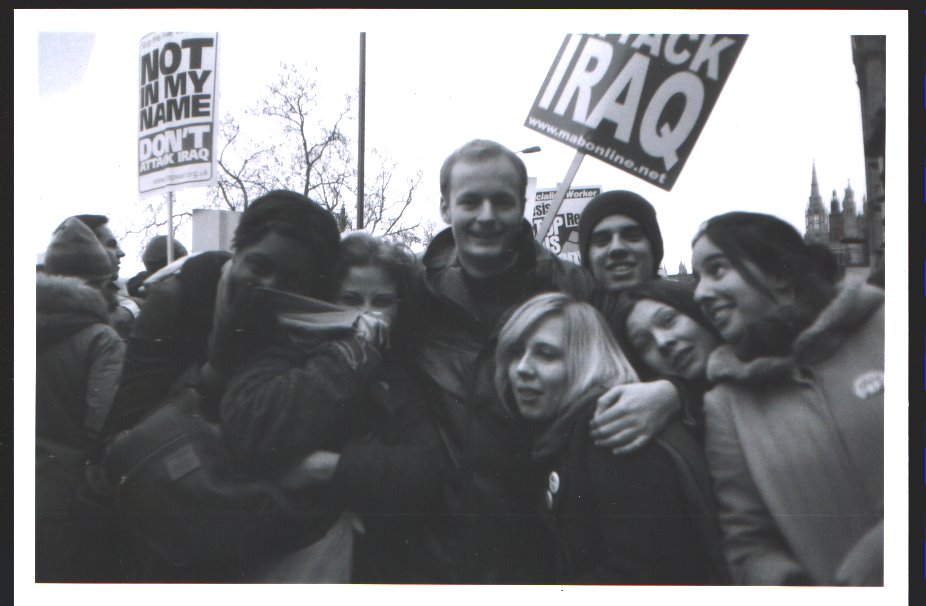
Cica took this photo at the big one. Left to right: Elisabeth, Mel, me, Clemency, Cica's cousin, Natasha, Elodie. Heh. It lends me some wholly undeserved glamour. What a great day that was. Pity we didn't win.
Thursday, 2 February 2006
Fast social science


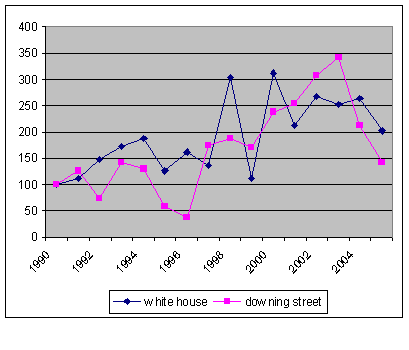
So on the subject of media attention to US and UK politics, these show the number of articles from the Times, FT and Guardian with different words in their headlines, 1990-2005. I rebased so that 1990=100, a dubious procedure because if 1990 was a very high or low year, that will make the subsequent pattern look better or worse. (In particular, take the White House/Downing Street comparison with a grain of salt.) Still, the trends are real enough. As far as I can see the story here is actually that Presidents and Prime Ministers have got more media attention, legislatures less. Country differences are pretty speculative.
Wednesday, 1 February 2006
Papers I would like to write
Whenever I get an idea I scribble it down on a sheet of paper and draw a little thought bubble at the top. This is an ongoing post with a list of papers I would like to write. Some of them are actual viable political or social science ideas. Others are things way out of my field, or ideas that might not be quite worth my time.
- Use "Blink"-style analysis of interviewers' posture, voice etc. when talking to politicians from different parties to provide an objective test of media bias.
- Why do human parents seek to control their children's sexual behaviour? This is AFAIK unique among animals. It is quite hard to understand from a genetic point of view: your children's interest in maximizing fitness is identical to your own (apart from the issue of degrees of relatedness, which might conceivably make a difference e.g. in cultures where people marry their cousins). Is the parental behaviour cultural or is there a genetic component? How did it arise?
- Hobbes' theory of the church in Leviathan Chapter XII seems to foreshadow modern economic theories of religion. He actually mentions the church before he gets to the state. It would be an interesting topic in intellectual history.
- Modelling how a city's size is affected by the size of other nearby cities. You might expect big cities to "drain" the population of near neighbours. The model could be applicable to other phenomena - firms in markets, even countries.
- How to extend formal models of elections to include the spread of information about policy through the population.
- Small churches and political parties seem to suffer more splits than large ones. Why? A formal model invoking control over resources and the ability to buy off potential splitters might help.
- Media analysis of how reporting of US politics has increased in non-US countries. A simple hit count for "senator" and "president" versus "MP" and "Prime Minister" would be a start.
I'll keep posting these as I remember them. There are a lot more!
Wednesday, 4 January 2006
edge.org asked a bunch of scientists for their "dangerous idea"
Not surprisingly, there are a lot of ones about science and religion. Also a lot of ones about minds, brains and genes. Cognitive science is "hot". These ideas are interesting but not so new, at least to me personally. Quite a lot of physicists talk about the idea of a "multiverse". A more political trend is a worry about American decline - there are a lot of grumbles about the lack of US science students.
Here are some of the ones I liked:
Sherry Turkle on the end of authenticity
http://www.edge.org/q2006/q06_8.html#turkle
Steven Strogatz on the end of insight
http://www.edge.org/q2006/q06_8.html#strogatz
Jaron Lanier on homuncular flexibility
http://www.edge.org/q2006/q06_7.html#lanier
Richard Nisbett on not knowing ourselves
http://www.edge.org/q2006/q06_3.html#nisbett
Jeremy Bernstein: the idea that we understand plutonium
http://www.edge.org/q2006/q06_3.html#bernstein
Frank Tipler on antimatter
http://www.edge.org/q2006/q06_4.html#tipler
Gregory Cochran: evolution has taken place within recorded history
http://www.edge.org/q2006/q06_4.html#cochran
Alison Gopnik: the idea of "dangerous ideas"
http://www.edge.org/q2006/q06_4.html#gopnik
Brian Greene on the multiverse (several physicists mention this theme):
http://www.edge.org/q2006/q06_5.html#greene
Diane F. Halpern on choosing your child's sex
http://www.edge.org/q2006/q06_7.html#halpern
Daniel Dennett: not enough minds for our memes
http://www.edge.org/q2006/q06_8.html#dennett
Robert Shapiro on monomers and the search for the origin of life
http://www.edge.org/q2006/q06_9.html#shapiro
Geoffrey Miller: aliens are too busy playing their Xboxes
http://www.edge.org/q2006/q06_9.html#miller
Bart Kosko: we're all using the wrong Bell Curve!
http://www.edge.org/q2006/q06_11.html#kosko
Marco Iacoboni: media violence induces imitative violence
http://www.edge.org/q2006/q06_11.html#iacaboni
Leo Chalupa: give me peace and quiet!
http://www.edge.org/q2006/q06_12.html#chalupa
Here are some of the ones I liked:
Sherry Turkle on the end of authenticity
http://www.edge.org/q2006/q06_8.html#turkle
Steven Strogatz on the end of insight
http://www.edge.org/q2006/q06_8.html#strogatz
Jaron Lanier on homuncular flexibility
http://www.edge.org/q2006/q06_7.html#lanier
Richard Nisbett on not knowing ourselves
http://www.edge.org/q2006/q06_3.html#nisbett
Jeremy Bernstein: the idea that we understand plutonium
http://www.edge.org/q2006/q06_3.html#bernstein
Frank Tipler on antimatter
http://www.edge.org/q2006/q06_4.html#tipler
Gregory Cochran: evolution has taken place within recorded history
http://www.edge.org/q2006/q06_4.html#cochran
Alison Gopnik: the idea of "dangerous ideas"
http://www.edge.org/q2006/q06_4.html#gopnik
Brian Greene on the multiverse (several physicists mention this theme):
http://www.edge.org/q2006/q06_5.html#greene
Diane F. Halpern on choosing your child's sex
http://www.edge.org/q2006/q06_7.html#halpern
Daniel Dennett: not enough minds for our memes
http://www.edge.org/q2006/q06_8.html#dennett
Robert Shapiro on monomers and the search for the origin of life
http://www.edge.org/q2006/q06_9.html#shapiro
Geoffrey Miller: aliens are too busy playing their Xboxes
http://www.edge.org/q2006/q06_9.html#miller
Bart Kosko: we're all using the wrong Bell Curve!
http://www.edge.org/q2006/q06_11.html#kosko
Marco Iacoboni: media violence induces imitative violence
http://www.edge.org/q2006/q06_11.html#iacaboni
Leo Chalupa: give me peace and quiet!
http://www.edge.org/q2006/q06_12.html#chalupa
Tuesday, 20 December 2005
More phone photos




I've had to use my phone since my camera got nicked. The constraints of a tiny image size can be liberating. These are mostly of the Colne estuary, which I walk along regularly. Actually the dog is here too.





Thursday, 8 December 2005
If you believe in expert judgment
... more than mechanical statistical predictions, as I tend to do, this might be interesting.
Monday, 5 December 2005


Wednesday, 16 November 2005
planet Iraq
Whole load more bloggers added to planet Iraq, mostly via an excellent history of Iraqi blogging (available from the main page). The typography is still a bit of a mess - unfortunately the software I am using doesn't deal very well with the rather messy XML feeds coming off all these blogs.
There are getting to be so many of these people that a single page can't really do justice. Which is nice. If only all the news from Iraq were so cheerful.
There are getting to be so many of these people that a single page can't really do justice. Which is nice. If only all the news from Iraq were so cheerful.
Friday, 11 November 2005
just one more thing...
Had to share this very cool link - a flash diagram of the world income distribution, 1970-2000. You can run it forward or backward, and examine different countries. It's based on Xavier-Sala-i-Martin's figures - I seem to recall, there is some controversy about his claims - but still very interesting.
(Update: you should also check out the Prof's website. For a Columbia economics professor, it's pretty funny.)
(Update: you should also check out the Prof's website. For a Columbia economics professor, it's pretty funny.)
More on income
I was wandering around the library in my usual Friday haze when I noticed the DSS's publication Households on Below Average Income 1979-1996/7. Aha. Just the place to find more detailed data on the effect of Evil Thatch on incomes.
The basic picture is straightforward: inequality rose markedly under Thatch. From 1979 to 1995/6, the proportion of people below half average income more or less doubled.
Of course, partly that is because average incomes rose markedly (by about 40% adjusted for inflation). But the appendices have information on the percentages of groups below various fractions of 1979 average income, held constant. In 1979, 8% of people were living below half 1979 average income. In 1995/6, 5% of people were living below half 1979 average income (adjusted for inflation). The figures for 60% of 1979 average income are similar: 18% and 10% respectively.
However, the AHC figures are much less cheerful, with the proportions of individuals living below these thresholds remaining almost constant. And the very poor do badly. There were about as many people below 40% of 1979 average income in 1995/6 as there were in 1979, whether Before or After Housing Costs.
End of brief statistical lecture. Everything is much more complex than this - for example, what about the experience of different groups? Families with children? Pensioners? What about the persistence of inequality over time? What's the right way to define or even conceptualise poverty? Despite being a Sinister Rightwinger, I believe that relative poverty is very important. Being poor, and specifically being poorer than other people, is horrible. Of course absolute poverty is bad too. Oddly enough these ideas tend to be backed up by the (stereotypically, right-wing) Darwinian approach to society: beyond satisfaction of our basic needs, we care about our relative position rather than our absolute wealth.
Corrections from the people at ISER (who do this kind of thing seriously) are of course welcome. Perhaps I should now stop reading DSS statistics on Friday night.
Just one further thought. The distribution of "talent" of many kinds is probably normal, like most things that rely on many different factors (if you add a lot of random variables together, you approach a normal distribution - the famous bell curve). The distribution of income is not normal. It looks much more like a lognormal distribution, such as the lefthand picture below
The basic picture is straightforward: inequality rose markedly under Thatch. From 1979 to 1995/6, the proportion of people below half average income more or less doubled.
Of course, partly that is because average incomes rose markedly (by about 40% adjusted for inflation). But the appendices have information on the percentages of groups below various fractions of 1979 average income, held constant. In 1979, 8% of people were living below half 1979 average income. In 1995/6, 5% of people were living below half 1979 average income (adjusted for inflation). The figures for 60% of 1979 average income are similar: 18% and 10% respectively.
However, the AHC figures are much less cheerful, with the proportions of individuals living below these thresholds remaining almost constant. And the very poor do badly. There were about as many people below 40% of 1979 average income in 1995/6 as there were in 1979, whether Before or After Housing Costs.
End of brief statistical lecture. Everything is much more complex than this - for example, what about the experience of different groups? Families with children? Pensioners? What about the persistence of inequality over time? What's the right way to define or even conceptualise poverty? Despite being a Sinister Rightwinger, I believe that relative poverty is very important. Being poor, and specifically being poorer than other people, is horrible. Of course absolute poverty is bad too. Oddly enough these ideas tend to be backed up by the (stereotypically, right-wing) Darwinian approach to society: beyond satisfaction of our basic needs, we care about our relative position rather than our absolute wealth.
Corrections from the people at ISER (who do this kind of thing seriously) are of course welcome. Perhaps I should now stop reading DSS statistics on Friday night.
Just one further thought. The distribution of "talent" of many kinds is probably normal, like most things that rely on many different factors (if you add a lot of random variables together, you approach a normal distribution - the famous bell curve). The distribution of income is not normal. It looks much more like a lognormal distribution, such as the lefthand picture below
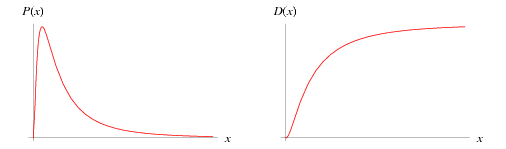
- pictures filched from http://mathworld.wolfram.com/LogNormalDistribution.html
Why? I am sure there are many extant answers to this question. My guess, keeping with the Darwinian theme, is that overachievers tend both to hang out with each other, and to compete with each other for income (or various correlates of income). This makes for a "long tail" distribution, with the mobile phone salespersons, the city slickers, and Bill Gates at the very, very top.
Seal and hard drive
I saw the seal again today. This time he (she?) was swimming. He ducked down under water after a few seconds, and reappeared a few minutes later and 200 yards downstream, just a black blob on the waves. Very nice.
Slashdot has a discussion on how long it would take for the police to decrypt an encrypted hard drive. This was one of the justifications offered for 90-day detention. Bottom line: 90 days is a slight underestimate. Good encryption cannot be cracked within the lifespan of the known universe, unless you can guess the password. Encryption is one of the subtlest parts of computer science, about which I know little, but the fundamental deal is fairly straightforward: every time you add a character (say just a-z) to your password, you multiply the number of potential passwords, and the time it takes to guess the password by brute force, by 26. Go type "26 x" into your calculator and hit "=" a few times. See?
Slashdot has a discussion on how long it would take for the police to decrypt an encrypted hard drive. This was one of the justifications offered for 90-day detention. Bottom line: 90 days is a slight underestimate. Good encryption cannot be cracked within the lifespan of the known universe, unless you can guess the password. Encryption is one of the subtlest parts of computer science, about which I know little, but the fundamental deal is fairly straightforward: every time you add a character (say just a-z) to your password, you multiply the number of potential passwords, and the time it takes to guess the password by brute force, by 26. Go type "26 x" into your calculator and hit "=" a few times. See?
Thursday, 10 November 2005
UK wages
A friend and me disagreed last night over a pint in the Rose and Crown about what had happened to wages during the period of the Evil Thatch and subsequently. Statistics.gov.uk is the place to look. The old New Earnings Survey has been replaced by something called the Annual Survey on Hours and Earnings. There's a nice summary of the Evil Blair period here:
Patterns of Pay 1998-2004
In particular, check out Figure 7 - Blogger seems to mess up the title: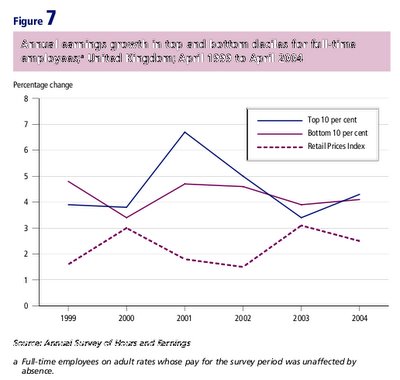
This shows that the wages of even the lowest decile beat inflation consistently. Some credit due to New Labour? (But note that this is only for full-time employees. The pdf above has more details on the distribution of hours.)
The NES doesn't seem to have a similar time series available, but here is a useful webpage on historical average earnings. Clicking the link will show you real and nominal earnings, as well as the RPI, for 1979-2004. Really, we would prefer median earnings - they explain how they calculate average earnings but it seems complex, perhaps because they provide statistics going back to 1264!
That's all I can manage for the moment. Clearly average wages have consistently increased since 1979. The more interesting question is what has happened to the different percentiles.
Patterns of Pay 1998-2004
In particular, check out Figure 7 - Blogger seems to mess up the title:

This shows that the wages of even the lowest decile beat inflation consistently. Some credit due to New Labour? (But note that this is only for full-time employees. The pdf above has more details on the distribution of hours.)
The NES doesn't seem to have a similar time series available, but here is a useful webpage on historical average earnings. Clicking the link will show you real and nominal earnings, as well as the RPI, for 1979-2004. Really, we would prefer median earnings - they explain how they calculate average earnings but it seems complex, perhaps because they provide statistics going back to 1264!
That's all I can manage for the moment. Clearly average wages have consistently increased since 1979. The more interesting question is what has happened to the different percentiles.
Wednesday, 9 November 2005
Blair defeated over 90 days!
That rocks. I'm surprised and greatly pleased. When they withdrew last time, I guessed it was a tactical retreat. Now they failed to concede and apparently lost even more support. Hah.
Update:
Now everyone is asking whether this is the end of Blair's authority. I guess it depends on the causes of the vote. Perhaps, as a premier nearing the end of his shelf life, Blair no longer wields the power to threaten backbenchers. If so, expect more revolts. Can Brown step in to quell the rebels? That probably depends on his perceived chances of winning the next election. Major's experience shows that as a government's time in office draws to a close, discipline crumbles. If that in turn makes the government appear less popular and competent, you get a vicious circle.
(Polisci geek note: I wonder if anyone has written about the game theory of the UK parliamentary system. There's lots about the US and lots about coalitions in proportional representation systems, but I don't know of any stuff for our particular setup, beyond Bagehot's famous analysis in the 19th century.)
The latest initiative - standardised testing for tiny tots - isn't exactly an inspiring big idea. More like a New Labour self-parody. If they can't do better than that I think we can expect trouble for Labour in 2009.
Update:
Now everyone is asking whether this is the end of Blair's authority. I guess it depends on the causes of the vote. Perhaps, as a premier nearing the end of his shelf life, Blair no longer wields the power to threaten backbenchers. If so, expect more revolts. Can Brown step in to quell the rebels? That probably depends on his perceived chances of winning the next election. Major's experience shows that as a government's time in office draws to a close, discipline crumbles. If that in turn makes the government appear less popular and competent, you get a vicious circle.
(Polisci geek note: I wonder if anyone has written about the game theory of the UK parliamentary system. There's lots about the US and lots about coalitions in proportional representation systems, but I don't know of any stuff for our particular setup, beyond Bagehot's famous analysis in the 19th century.)
The latest initiative - standardised testing for tiny tots - isn't exactly an inspiring big idea. More like a New Labour self-parody. If they can't do better than that I think we can expect trouble for Labour in 2009.
Monday, 7 November 2005
I'm 30
To be honest I don't really believe it. I don't yet feel eighteen.
Anyway I had a party to celebrate the alleged event this weekend, which was excellent. Dave Padua, Clem, Emily Comyn and Kemal all came down from Outside. So the next day we sat in the Rose and Crown and continued to drink. Kristi put up very kindly with having a bunch of randoms on the sitting room floor, and came out with us the next day. Kemal got me a Prodigy CD. Charley says, never go out without telling your mother first. Mreowww! Clem got me the best. Card. Ever. Probably not safe to link here.
Cometh Monday, cometh the payoff....
Anyway I had a party to celebrate the alleged event this weekend, which was excellent. Dave Padua, Clem, Emily Comyn and Kemal all came down from Outside. So the next day we sat in the Rose and Crown and continued to drink. Kristi put up very kindly with having a bunch of randoms on the sitting room floor, and came out with us the next day. Kemal got me a Prodigy CD. Charley says, never go out without telling your mother first. Mreowww! Clem got me the best. Card. Ever. Probably not safe to link here.
Cometh Monday, cometh the payoff....
Friday, 4 November 2005
 ... found on
 Tuesday, 1 November 2005
iPod Nano
.... heh heh heh.
A present from the bruvs in America. You can see me on campus wandering around like the guy in the adverts, nodding my head in a hip and groovy way.
Epitonic have a really, really good selection of free music. I mean, St. Etienne.
A present from the bruvs in America. You can see me on campus wandering around like the guy in the adverts, nodding my head in a hip and groovy way.
Epitonic have a really, really good selection of free music. I mean, St. Etienne.
A comment on ancient (direct) democracy
Further, for oligarchic cities it is necessary to keep to alliances and oaths. If they do not abide by agreements or if injustice is done, there are the names of the few who made the agreement. But whatever agreements the populace makes can be repudiateed by referring the blame to the one who spoke or took the vote, while the others declare they were absent or did not approve of the agreement made in the full assembly.... And if there are any bad results from the people's plans, they charge that a few persons, working against them, ruined their plans; but if there is a good result, they take the credit for themselves.
-- Old Oligarch, Constitution of Athens, quoted in Xenophon
Working paper available
A draft working paper on counter-initiatives is available from my Essex website. I presented this yesterday to the Political Economy Seminar, where it got a fairly good reaction.
Wednesday, 19 October 2005
Seal
I bike along the Wivenhoe Trail every morning, by the banks of the Colne estuary. This morning I saw something unusual on the mud banks.

A lady who had stopped as well took the photograph.

Tuesday, 18 October 2005
Broadcasting House
BH is my favourite Radio 4 program, an irreverent hour of news every Sunday hosted by Fi Glover, who has a delightful way of calling respectable old male politicians "sir". They also do serious stuff and this week there was an amazing report on the July 7 bombings. I don't normally expect much from reports on bombings and disasters - perhaps inevitably, they tend to sound like cliches. This was very different. The reporter was the BBC guy who was shot last year in Riyadh, and is himself now paraplegic. He elicited extraordinarily intense personal testimony from people caught up right at the centre of the bomb blasts, some of whom were very badly injured, and from a paramedic who was early on the scene. Their descriptions of the event are almost surreal and their reactions are very moving. This week's programme is still online - this report starts after about 35 minutes so you will need to fast forward through.
Friday, 14 October 2005
Dog news


While my flatmate Kristi has been away in Berlin I have been taking care of her pooch Bella. (I would have better photos, obviously, if NWA employees hadn't nicked my camera - the airline has since gone bust, by the way, not that I'm saying anything or anything.)
I can speak German, honest!
hey Vasanthi
Es war sehr nett, von Dir zu hoeren aber ich habe kein Email fuer Dich! Also email mir mal an. (Ist das das Wort?)
Dave
Es war sehr nett, von Dir zu hoeren aber ich habe kein Email fuer Dich! Also email mir mal an. (Ist das das Wort?)
Dave
Subscribe to:
Posts (Atom)