Monday, 12 June 2006

R tips

I've been working with large datasets in R and thought I would share some tips. Of interest to statisticians only!

1. On Windows, get tinn-R. You don't want to be working with the basic R editor. On Linux, use emacs or vi as you prefer - emacs is supposedly pretty good.

2. Record everything you do - don't rely on saving the history for this, as it will be indecipherably messy. The ideal is that anyone should be able to replicate your results, from publicly available data, just by running your file of commands. It also helps a lot when you lose data and have to go back and redo it.

3. You will probably end up with a lot of temporary variables. To know which variables you can safely delete, give temporary variables a dot at the end of their name, like:

for (yr. in dataset$years)


4. Save shortened versions of often-used commands in your Rprofile file (on Windows, this will be in c:\program files\R\R-\etc\Rprofile.site).

For example, I like to type hs instead of help.search. If I just put

hs <- help.search

in Rprofile.site, I will get an error on startup. This is because help.search is in the utils package which is not loaded until after the Rprofile has been executed. So you have to be a little sneaky:

setHook(packageEvent("utils", "onLoad"), function (...) {
hs <<- utils::help.search
})

This means that when utils gets loaded, the function help.search gets assigned to hs. The double-headed arrow, by the way, is for global assignment. Otherwise, the assignment would only happen in the body of our function, which would be useless.

5. You can create new operators. For example, I like to be able to type
1:5 %-% 3
and get c(1, 2, 4, 5), i.e. the numbers from 1 to 5 with 3 removed. Another line in my Rprofile.site:
"%-%" <<- setdiff
The setdiff function does what I want, but with %-% it's quicker and more intuitive to read. Similarly

"%like%" <<- function(x,y) grep(y,x, perl=T)
means I can type state[state$name %like% "Al.*",] and get data for Alabama and Alaska.

6. Statisticians tend to want to put everything in one huge table. So for example, if they have 50000 Eurobarometer respondents and they want to use respondent's nation's GDP as an independent variable, they'll create a big table with 50000 rows:
name | nation | GDP | ... other national variables
This is fine until you want to take the log of GDP and it takes the computer five minutes to create 50000 new variables, most of which are duplicates. Take a hint from database administration: keep national variables in a separate data frame, with one row for each nation. Then merge them once you have created all your independent variables, before you start running regressions.

(If you want to know more about how to create good databases, here's a good guide.)

7. Tired of typing brackets all the time to run simple commands? Here's a neat hack:
print.command <- function (x) {
default.args <- attr(x, "default.args")
if (! length(default.args)) default.args <- list()
print(do.call(x, default.args, envir=parent.frame()))
}

class(ls) <- c("command", class(ls))
class(search) <- c("command", class(search))

Now you can type ls or search at the command line without brackets. The magic here is that the end result of any command line is printed, i.e. the print method is called on the object. If we give ls a class of "command", the function
print.command gets called when we evaluate ls. This then runs the function in the command line environment. To set up default arguments, do, e.g.:

attr(ls, "default.args") <- list(all=T)

It would be nice to be able to type fix foo instead of fix(foo), but I don't think it's possible. Correct me if you know better.

NEW 8. You don't have to save everything in one workspace. This is the easiest way to go at first, but when your data becomes large and takes minutes to load, you can separate it into different workspaces and load only the bits you need. To do this, instead of save.image, use

save(foo1, file="foo1.RData")
save(foo2, file="foo2.RData")

et cetera. You then load these in the normal way.


That's your lot! For more, check out http://wiki.r-project.org or R tips. And of course, the occasionally grumpy but always enlightening R-help mailing list.

Backlash

A friend of mine is involved in Backlash, which was set up to combat the UK Government's proposed legislation banning some kinds of extreme pornography. The site has some punchy arguments.

Monday, 15 May 2006

Clem's bluebell pictures


...from near Bristol. Wivenhoe wood is also looking pretty nice.

My entry for the Pimlott Prize

I wrote this for this year's Pimlott Prize, but didn't get shortlisted so I decided to put it up here. It's quite on the gloomy side but I am reasonably persuaded that the fundamental analysis is valid.

You can’t have your cake and eat it

A Lithuanian acquaintance, a graphic designer turned London scaffolder – better cash – took me on a tour of his neighbourhood, Plaistow in East London. We stopped at the Pakistani family whose home he shared, then visited the local beer hall. After a couple of pints, he asked me if I wanted to see “the whites-only pub”. We wandered in. It was dingy and depressing, not frightening (to me). A fat glum barmaid waited for customers. Silence and decay reigned.

The Left has decided that, after decades of peeling paint and lost custom, British identity needs a makeover – and a new, non-racist ownership. The renewed interest started with David Goodhart's essay in Prospect magazine, “Too Diverse?”, which claimed that too much cultural diversity could undermine solidarity, and that shared values might depend on a shared history. As radical Islam hit the headlines, the argument had legs. Trevor Phillips of the Commission for Racial Equality attacked Goodhart as a “liberal Powellite”, but also broke with multiculturalism. Gordon Brown has weighed in with a speech on British identity. The debate has been lively and open-minded. Cultural relativism, the once-common view that value judgments could not cross cultural boundaries, is rarely heard. Neither are there calls for a return to bland ethnic uniformity. Instead, participants struggle to define Britishness as the core minimum that everyone in our society can and must accept. Do we need shared values? Attachment to institutions? Or a broader sense of history and heritage?

To see why this question has hit the agenda, take the family friend who arrived recently from Pakistan's North-West Frontier. A teenage girl, in Liverpool to study computing and business, she was scandalized by the locals: “No culture! No values! And” (lowering her voice) “we get abuse if we go out alone.” Talk of British identity is not just a response to religious extremism: there is also the guilty sense that our civic values are not what they once were. Hence, when the Home Secretary announced a “Britishness test” for immigrants, the wry cartoons of new arrivals answering questions on Burberry and binge-drinking.

How will redefining Britishness work in practice? You don't have to be a Marxist to think that a sense of identity can't just be developed by policy wonks, then handed out to the wider community. Before anything else, after all, national identity is about loyalty to a particular group: about whose side you are on. The English language, the common law, chicken tikka masaala, and other components of our national identity – warm beer and old maids on bicycles, as John Major put it, or liberty, fairness and civic pride if you prefer Gordon Brown's version – all ultimately rest on this foundation. At bottom a nation is just a group of people who are prepared to work together for their common good, what the philosopher John Rawls, in a slightly different context, called a “cooperative venture for mutual advantage”. So perhaps our first question should be, is there still a British nation at all?

Historically, British identity was like other nationalisms, bound up with war. National identity was needed because those that had it would defeat those who didn't. The high point of nationalism came after Napoleon's armies demonstrated the power of this principle Europe-wide. Modern warfare required mass citizen armies, which in turn required mass loyalty. In Britain, this loyalty bound classes together in an unequal partnership. Kipling, the poet of nationalism and empire, eulogized the working-class Tommy Atkins. For their part, the working classes in Britain and elsewhere notoriously sided with nation rather than class in 1914. (This was probably a wise choice: losing a war has worse consequences than losing some share of the surplus from economic development.) Historically, also, nations were communities of fate, in the sense that for almost all their inhabitants, migration to another country cost too much to consider except in dire emergency. It made sense to support the country you were born into, because there was no alternative.

However, the past was not an age of unambiguous national solidarity. The ruling classes could be passionately patriotic, but their attachment was to a particular idea of Britain, not necessarily to everyone within it. About a thousand Old Etonians were killed in the Great War – literally decimation, and an example of the disproportionate share of casualties taken by the officer classes – but at the same time the wealthy could teach their children, as George Orwell was taught, that “the lower classes smell”. David Cannadine’s history of imperial views, Ornamentalism, shows the mixed loyalties of British colonial administrators who might prefer native elites to their own countrymen: “in the Raj Quartet, Major Ronald Merrick, whose social background was relatively lowly, believed that ‘the English were superior to all other races, especially black’. But the Cambridge-educated Guy Perron feels a greater affinity with the Indian Hari Kumar, who went to the same public school as he did, than he does with Merrick… .” Kipling himself recognized that national solidarity waxed and waned as it seemed to be required: “... it's Tommy this, an' Tommy that, an' 'Chuck him out, the brute!' / But it's 'Saviour of 'is country' when the guns begin to shoot”. Britain was a partnership between classes, but an uneasy one.

The conditions for this partnership no longer exist. The threat of war in Europe has receded, as have the potential gains from military empire-building, and in any case mass citizen armies are redundant. Cheaper transport means that nations are more and more communities of choice, not fate. In particular, EU citizens have the right to live and work throughout the Union – a right which is particularly easy to exercise for the highly-skilled and rich. Peace and freedom are, needless to say, very good things, but they have removed the old bases for national identity. This is particularly true for political and social elites, who are increasingly integrated into global economic and social networks, and have correspondingly fewer connections with their own countries. (Here's a quick self-test to find out if you fit this description: how many times have you visited Paris? Now, how many times have you visited Liverpool?)

A liberal optimist would welcome the fact that the old nationalism is redundant. Britain can be a successful economy, attracting talent from around the world. In fact, if we pander to xenophobia by erecting barriers to trade or migration, we only harm ourselves by making our economies less efficient. Whose side should we be on? Nobody's and everybody's.

This perspective has undoubted appeal. It is uncompromisingly cosmopolitan and impartial: the welfare of a Chinese textile worker counts as much as that of a Scottish one, so why favour either over the other? And economic freedom, the creation of integrated world markets in goods and maybe one day in labour, genuinely does make the world richer.

The problem is that globalization, economic integration and freedom of movement affect different parts of countries differently and unequally. Divide the world into three parts: already rich, getting rich and getting poorer. London and Silicon Valley are examples of the rich parts – magnets of talent and ambition. People come there to succeed. They power the world's knowledge economy, and their inhabitants reap corresponding rewards. The rich areas nowadays source much of their talent from the “getting rich” areas: India provides about one third of Silicon Valley's engineers. Both sides benefit from the relationship. Workers from developing countries “send money home”, as Western Union's advert puts it, and often return themselves, bringing new skills.

But not everywhere is like this. Some areas are getting poorer – not absolutely, but relatively. They lack the skills and the infrastructure to compete with the rich areas, but have higher labour costs than the developing world. Consider East Germany. Capital from the West has streamed past it to Eastern Europe, while cheap workers have gone in the opposite direction. Since unification its population has shrunk by 2 million. Or think of Southern Italy, which is such a drain on national resources that the Northern League is calling for secession. (The cruel paradox is that political unity with the rich parts of the world, and the corresponding labour market regulation, is often what makes these areas so unappealing to globally mobile capital.)

If the people in these areas only cared about absolute wealth, the gains from globalisation would outweigh the no doubt temporary pains of adjustment to a fairer and more open world. Alas, humans aren't like that. Adam Smith suggested that it was better to be an English peasant than a king in Africa, who might be the absolute ruler of ten thousand people, but was worse clothed and housed. Stanford undergraduates have settled that question empirically: asked whether they would prefer being twice as rich as they were, if everyone around them were four times richer, or twice as poor but with everyone else four times poorer, they overwhelmingly plumped for the latter. This is not just about envy. As Mind The Gap, Richard Wilkinson's book on health and inequality, argues, relative poverty is fundamentally bad for your health, making you more stressed, more prone to heart attacks and likely to die younger.

The logic of globalization is that Coventry, say, will someday soon be poorer than Bombay, and less connected to London. (This inevitable development could not be changed by any improvement in our workforce's education, contrary to New Labour mythology. Large countries are more important markets than small ones, and their commercial centres draw on a greater pool of talent. Besides, why should developing countries be less able to improve their education systems than we are?) Whatever the absolute gains from free trade, this fall in relative status will be bitterly resented, and there will be enormous political pressure to interfere in the market. In effect, the poorer parts of Britain will ask the rich parts: whose side are you on?

Not everybody has yet understood the lost basis of traditional British identity. Perhaps it is least understood by those who have most to lose. The danger is that when they do, and when they see themselves falling increasingly behind the richer areas of the country, they will seek different repositories for their allegiance. These new groups will not represent Britain in the traditional sense – the old agreement between the classes – but they will call themselves British, and very likely define Britishness by ethnicity. Then our politics really will take on a grimly communal cast.

This has happened already elsewhere. The debate over British identity was fuelled by the visibility of militant Islam, but in the long run a more important context may be the emergence of the radical nationalist Right across Europe. We like to think that our relatively weak Far Right is due to the British tradition of tolerance and moderation. In fact it probably has more to do with the first-past-the-post electoral system, which prevents extremists from getting a foothold. That, however, does not apply in political arenas beyond Westminster – arenas which will become more important, if the cross-party consensus in favour of decentralization has practical results.

This worry explains New Labour's sudden interest in defining Britishness, and in particular the focus on what can bind Britons of different races together. The intention is creditable. But if it is going to be more than a public relations exercise, it will require progressive opinion in this country to make choices for which it is rather unprepared, but which follow inevitably from the view that national identity is at bottom about loyalty to people rather than ideas.

The first of these is that you cannot lecture people on national pride until you have some yourself. The British Social Attitudes survey shows that people with a college degree are about half as likely to say they are “very proud” of being British than people without a qualification. Fair enough: nationalism lost popularity with educated people because of changing economic conditions, but also because it was correctly believed to be the root of many 20th century evils. We are now rediscovering the positive side, though, and would like a new patriotism for the 21st century. Doing that calls less for creative, multicultural redefinitions – we have plenty of those already – than for a new commitment to Britain by those who have the most choice in the matter.

Secondly, this commitment must be reflected in policy. Both major parties have rejected economic protectionism in favour of free trade and openness. Retreating into protectionism and populism would indeed be a terrible mistake. The best way to avoid it is to give greater priority, in social policy, to protecting British communities whose status is endangered by globalization. This requires a hard choice between competing values. Take a simple example. A new publication by the Young Foundation, The New East End: Kinship, Race and Conflict, describes the resentment felt by white East End families when the old system for allocating public housing, based on residence and connection to the community, was replaced by one based on need alone. From a universalist perspective, this resentment simply expresses a formerly privileged group’s unjust sense of entitlement. Residents might, and do, reply that they were owed something as Britons, partners in an ongoing social contract which should not have been broken for the sake of charitable motives. Both views are reasonable, but only one is compatible with talking about national identity.

Which leads unavoidably to an issue most Left-wingers won’t like. Bluntly, if you define Britishness without ethnicity, then you need some other way of defining national membership, and that implies a tough line on immigration. The logic of talking about British identity is to tell people in economically deprived and dislocated areas, “we are on your side, we are part of one nation, you can rely on us to help you through the pains of globalization”. That promise means nothing if the group you point at as the focus of your loyalty can be expanded at will to suit the demands of the market. It’s not a racial issue: opinion polls in 2003 showed that majorities of blacks and Asians, like their white compatriots, saw immigration as out of control. This is unsurprising. Pakistanis in Bradford, just like whites in Essex, face the threat of globalization. There are surely prejudices involved, but the most important one is the – no doubt very unjust – prejudice of disadvantaged and economically insecure Britons in favour of themselves.

Specifically, nobody yet knows whether openness to migration, in an age of cheap travel, can be combined with a generous welfare state, including universal free education and healthcare. On the face of it, it seems extremely improbable. More likely is the USA’s pattern of high growth but very large inequalities. (The United States has combined this with a strong sense of patriotism, and a national identity based on immigrants' dreams of prosperity and success. Perhaps the American dream is simply a myth to justify an unfair society. Whatever truth it has comes from the fact that most US citizens are immigrants or their relatively recent descendants: they or their forefathers – with the obvious exception of African Americans – chose to live somewhere with a lot of freedom but not much security. That is clearly not the case for Britons.)

The Left, and the British political system in general, faces a choice of values: internationalism or nationalism? The power and appeal of internationalism, a proud Left tradition, was shown in widespread support for the Make Poverty History campaign against European trade barriers which harm the developing world's peasant farmers. There is nothing wrong with wanting to treat Chinese and Scottish textile workers the same. But you cannot do that and simultaneously call for a renewed sense of national identity.

The Plaistow pub will probably still stand empty for a long while. Who would ever want to go back there? We could build something more modern, a warm, welcoming place for people of all races. But to do this, we need to rebuild from the foundations, rather than merely changing the décor. In other words, we need not just a different way of expressing national identity, but a new nation which citizens of all races and classes are part of. Alternatively, we can embrace the global market, stay on an economically liberal path (with a few prudent concessions to the misguided majority), let the world benefit, and let outmoded loyalties die in peace.

Sunday, 23 April 2006

MPSA joy

Last day at the Midwestern Political Science Association conference. This is the first time I've been to one of these big ones - more than 4000 presenters. It's like a polisci geek Glastonbury: you can run around trying to see all the cool bands, or you can sit in your tent smoking dope and occasionally wandering down to the stage to see what's on. I'm here with Laurence, another Essex PhD student. I have taken the blue-arsed fly approach, while he's been more on the spliff-rolling side of things, metaphorically. I've missed two sessions out of the 14 - 8.30 today and yesterday - and seen some really great papers. Highlights: John [?] Londregan, v interesting sort of leftfield paper about voting as a signal of willingness to fight in wars; Ethan Bueno de Mesquita, presenting a formal model of bureaucratic oversight with great clarity; James Fowler talking about how mono- and dizygotic twins vote - this man is obviously very smart; wandering into a more-or-less random session and getting, quite by chance and from a completely different field, a potential method for my next paper; and (heh) watching Vera Troeger discuss some papers. (Surgical.)

Hopefully will meet up with Robert Klemmensen today (w00t! I have another reader!) and try to come up with something clever for this amusing diversion, listed on POLMETH. (Everyone has a pet "really simple guaranteed winner" for this.) I see James Fowler is also behind this. Yikes.

Saturday, 22 April 2006

Sonnet VII

How soon hath Time the suttle theef of youth,

Stoln on his wing my three and twentith yeer!

My hasting dayes flie on with full career,

But my late spring no bud or blossom shew’th.

Perhaps my semblance might deceive the truth,

That I to manhood am arriv’d so near,

And inward ripeness doth much less appear,

That som more timely-happy spirits indu’th.

Yet be it less or more, or soon or slow,

It shall be still in strictest measure eev’n,

To that same lot, however mean, or high,

Toward which Time leads me, and the will of Heav’n;

All is, if I have grace to use it so,

As ever in my great task Masters eye.

Milton


He revisited this theme with greater power in On His Blindness.

Tuesday, 28 February 2006

Torture in US "black prisons"

http://www.democracynow.org/article.pl?sid=06/02/27/1519239

(via http://www.jordanplanet.net/)

CLIVE STAFFORD SMITH: Yeah, you know, Hussein Mustafa, I met with him in Jordan, and he was an incredibly credible person. He is a dignified older gentleman, about now 50 years old, and he wanted to talk about what had happened to him, but he really didn’t want to talk about that sexual stuff, and in the end, you know, I said to him, “Look, you don’t have to, but it’s very important if things happened, that the story get out, so they don't happen to other people,” and in the end he did, and it was in front of half a dozen people who were just transfixed as he described how four soldiers took him, one on each shoulder, one bent down his head and then the fourth of them took this broomstick and shoved it up his rectum.

Now there was no one in that room -- and they were from a variety of places -- who didn't believe that what this man was saying was true, but I am afraid, I’ve got to tell you, that that’s far from the worst that’s happened. When you talk about Bagram, when you talk about Kandahar, those aren’t the worst places the U.S. has run in Afghanistan. The dark prison, sometimes called “Salt Pit,” in Kabul itself, which is separate from Bagram, has been far worse than that, and I can tell you stories from there that just make your skin crawl.

Monday, 6 February 2006

Iraq demo


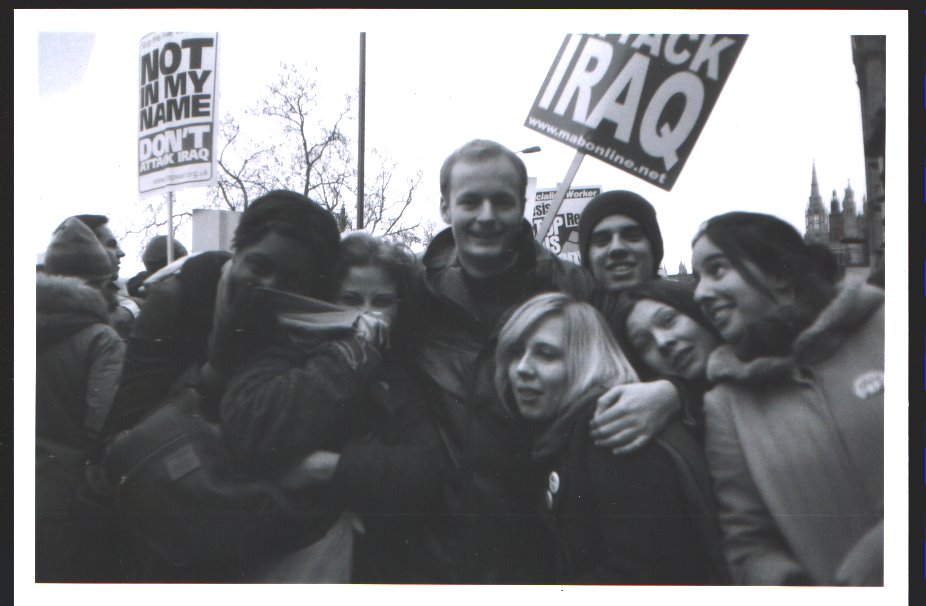
Cica took this photo at the big one. Left to right: Elisabeth, Mel, me, Clemency, Cica's cousin, Natasha, Elodie. Heh. It lends me some wholly undeserved glamour. What a great day that was. Pity we didn't win.

Thursday, 2 February 2006

Fast social science


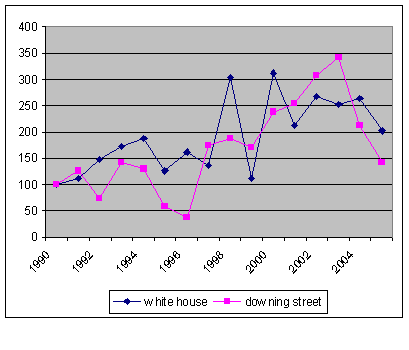
So on the subject of media attention to US and UK politics, these show the number of articles from the Times, FT and Guardian with different words in their headlines, 1990-2005. I rebased so that 1990=100, a dubious procedure because if 1990 was a very high or low year, that will make the subsequent pattern look better or worse. (In particular, take the White House/Downing Street comparison with a grain of salt.) Still, the trends are real enough. As far as I can see the story here is actually that Presidents and Prime Ministers have got more media attention, legislatures less. Country differences are pretty speculative.

Wednesday, 1 February 2006

Papers I would like to write

Whenever I get an idea I scribble it down on a sheet of paper and draw a little thought bubble at the top. This is an ongoing post with a list of papers I would like to write. Some of them are actual viable political or social science ideas. Others are things way out of my field, or ideas that might not be quite worth my time.

  1. Use "Blink"-style analysis of interviewers' posture, voice etc. when talking to politicians from different parties to provide an objective test of media bias.
  2. Why do human parents seek to control their children's sexual behaviour? This is AFAIK unique among animals. It is quite hard to understand from a genetic point of view: your children's interest in maximizing fitness is identical to your own (apart from the issue of degrees of relatedness, which might conceivably make a difference e.g. in cultures where people marry their cousins). Is the parental behaviour cultural or is there a genetic component? How did it arise?
  3. Hobbes' theory of the church in Leviathan Chapter XII seems to foreshadow modern economic theories of religion. He actually mentions the church before he gets to the state. It would be an interesting topic in intellectual history.
  4. Modelling how a city's size is affected by the size of other nearby cities. You might expect big cities to "drain" the population of near neighbours. The model could be applicable to other phenomena - firms in markets, even countries.
  5. How to extend formal models of elections to include the spread of information about policy through the population.
  6. Small churches and political parties seem to suffer more splits than large ones. Why? A formal model invoking control over resources and the ability to buy off potential splitters might help.
  7. Media analysis of how reporting of US politics has increased in non-US countries. A simple hit count for "senator" and "president" versus "MP" and "Prime Minister" would be a start.

I'll keep posting these as I remember them. There are a lot more!

Wednesday, 4 January 2006

edge.org asked a bunch of scientists for their "dangerous idea"

Not surprisingly, there are a lot of ones about science and religion. Also a lot of ones about minds, brains and genes. Cognitive science is "hot". These ideas are interesting but not so new, at least to me personally. Quite a lot of physicists talk about the idea of a "multiverse". A more political trend is a worry about American decline - there are a lot of grumbles about the lack of US science students.

Here are some of the ones I liked:

Sherry Turkle on the end of authenticity
http://www.edge.org/q2006/q06_8.html#turkle

Steven Strogatz on the end of insight
http://www.edge.org/q2006/q06_8.html#strogatz

Jaron Lanier on homuncular flexibility
http://www.edge.org/q2006/q06_7.html#lanier

Richard Nisbett on not knowing ourselves
http://www.edge.org/q2006/q06_3.html#nisbett

Jeremy Bernstein: the idea that we understand plutonium
http://www.edge.org/q2006/q06_3.html#bernstein

Frank Tipler on antimatter
http://www.edge.org/q2006/q06_4.html#tipler

Gregory Cochran: evolution has taken place within recorded history
http://www.edge.org/q2006/q06_4.html#cochran

Alison Gopnik: the idea of "dangerous ideas"
http://www.edge.org/q2006/q06_4.html#gopnik

Brian Greene on the multiverse (several physicists mention this theme):
http://www.edge.org/q2006/q06_5.html#greene

Diane F. Halpern on choosing your child's sex
http://www.edge.org/q2006/q06_7.html#halpern

Daniel Dennett: not enough minds for our memes
http://www.edge.org/q2006/q06_8.html#dennett

Robert Shapiro on monomers and the search for the origin of life
http://www.edge.org/q2006/q06_9.html#shapiro

Geoffrey Miller: aliens are too busy playing their Xboxes
http://www.edge.org/q2006/q06_9.html#miller

Bart Kosko: we're all using the wrong Bell Curve!
http://www.edge.org/q2006/q06_11.html#kosko

Marco Iacoboni: media violence induces imitative violence
http://www.edge.org/q2006/q06_11.html#iacaboni

Leo Chalupa: give me peace and quiet!
http://www.edge.org/q2006/q06_12.html#chalupa

Tuesday, 20 December 2005

More phone photos


I've had to use my phone since my camera got nicked. The constraints of a tiny image size can be liberating. These are mostly of the Colne estuary, which I walk along regularly. Actually the dog is here too.

Who is this sweet little doggie?


Wednesday, 16 November 2005

planet Iraq

Whole load more bloggers added to planet Iraq, mostly via an excellent history of Iraqi blogging (available from the main page). The typography is still a bit of a mess - unfortunately the software I am using doesn't deal very well with the rather messy XML feeds coming off all these blogs.

There are getting to be so many of these people that a single page can't really do justice. Which is nice. If only all the news from Iraq were so cheerful.

worth reading

http://www.nationalreview.com/comment/huerta200511110822.asp

Friday, 11 November 2005

just one more thing...

Had to share this very cool link - a flash diagram of the world income distribution, 1970-2000. You can run it forward or backward, and examine different countries. It's based on Xavier-Sala-i-Martin's figures - I seem to recall, there is some controversy about his claims - but still very interesting.

(Update: you should also check out the Prof's website. For a Columbia economics professor, it's pretty funny.)

More on income

I was wandering around the library in my usual Friday haze when I noticed the DSS's publication Households on Below Average Income 1979-1996/7. Aha. Just the place to find more detailed data on the effect of Evil Thatch on incomes.

The basic picture is straightforward: inequality rose markedly under Thatch. From 1979 to 1995/6, the proportion of people below half average income more or less doubled.

Of course, partly that is because average incomes rose markedly (by about 40% adjusted for inflation). But the appendices have information on the percentages of groups below various fractions of 1979 average income, held constant. In 1979, 8% of people were living below half 1979 average income. In 1995/6, 5% of people were living below half 1979 average income (adjusted for inflation). The figures for 60% of 1979 average income are similar: 18% and 10% respectively.

However, the AHC figures are much less cheerful, with the proportions of individuals living below these thresholds remaining almost constant. And the very poor do badly. There were about as many people below 40% of 1979 average income in 1995/6 as there were in 1979, whether Before or After Housing Costs.

End of brief statistical lecture. Everything is much more complex than this - for example, what about the experience of different groups? Families with children? Pensioners? What about the persistence of inequality over time? What's the right way to define or even conceptualise poverty? Despite being a Sinister Rightwinger, I believe that relative poverty is very important. Being poor, and specifically being poorer than other people, is horrible. Of course absolute poverty is bad too. Oddly enough these ideas tend to be backed up by the (stereotypically, right-wing) Darwinian approach to society: beyond satisfaction of our basic needs, we care about our relative position rather than our absolute wealth.

Corrections from the people at ISER (who do this kind of thing seriously) are of course welcome. Perhaps I should now stop reading DSS statistics on Friday night.

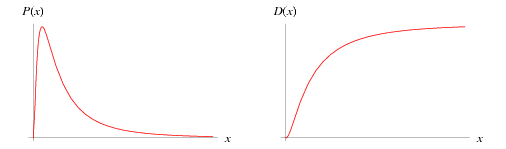
Just one further thought. The distribution of "talent" of many kinds is probably normal, like most things that rely on many different factors (if you add a lot of random variables together, you approach a normal distribution - the famous bell curve). The distribution of income is not normal. It looks much more like a lognormal distribution, such as the lefthand picture below


- pictures filched from http://mathworld.wolfram.com/LogNormalDistribution.html


Why? I am sure there are many extant answers to this question. My guess, keeping with the Darwinian theme, is that overachievers tend both to hang out with each other, and to compete with each other for income (or various correlates of income). This makes for a "long tail" distribution, with the mobile phone salespersons, the city slickers, and Bill Gates at the very, very top.


Seal and hard drive

I saw the seal again today. This time he (she?) was swimming. He ducked down under water after a few seconds, and reappeared a few minutes later and 200 yards downstream, just a black blob on the waves. Very nice.

Slashdot has a discussion on how long it would take for the police to decrypt an encrypted hard drive. This was one of the justifications offered for 90-day detention. Bottom line: 90 days is a slight underestimate. Good encryption cannot be cracked within the lifespan of the known universe, unless you can guess the password. Encryption is one of the subtlest parts of computer science, about which I know little, but the fundamental deal is fairly straightforward: every time you add a character (say just a-z) to your password, you multiply the number of potential passwords, and the time it takes to guess the password by brute force, by 26. Go type "26 x" into your calculator and hit "=" a few times. See?

Thursday, 10 November 2005

Via email from Becca

UK wages

A friend and me disagreed last night over a pint in the Rose and Crown about what had happened to wages during the period of the Evil Thatch and subsequently. Statistics.gov.uk is the place to look. The old New Earnings Survey has been replaced by something called the Annual Survey on Hours and Earnings. There's a nice summary of the Evil Blair period here:

Patterns of Pay 1998-2004

In particular, check out Figure 7 - Blogger seems to mess up the title:
This shows that the wages of even the lowest decile beat inflation consistently. Some credit due to New Labour? (But note that this is only for full-time employees. The pdf above has more details on the distribution of hours.)

The NES doesn't seem to have a similar time series available, but here is a useful webpage on historical average earnings. Clicking the link will show you real and nominal earnings, as well as the RPI, for 1979-2004. Really, we would prefer median earnings - they explain how they calculate average earnings but it seems complex, perhaps because they provide statistics going back to 1264!

That's all I can manage for the moment. Clearly average wages have consistently increased since 1979. The more interesting question is what has happened to the different percentiles.

Wednesday, 9 November 2005

Blair defeated over 90 days!

That rocks. I'm surprised and greatly pleased. When they withdrew last time, I guessed it was a tactical retreat. Now they failed to concede and apparently lost even more support. Hah.

Update:

Now everyone is asking whether this is the end of Blair's authority. I guess it depends on the causes of the vote. Perhaps, as a premier nearing the end of his shelf life, Blair no longer wields the power to threaten backbenchers. If so, expect more revolts. Can Brown step in to quell the rebels? That probably depends on his perceived chances of winning the next election. Major's experience shows that as a government's time in office draws to a close, discipline crumbles. If that in turn makes the government appear less popular and competent, you get a vicious circle.

(Polisci geek note: I wonder if anyone has written about the game theory of the UK parliamentary system. There's lots about the US and lots about coalitions in proportional representation systems, but I don't know of any stuff for our particular setup, beyond Bagehot's famous analysis in the 19th century.)

The latest initiative - standardised testing for tiny tots - isn't exactly an inspiring big idea. More like a New Labour self-parody. If they can't do better than that I think we can expect trouble for Labour in 2009.

Monday, 7 November 2005

I'm 30

To be honest I don't really believe it. I don't yet feel eighteen.

Anyway I had a party to celebrate the alleged event this weekend, which was excellent. Dave Padua, Clem, Emily Comyn and Kemal all came down from Outside. So the next day we sat in the Rose and Crown and continued to drink. Kristi put up very kindly with having a bunch of randoms on the sitting room floor, and came out with us the next day. Kemal got me a Prodigy CD. Charley says, never go out without telling your mother first. Mreowww! Clem got me the best. Card. Ever. Probably not safe to link here.

Cometh Monday, cometh the payoff....

Tuesday, 1 November 2005

iPod Nano

.... heh heh heh.

A present from the bruvs in America. You can see me on campus wandering around like the guy in the adverts, nodding my head in a hip and groovy way.

Epitonic have a really, really good selection of free music. I mean, St. Etienne.

A comment on ancient (direct) democracy

Further, for oligarchic cities it is necessary to keep to alliances and oaths. If they do not abide by agreements or if injustice is done, there are the names of the few who made the agreement. But whatever agreements the populace makes can be repudiateed by referring the blame to the one who spoke or took the vote, while the others declare they were absent or did not approve of the agreement made in the full assembly.... And if there are any bad results from the people's plans, they charge that a few persons, working against them, ruined their plans; but if there is a good result, they take the credit for themselves.

-- Old Oligarch, Constitution of Athens, quoted in Xenophon

Working paper available

A draft working paper on counter-initiatives is available from my Essex website. I presented this yesterday to the Political Economy Seminar, where it got a fairly good reaction.

Wednesday, 19 October 2005

Seal


I bike along the Wivenhoe Trail every morning, by the banks of the Colne estuary. This morning I saw something unusual on the mud banks.


A lady who had stopped as well took the photograph.


Tuesday, 18 October 2005

Broadcasting House

BH is my favourite Radio 4 program, an irreverent hour of news every Sunday hosted by Fi Glover, who has a delightful way of calling respectable old male politicians "sir". They also do serious stuff and this week there was an amazing report on the July 7 bombings. I don't normally expect much from reports on bombings and disasters - perhaps inevitably, they tend to sound like cliches. This was very different. The reporter was the BBC guy who was shot last year in Riyadh, and is himself now paraplegic. He elicited extraordinarily intense personal testimony from people caught up right at the centre of the bomb blasts, some of whom were very badly injured, and from a paramedic who was early on the scene. Their descriptions of the event are almost surreal and their reactions are very moving. This week's programme is still online - this report starts after about 35 minutes so you will need to fast forward through.

Friday, 14 October 2005

Dog news


While my flatmate Kristi has been away in Berlin I have been taking care of her pooch Bella. (I would have better photos, obviously, if NWA employees hadn't nicked my camera - the airline has since gone bust, by the way, not that I'm saying anything or anything.)

I can speak German, honest!

hey Vasanthi

Es war sehr nett, von Dir zu hoeren aber ich habe kein Email fuer Dich! Also email mir mal an. (Ist das das Wort?)

Dave

Tuesday, 27 September 2005

sloes

Sloes are the little blue-black fruit that grow on the blackthorn bushes by the Colne estuary. They are ripe about now and on Saturday I went and picked about two pounds. They're too bitter to eat in bulk - although one will take the skin off your tongue in an amusing way - but you can make DRINK with them. I had a half-bottle of vodka and one of whisky, so I filled them with sloes and added a bit of sugar. Now they are sitting on the kitchen windowsill, slowly turning deeper red. You have to prick the sloes before you put them in (or freeze them so they burst their skins)... the sloe gin website has more details.

By Christmas or so I'll have some rich red booze. The neighbours (Pete and Sam from IDA) are getting some gin in which is the more traditional base liquor.

Wednesday, 21 September 2005

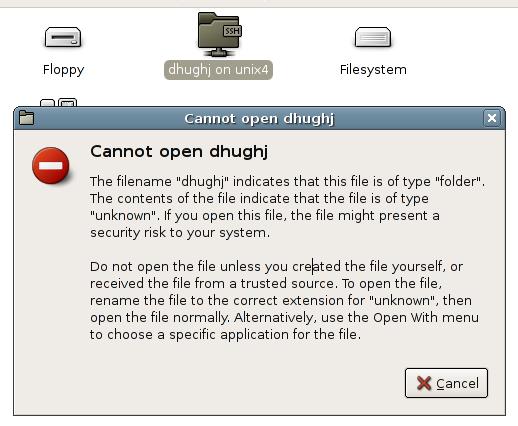
meaningless computer error messages: a collection.

We name the guilty applications.

Firefox. This pops up while browsing print.google.com. What document contains no data? What sort of data should it contain? What do you mean?

Copying files in Gnome. What's an invalid parameter?


This one popped up when I tried to connect to a remote server without plugging the network card in. God knows why it suddenly thinks the server is a "file" or a "folder" and starts worrying about security risks.

sermon material for the Devil's chaplain

Biology, not for the faint-hearted

chortle

Bush braces as Cindy Sheehan's other son drowns in New Orleans (The Onion)

Tuesday, 20 September 2005

Nice weekend in Paris

... a v cheap trip with me mum around her birthday. We headed over on the bus which was pleasant though long. Awful tour guide. Saturday went to the Louvre and saw some beautiful Michelangelos. Ma is a fan of the very early florentines, the amazing iconic stuff when they are just beginning to paint in three dimensions. I am more into the slightly later high renaissance but we both agree that at Venice it all gets a bit feeble.

Saturday night I see Viv and meet some friends of hers including the vivacious and mega-successful Elena who is an ex-World Banker. I miss the metro home and end up walking for hours through the banlieux of Northern Paris to the hotel. Yikes. Sunday we see Notre Dame and meet Viv again in a caff in front of the Sorbonne. Monday, back, another whopping trip but it gives me a chance to almost finish Shirer's Rise and Fall of the Third Reich. Shirer was a journalist, actually in Germany for a lot of the thirties, with a crackling prose style. The theme of the book is the cowardice of the people around Hitler - both nationally and internationally - and insofar as there is an explanation, at least for the Germans such as the generals who knew they were being led to destruction, he pins the blame on an inadequate political understanding. By understanding I don't just mean political science understanding, as in predicting who will do what, but also understanding of, say, the duties of a citizen or the dignity of man. (And actually these failures then lead the Nazis to make inaccurate predictions also: they cannot understand why, for example, Britain fights on rather than surrendering in 1940. It's a strong example for those who say that in social science, prediction requires understanding, and who therefore make a clear distinction between social and natural science.)

Perhaps Shirer's is a very American approach, but it basically chimes with the attitude of, say, Arendt, and contrasts strongly with the critical theorists who see fascism as the final expression of a social system - capitalism - and hence find rather little comfort in the triumph of the US. I think in this point the "politics" approach is more accurate.

As an aside: in history, I always gain insight from reading the "great" classic texts: professional historians' latest appraisals will change with the whims of academic fashion. Here at least, the judgment provided by an intelligent individual is more important than method, which may improve as the discipline progresses.

Tuesday, 13 September 2005

moved

I am now no longer in Hythe, where the locals shout racist abuse at each other in the streets, but in lovely Wivenhoe, a socialist utopia where the delicatessen is just around the corner, PhD students gather in the pub by the estuary and the folk music club meets once a month. My new house has a fireplace and a dog (and a very nice flatmate). Hooray!

Thursday, 8 September 2005

Cheap talk part 3


I'm going to plunge straight into this. Parts one and two are also available if you are lost.

[ed: as you can see, I end up failing to prove what I meant to prove... also, blogger keeps eating my post.]

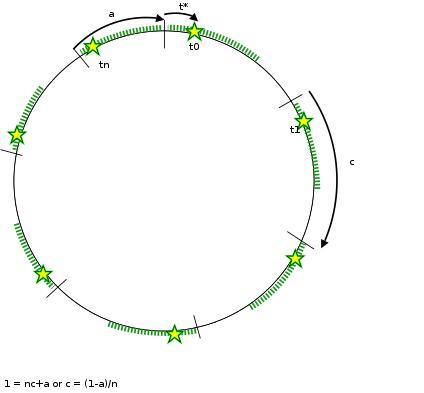
Suppose that c = (1-a)/n where n is an integer and 0 <= a < c. In other words, there are n intervals around the unit circle, plus a remainder of a.

(1) Suppose that n is even, and that Senders of type t send a message m = t* =
t modulo c, when t* < a. Now it's a best response for Receiver to randomize equally over possible values of t in response to this message. Proof:

Let's call the possible values of t, t0 to tn where ti = ci + t*. Take any arbitrary ti. Choose an interval H = (ti, ti+1/2] or (ti, ti-1/2], such that H does not contain the zero point, and therefore does not contain both t0 and tn. (For example, from t0, go clockwise and from tn go anticlockwise.)

The interval H now contains n/2 possible values of t. Proof: ts are evenly spaced along the interval, c apart, with the first one at ti+c or ti-c (as the interval is open at ti itself). Temporarily normalizing ti to zero, the interval (0, 1/2] or (0, -1/2] is of length 1/2 and, as 1 = nc+a, 1/2 = (n/2)c + a/2 where 0 <= a/2 < c. Moving from ti into H therefore moves you towards n/2 equally likely values of t, and away from n/2+1 equally likely values of t. As we are assuming no risk-aversion (Receiver's utility is linear in distance from t), moving away from ti therefore reduces utility. Similarly, moving away in the opposite direction is moving into an interval of size 1/2, excluding ti itself, which also must contain the remaining n/2 possible values of t from the set tj, j ^= i, and away from n/2+1 equally likely values of t.

(Apologies for the HTML notation: ^= means "does not equal".)

Therefore, any a ^= ti, for all i, is strictly dominated by some pure strategy a = ti for some i, and any mixed strategies containing anything other than the tis is strictly dominated by a mixed strategy containing only tis.

Furthermore, expected distance from t is the same at any ti (leaving the proof for now, I am fairly sure) and thus the mixed strategy choosing ti with probability 1/(n+1) is a best strategy.

(2) Given this strategy, Sender's strategy is a best response. Proof: for t = ti, i e {1,2,...,n-1}, the proof is identical to that given above as Sender's ideal point is just the same as to Receiver's ideal point when t=ti+1. When t = tn, ...

ah. No wait. When t = tn Sender's ideal point will be t+c which is strictly greater than t0 = t+a (we are crossing the zero point). If so, this will surely generate an incentive to deceive Receiver by claiming to be a different type. Blast. Perhaps we can remove the interval [nc, 1) from the set of types that sends an informative message? Well, this is obviously not over yet. More pointless fun awaits.

Wednesday, 7 September 2005

Time to ditch that Yahoo! account?

Yahoo! helped jail Chinese journalist (BBC news)

If you are still using Yahoo!, why not try Gmail, Google's free email service. It's extremely easy to use and lets you import contacts from Yahoo!. Google has been accused of censoring its search engine listings for China, but at least it hasn't actually turned into a police snitch. I have several accounts to give away if anyone wants one.

Monday, 5 September 2005

car found

So the police found my car about five minutes from where it was nicked. It had swerved off the side of the street. As we went to collect it, an Indian guy came up and told us that he'd seen five kids jump out and run off, about 4am. The exhaust had fallen off completely.

The police, of course, weren't interested in investigating. I don't really expect them to care, but it would be nice if they just pretended, you know? Of the several crimes I know in which I or friends of mine have been victims, not one has been cleared up by the police.

In other news, I just interrupted a couple of guys cottaging in the level 4 loos. Scandalous!

Sunday, 4 September 2005

My car got nicked

I drove down to help Dad move his stuff out of the Economist building: he's finally retiring after twenty-five years or so at the paper. Five minutes from his house the exhaust fell off my crappy grad-student Rover Metro. We tied it on with plastic ties and continued. That night, the car got nicked. Not hard to do as the boot was also only closed with ties.

That has to be the least profitable car theft ever, man. The value of that car was probably negative.

Eventually we persuaded the police to take the crime report, despite them trying to persuade me that the car wasn't registered in my name on their database (it was). I don't expect them to catch the criminals or even recover the car, I just wanted them at least to acknowledge that a crime had happened.

Another amazing Katrina-related website

http://www.nola.com/hurricane/?/washingaway/

This is a report from the New Orleans' Times-Picayune on the potential for New Orleans to experience a devastating hurricane. Written in 2002.

Saturday, 3 September 2005

Friday, 2 September 2005

So, back in Essex...

... and clocking reasonable amounts of work, in between the blog entries.

This one was going to be written on my trendy new PDA phone, the Orange SPV M500. However, the trendy PDA phone is going back to Orange on Monday. I'd never used a PDA before and wanted to see if it's worth the hassle. Nope. Handwriting technology is way too inaccurate, and to do almost anything you need to take the stylus out and tap the screen. This is infuriating for phone features when you just want to hit a button. In general, I think I can see why PDAs have not caught on. The user interface is like an attempt to shoehorn a Windows-style computer into a phone. This just doesn't work. It's far too fiddly and over-complicated. The whole apparatus of scrollbars, popup buttons, different windows, right-clicking etc. is just not suitable. I should have stayed a loyal Nokia customer. Their basic phones have a really simple and elegant user interface, everything is natural. The apps, like the calendar, which holds my entire social life (no jokes), are just more suitable given the screen real estate.

Apart from that... well, the only other thing I wanted it for, apart from quick notes, was to blog. But if I login to blogger, Pocket Internet Explorer crashes. Bah.

why the internet is good

http://mgno.com/ - live from inside New Orleans.
Any attempt to flag down police results in being told to get away at gunpoint. Hour after hour they watch buses pass by filled with people from other areas. Tensions are very high, and there has been at least one murder and several fights. 8 or 9 dead people have been stored in a freezer in the area, and 2 of these dead people are kids.

The people are so desperate that they're doing anything they can think of to impress the authorities enough to bring some buses. These things include standing in single file lines with the eldery in front, women and children next; sweeping up the area and cleaning the windows and anything else that would show the people are not barbarians.

The buses never stop.

Wednesday, 31 August 2005

Frustration, and more about the jolly game

My bastard computer ate 6 hours of work. Then I tried to backup my stuff to CD and whenever I unplug the supposedly hotpluggable CD burner, my computer crashed.

I'm on Linux, as if you didn't know. Bah. I'm sick of having an operating system built by volunteers. I want a professional product that just works. My idealism has run out.

Now, on to more amusing things. That cheap-talk game. (You don't find abstract game theory interesting? Shame on you.)

Although it is true that there is no equilibrium in which types within different intervals along the circle play different messages, there may be an equilibrium with an infinity of messages. For example, suppose that c = 1/3 (recall that c is the difference between Sender's and Receiver's ideal points on the circle). Then, there is an equilibrium in which the message space M is [0, 1/3) and Senders send a message equal to their type, modulo 1/3. For example, senders with types 1/6, 1/2 and 5/6 would all send m = 1/6.

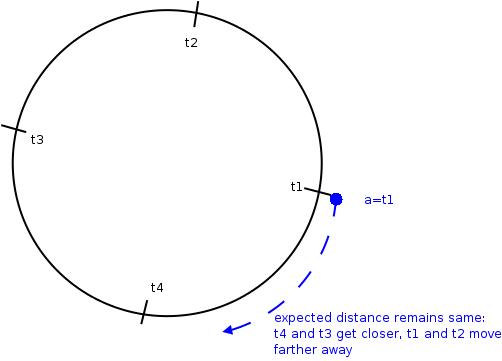
Receiver's best response is then any mixed strategy having as its support only actions with the possible values of Sender's type t. For example, if m = 1/6, Receiver can play any combination of 1/6, 1/2 and 5/6. The expected distance from sender's type of any one of these actions is (1/3 * 0 + 1/3*1/3 + 1/3*1/3) = 2/9. The expected distance from sender's type of any other action a is greater than this. The simplest way to see this is to imagine the three possible values of t. By moving Receiver's action a away from one of these values, two of the values get farther away, while one of them gets closer:

Now we consider Sender's best response to Receiver's strategy. First note that if Receiver plays, say "2/3" with probability 1 on receiving m = 0, but randomizes over all 3 possible types for e.g. m = 1/10, then when t = 1/3+1/10 it will be more sensible to send m = 0 (guaranteeing a response close to her bliss point) than the assumed strategy of m = 1/10. So we focus on the case when Receiver randomizes with equal probability over all 3 types, for all messages m in [0,1/3).

In this case, the logic above also holds true for Sender's utility. By sending a message reflecting her true type, she elicits a best response of one of her three possible types. The logic for Sender is just as for Receiver: this has a one in three chance of being at her bliss point (at t+c, where t+c is one of the three possible types) and a 2/3 chance of being 1/3 away; any alternative message would generate a greater expected distance from t+c. Thus, honesty is a best response to Receiver's strategy, and we have our Bayesian Nash equilibrium.

The same logic holds whenever c = 1/n, and n is odd. Then, any message m in [0,1/n) where m corresponds to t modulo 1/n will generate a best response of choosing one of the possible types: any move away from a possible type moves (n+1)/2 of the possible types away from you, and (n-1) towards you, all by the same distance.

On the other hand, when n is even, the equilibrium remains technically but is much less plausible. Now all Receiver's strategies are equally good, because moving action a away from a possible type brings n/2 possible types closer while n/2 move farther away by the same distance. The case with n=4 is shown below:


The equilibrium remains, technically, because choosing a equal to some possible value of t is still a best response. But there would be no incentive, in the long term, for Receiver to play this equilibrium. When n is odd, there are plenty of best responses that don't lead to equilibrium (such as mixed strategies where Receiver doesn't always randomize equally between points) but in the long term one might expect Receiver to play "nicely" in order to keep the flow of useful information going. (I don't know if anyone has toyed with repeated cheap-talk games.)

Before moving on to the general case, where c does not "fit neatly" into the circle, it is worth pointing out that here, as c decreases, the potential equilibria are getting less informative rather than more, in the following two senses:

  1. The message space for e.g. c = 1/5 is [0,1/5), which is a proper subset of the message space for c = 1/3, [0,1/3).
  2. The expected distance from Receiver's (and Sender's) ideal point, when c=1/n, is (n^2-1)/4(n^2). This increases as n increases, with a limit of 1/4. For example, expected distance when c = 1/3 is just 2/9, when c = 1/5 it is 6/25.
Of course, the fact that, in this family of games, one particular kind of equilibrium gets less informative as conflict of interest decreases doesn't prove that the most informative equilibrium gets less informative. Perhaps there is a wholly different sort of equilibrium I haven't yet thought about, which improves on this one. Intuitively, I doubt it because it seems to me that strategies with an infinite message set are unlikely to improve on the "message sending modulo c" equilibrium without generating potential cheating. It would be nice to prove that this is, indeed, the most informative equilibrium possible. Then we would have a counterexample to the idea that talk always gets more informative as conflict of interest decreases.

That's all for now. Next post, I'll have a shot at the general case. I suspect this will also have an equilibrium of some kind.

Monday, 29 August 2005

A jolly little cheap-talk game

This is just to show off my newly-acquired skills from ICPSR summer school. If you aren't into game theory it will mean nothing to you - you have been warned!

The standard cheap-talk game, found e.g. in Morrow, has Sender's type t drawn from a uniform distribution on a unit interval: t ~ U[0,1]. Sender sends a message m from some set of possible messages M; then Receiver chooses an action a from that same unit interval. Receiver's utility declines monotonically, continuously and symmetrically with the distance of a from t, e.g. U
R(a) = - (t-a)^2. In effect Receiver is trying to guess Sender's type. Sender's utility declines monotonically, continuously and symmetrically with distance of a from some point t+c, where c>0 and measures some conflict of interest. For example, Sender's utiliy might be US(a) = - (t+c-a)^2. So Sender wants Receiver to guess Sender's type, but be a little bit off.

It then turns out that if c is small enough, there are informative equilibria where different ranges of types send different messages (so that Receiver can infer something about Sender's type); and as c shrinks the maximum number of messages in a potential equilibrium increases. It's a nice prediction - communication gets easier when there are common interests to rely on.

But now consider this jolly little variation. (I should warn you at once that I can think of no substantive applications, but it's food for thought in any case.)

Suppose that Sender's type is still drawn from U[0,1], but now we think of it as being defined on a unit circle, with distance defined as the shortest possible way round the circle. So now, for example, choosing a = 1 when t=0 would be a very good action for Receiver, as this would give a-t=0.

Now there is no equilibrium in which Senders with t in different sub-intervals send different messages, no matter how small c is. (I am not sure I can prove that there is no informative equilibrium at all. Perhaps there's one in which a continuum of possible messages are sent, informing R about the value of t modulo c, or something similar.)

Proof

Suppose that there are n different sub-intervals around the circle; Senders with t in any of these sub-intervals send different messages. Let's take an arbitrary pair of adjacent sub-intervals (x,y) and (y,z), sending messages m1 and m2. As usual, since t is uniformly distributed, Receiver's best responses are a1 = (x+y)/2 and a2=(y+z)/2. And, as usual, because Sender's utility function is continuous w.r.t. a, Senders at the boundary where t = y must be indifferent between a1 and a2.

Therefore, it must be the case that the distance from a1 to y+c (Sender's ideal point when t=y) is equal to the distance from a2 to y+c. And so the boundary point y must be closer to the midpoint of (x,y) than to the midpoint of (y,z); and so the interval (y,z) must be larger than (x,y).


But this must be true for all intervals round the circle, which is clearly impossible. (If there is a finite number of intervals, n, then the nth interval must be bigger than the n-1th interval, which itself is bigger than the n-2th interval and so on down to the first; but it must also be smaller than the first interval which is adjacent to it. If there are an infinite number of intervals, then choose an arbitrary selection of 2 or more points on the circle and consider that the size of the intervals containing these points must continue to increase as you move clockwise around the circle. I think this works. Hey, it's a blog, and I'm only writing this to avoid real work.) QED.

Note that nothing here depends on the exact geometry of the "circle". The proof works for any interval with distance defined in an appropriately circular fashion. (But, as I said, what the hell are the substantive applications? A hunter is chasing an elephant, which itself is chasing a bear around a big lake; he wants his friend to slay both elephant and bear, but his friend only wants to tackle the elephant. Oh Lord. Answers on a postcard?)

and on the other hand

7.50 this morning we get dear old Rabbi Blue on Thought for the Day, an exemplar of kindness, humour and good sense.

Sunday, 28 August 2005

2am eternal

It's 2 am. On the world service: "Reporting Religion".


First up, two rabbis discuss the meaning of Zionism. One of them believes that compromise over the status of Jerusalem is impossible, because the Jewish people have a contract with God.


Next: Delhi is being overrun by monkeys, who have been e.g. attacking children. The monkeys cannot be harmed because they are sacred, in fact divine.


And finally, does the Koran contain truths only recently discovered by Western science? A columnist in an Egyptian newspaper thinks so, and has a page of scriptural reinterpretation every week.


The traditional response to idiocies of this kind has been something like "religion and science deal with different, incommensurable kinds of truth". Here's an alternative way to look at it. All the three ideas above involve empirical claims, which are more or less testable... and completely preposterous. Monkey Gods, contracts between God and his "chosen people", quantum physics hidden in the Koran code: what serious person can regard these ideas with anything but contempt?


There are some complex explanations of the "revenge of God", the resurgence of religion over the past fifty years. Here's a simple one, which I'm sure cannot be the whole truth: enlightened, thoughtful people took their eye off the ball. The others got so angry when we disputed their stories, that it became easier just to go along and to pretend that there was no fact of the matter in these areas. So the nutters grew louder, more confident and madder than ever. Now we should learn our lesson. When someone talks nonsense, we should stand up and call it nonsense to its face.

Monday, 22 August 2005

In NY again

So I'm back in New York. This time I haven't managed to fall on my feet like the last two times: instead I rented a flat off craigslist.com and am in a nice area of Brooklyn, but still not as nice as downtown Manhattan. It has a pretty little courtyard and I'm sitting out there in the dark, leeching someone's wifi as usual. I would take a photo of it... but when I picked up my baggage from the Northwest Airlines flight, my camera was not in it. I'm not happy at all. That was the most valuable thing I owned, and a gift from my brother. NWA had a strike the day I went out, and I guess they had hired temporary baggage handlers. Draw your own conclusions.

Friday, 19 August 2005

Quote

There have been abundance of people, in all ages of Christianity, who tried ... to convert us into a sort of Christian Mussulmans, with the bible for a Koran, prohibiting all improvement: and great has been there power, and many have had to sacrifice their lives in resisting them. But they have been resisted, and the resistance has made us what we are, and will yet make us what we are to be.

-- John Stuart Mill, The Subjection of Women (1869)

Monday, 8 August 2005

A Room of One's Own

I've just read Virginia Woolf's A Room of One's Own for the first time. What an astonishing book. It's only about a hundred pages long, but like one of those pop-up birthday cards, it unfolds to reveal a very intricate architecture, containing in miniature almost the whole programme of feminism from that day to this: anger at inequalities of power, wealth and privilege, and examination of their roots; a call for a women's history; a sceptical focus on men's “knowledge” of women; mistrust of simple ideas about the sexes; interest in relations among women where men stop being the focus. As if she just knew! The book – it was originally meant for a lecture to undergraduate's at the women's colleges of Girton and Newnham – is full of casual asides as to how a student might profitably look at, say, the domestic history of the Elizabethan household, or the psychology of women's art.


The idea that culture has material foundations, that you need a room of your own and five hundred pounds a year to be a poet, is a Bloomsbury theme, it comes out in Howards' End too. The Bloomsbury people's intellectual elitism and passionate love for higher things combined with this intense awareness to make them more egalitarian, funnily enough. If you think pushpin is just as good as poetry then the fact that some people are poor and others rich doesn't really matter much, especially as everybody is getting richer together. But if you think Art and Beauty and above all good Conversation are the most important things in the world, then it matters terribly. (So I suppose that the Blair government's artistic policy of “access” is another way in which the powerless little clique has conquered the world.)


Did they conquer the world? If you could trace back the lineage of the spiky-haired gothic brats in Camden Town, and the elegant loft-dwellers of Manhattan or Hoxton, and the pot-smoking first-homers in small towns everywhere – of everything alternative or bohemian or unconventional, which by now includes almost everything in contemporary culture, would you find the little Cambridge gang of lesbians and nutters? I would like to think so.


Here are two quotes which make me very happy.


Meanwhile the wineglasses had flushed yellow and flushed crimson; had been emptied; had been filled. And thus by degrees was lit, halfway down the spine, which is the seat of the soul, not that hard little electric light which we call brilliance, as it pops in and out upon our lips, but the more profound, subtle and subterranean glow which is the rich yellow flame of rational intercourse. No need to hurry. No need to sparkle. No need to be anyone but oneself.


So long as you write what you wish to write, that is all that matters; and whether it matters for ages or only for hours, nobody can say. But to sacrifice a hair of the head of your vision, a shade of its colour, in deference to some Headmaster with a silver pot in his hand or to some professor with a measuring-rod up his sleeve, is the most abject treachery, and the sacrifice of wealth and chastity which used to be said the greatest of human disasters, a mere flea-bite in comparison.


Reading books like this could be a very bad idea. After spending a few hours with Virginia Woolf, you may not want to spend time with anyone else, and you may not care about anyone else's good opinion. Then you will be cursed with the worm that dyeth not, of permanent dissatisfaction, because there aren't many people like that in the world.


But she's wrong about the silver pot. The trick is to want praise and commendation from the right people.


Thursday, 4 August 2005

You know you're at ICPSR when...

... you've been working till 11 and you get out of Helen Newberry building and head home... but at midnight, your flatmate says, "hey, let's go to Rendezvous and work", and you find yourself sitting in the Rendezvous cafe doing equations until 2.30.

Good night!

Monday, 25 July 2005


and a bit more politics. this one is actually from the uk.


while i'm at it: the sex museum amsterdam. who is that shadowy figure in the white cap on the left? and the well-known international lawyer next to her?

i can't stand this tropical heat no more tracy!


a (slightly altered) political sticker in Ann Arbor. This is a very liberal town, not like the flyover stereotype.

it is HOT. and HUMID. I am drinking gallons of water, unable to concentrate or do anything.

things I didn't mention. When we were out dancing, two beautiful cornfed teenagers randomly came up and started shaking their booties at us in the most shocking way, bending right over a la detroit kronk. (If that's the expression?) They were chortling throughout.

So like previous generations of Englishmen, I am impressed with the frank and natural manner of American ladies.

What else? Well, the architecture isn't up to much and I haven't yet found a good breakfast spot. But thank god I have found a place to stay with aircon.

Sunday, 24 July 2005

So, America. In Detroit airport I wander around looking for a bus and getting ever more irate at the lack of infrastructure. Then a kindly man from the airport staff points me towards the shuttle bus and gives me four quarters in change to phone them; the shuttle bus company, ie a guy and his Mom, spend the entire journey trying to figure out where I should stay in Ann Arbor. And I end up in some kind of co-operative.

We go out. A band playing greatest hits of the 70s - funk, country and soul indiscriminately. This is unique. I have never been in a place where I was the best dancer. People standing around and watching. Couples where the girl wants to get into it and the guy is just standing there, ass rooted to the floor. She thinks she's a free spirit being held back, but she's playing a role too and is quite comfortable in her self-imposed restraint! So we show them what it's all about.


.... and then we go outside and there's a black guy playing his guitar, a two chord blues version of the latest dance hit, I think, and some couples doing the best, most joyous dancing I have ever seen. They jive to his blues - Asian, Latino, Black and White, the crowd clapping - just out on the sidewalk! Unimaginable in Europe.

But then you realise they are all professional.

But then, here anybody can be professional. No certificate required:all you have to be is good.

You see, this ambivalence is not really going to go away. It can be so amazing and then so dull.