Friday, 9 June 2006
R graph gallery
The R graph gallery is a great place to get ideas for plots. Try the thumbnails page.


Friday, 26 May 2006
Iraq cartoons
Just got an email pointing me at some pretty sharp webcomix about the Iraq war. Cheers to Latuff.
Monday, 22 May 2006

Monday, 15 May 2006



My entry for the Pimlott Prize
I wrote this for this year's Pimlott Prize, but didn't get shortlisted so I decided to put it up here. It's quite on the gloomy side but I am reasonably persuaded that the fundamental analysis is valid.
You can’t have your cake and eat it
A Lithuanian acquaintance, a graphic designer turned
The Left has decided that, after decades of peeling paint and lost custom, British identity needs a makeover – and a new, non-racist ownership. The renewed interest started with David Goodhart's essay in Prospect magazine, “Too Diverse?”, which claimed that too much cultural diversity could undermine solidarity, and that shared values might depend on a shared history. As radical Islam hit the headlines, the argument had legs. Trevor Phillips of the Commission for Racial Equality attacked Goodhart as a “liberal Powellite”, but also broke with multiculturalism. Gordon Brown has weighed in with a speech on British identity. The debate has been lively and open-minded. Cultural relativism, the once-common view that value judgments could not cross cultural boundaries, is rarely heard. Neither are there calls for a return to bland ethnic uniformity. Instead, participants struggle to define Britishness as the core minimum that everyone in our society can and must accept. Do we need shared values? Attachment to institutions? Or a broader sense of history and heritage?
To see why this question has hit the agenda, take the family friend who arrived recently from
How will redefining Britishness work in practice? You don't have to be a Marxist to think that a sense of identity can't just be developed by policy wonks, then handed out to the wider community. Before anything else, after all, national identity is about loyalty to a particular group: about whose side you are on. The English language, the common law, chicken tikka masaala, and other components of our national identity – warm beer and old maids on bicycles, as John Major put it, or liberty, fairness and civic pride if you prefer Gordon Brown's version – all ultimately rest on this foundation. At bottom a nation is just a group of people who are prepared to work together for their common good, what the philosopher John Rawls, in a slightly different context, called a “cooperative venture for mutual advantage”. So perhaps our first question should be, is there still a British nation at all?
Historically, British identity was like other nationalisms, bound up with war. National identity was needed because those that had it would defeat those who didn't. The
However, the past was not an age of unambiguous national solidarity. The ruling classes could be passionately patriotic, but their attachment was to a particular idea of
The conditions for this partnership no longer exist. The threat of war in
A liberal optimist would welcome the fact that the old nationalism is redundant.
This perspective has undoubted appeal. It is uncompromisingly cosmopolitan and impartial: the welfare of a Chinese textile worker counts as much as that of a Scottish one, so why favour either over the other? And economic freedom, the creation of integrated world markets in goods and maybe one day in labour, genuinely does make the world richer.
The problem is that globalization, economic integration and freedom of movement affect different parts of countries differently and unequally. Divide the world into three parts: already rich, getting rich and getting poorer.
But not everywhere is like this. Some areas are getting poorer – not absolutely, but relatively. They lack the skills and the infrastructure to compete with the rich areas, but have higher labour costs than the developing world. Consider
If the people in these areas only cared about absolute wealth, the gains from globalisation would outweigh the no doubt temporary pains of adjustment to a fairer and more open world. Alas, humans aren't like that. Adam Smith suggested that it was better to be an English peasant than a king in
The logic of globalization is that
Not everybody has yet understood the lost basis of traditional British identity. Perhaps it is least understood by those who have most to lose. The danger is that when they do, and when they see themselves falling increasingly behind the richer areas of the country, they will seek different repositories for their allegiance. These new groups will not represent
This has happened already elsewhere. The debate over British identity was fuelled by the visibility of militant Islam, but in the long run a more important context may be the emergence of the radical nationalist Right across
This worry explains New Labour's sudden interest in defining Britishness, and in particular the focus on what can bind Britons of different races together. The intention is creditable. But if it is going to be more than a public relations exercise, it will require progressive opinion in this country to make choices for which it is rather unprepared, but which follow inevitably from the view that national identity is at bottom about loyalty to people rather than ideas.
The first of these is that you cannot lecture people on national pride until you have some yourself. The British Social Attitudes survey shows that people with a college degree are about half as likely to say they are “very proud” of being British than people without a qualification. Fair enough: nationalism lost popularity with educated people because of changing economic conditions, but also because it was correctly believed to be the root of many 20th century evils. We are now rediscovering the positive side, though, and would like a new patriotism for the 21st century. Doing that calls less for creative, multicultural redefinitions – we have plenty of those already – than for a new commitment to
Secondly, this commitment must be reflected in policy. Both major parties have rejected economic protectionism in favour of free trade and openness. Retreating into protectionism and populism would indeed be a terrible mistake. The best way to avoid it is to give greater priority, in social policy, to protecting British communities whose status is endangered by globalization. This requires a hard choice between competing values. Take a simple example. A new publication by the Young Foundation, The New
Which leads unavoidably to an issue most Left-wingers won’t like. Bluntly, if you define Britishness without ethnicity, then you need some other way of defining national membership, and that implies a tough line on immigration. The logic of talking about British identity is to tell people in economically deprived and dislocated areas, “we are on your side, we are part of one nation, you can rely on us to help you through the pains of globalization”. That promise means nothing if the group you point at as the focus of your loyalty can be expanded at will to suit the demands of the market. It’s not a racial issue: opinion polls in 2003 showed that majorities of blacks and Asians, like their white compatriots, saw immigration as out of control. This is unsurprising. Pakistanis in
Specifically, nobody yet knows whether openness to migration, in an age of cheap travel, can be combined with a generous welfare state, including universal free education and healthcare. On the face of it, it seems extremely improbable. More likely is the
The Left, and the British political system in general, faces a choice of values: internationalism or nationalism? The power and appeal of internationalism, a proud Left tradition, was shown in widespread support for the Make Poverty History campaign against European trade barriers which harm the developing world's peasant farmers. There is nothing wrong with wanting to treat Chinese and Scottish textile workers the same. But you cannot do that and simultaneously call for a renewed sense of national identity.
The Plaistow pub will probably still stand empty for a long while. Who would ever want to go back there? We could build something more modern, a warm, welcoming place for people of all races. But to do this, we need to rebuild from the foundations, rather than merely changing the décor. In other words, we need not just a different way of expressing national identity, but a new nation which citizens of all races and classes are part of. Alternatively, we can embrace the global market, stay on an economically liberal path (with a few prudent concessions to the misguided majority), let the world benefit, and let outmoded loyalties die in peace.
Monday, 1 May 2006
Sunday, 23 April 2006
MPSA joy
Last day at the Midwestern Political Science Association conference. This is the first time I've been to one of these big ones - more than 4000 presenters. It's like a polisci geek Glastonbury: you can run around trying to see all the cool bands, or you can sit in your tent smoking dope and occasionally wandering down to the stage to see what's on. I'm here with Laurence, another Essex PhD student. I have taken the blue-arsed fly approach, while he's been more on the spliff-rolling side of things, metaphorically. I've missed two sessions out of the 14 - 8.30 today and yesterday - and seen some really great papers. Highlights: John [?] Londregan, v interesting sort of leftfield paper about voting as a signal of willingness to fight in wars; Ethan Bueno de Mesquita, presenting a formal model of bureaucratic oversight with great clarity; James Fowler talking about how mono- and dizygotic twins vote - this man is obviously very smart; wandering into a more-or-less random session and getting, quite by chance and from a completely different field, a potential method for my next paper; and (heh) watching Vera Troeger discuss some papers. (Surgical.)
Hopefully will meet up with Robert Klemmensen today (w00t! I have another reader!) and try to come up with something clever for this amusing diversion, listed on POLMETH. (Everyone has a pet "really simple guaranteed winner" for this.) I see James Fowler is also behind this. Yikes.
Hopefully will meet up with Robert Klemmensen today (w00t! I have another reader!) and try to come up with something clever for this amusing diversion, listed on POLMETH. (Everyone has a pet "really simple guaranteed winner" for this.) I see James Fowler is also behind this. Yikes.
Saturday, 22 April 2006
Sonnet VII
How soon hath Time the suttle theef of youth,
Stoln on his wing my three and twentith yeer!
My hasting dayes flie on with full career,
But my late spring no bud or blossom shew’th.
Perhaps my semblance might deceive the truth,
That I to manhood am arriv’d so near,
And inward ripeness doth much less appear,
That som more timely-happy spirits indu’th.
Yet be it less or more, or soon or slow,
It shall be still in strictest measure eev’n,
To that same lot, however mean, or high,
Toward which Time leads me, and the will of Heav’n;
All is, if I have grace to use it so,
As ever in my great task Masters eye.
Milton
He revisited this theme with greater power in On His Blindness.
Wednesday, 5 April 2006
Tuesday, 14 March 2006

Tuesday, 28 February 2006
Torture in US "black prisons"
http://www.democracynow.org/article.pl?sid=06/02/27/1519239
(via http://www.jordanplanet.net/)
(via http://www.jordanplanet.net/)
CLIVE STAFFORD SMITH: Yeah, you know, Hussein Mustafa, I met with him in Jordan, and he was an incredibly credible person. He is a dignified older gentleman, about now 50 years old, and he wanted to talk about what had happened to him, but he really didn’t want to talk about that sexual stuff, and in the end, you know, I said to him, “Look, you don’t have to, but it’s very important if things happened, that the story get out, so they don't happen to other people,” and in the end he did, and it was in front of half a dozen people who were just transfixed as he described how four soldiers took him, one on each shoulder, one bent down his head and then the fourth of them took this broomstick and shoved it up his rectum.
Now there was no one in that room -- and they were from a variety of places -- who didn't believe that what this man was saying was true, but I am afraid, I’ve got to tell you, that that’s far from the worst that’s happened. When you talk about Bagram, when you talk about Kandahar, those aren’t the worst places the U.S. has run in Afghanistan. The dark prison, sometimes called “Salt Pit,” in Kabul itself, which is separate from Bagram, has been far worse than that, and I can tell you stories from there that just make your skin crawl.
Monday, 6 February 2006
Iraq demo
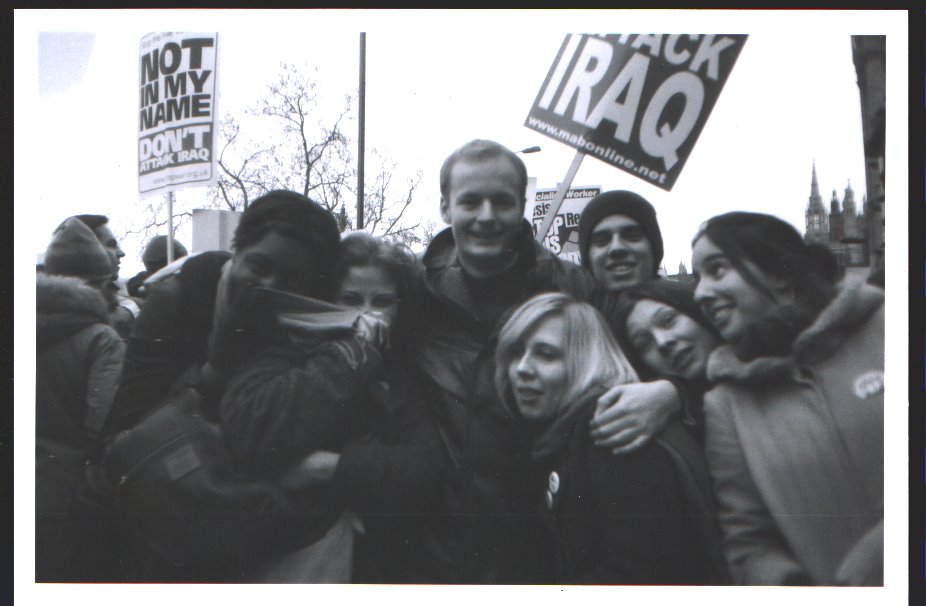
Cica took this photo at the big one. Left to right: Elisabeth, Mel, me, Clemency, Cica's cousin, Natasha, Elodie. Heh. It lends me some wholly undeserved glamour. What a great day that was. Pity we didn't win.
Thursday, 2 February 2006
Fast social science


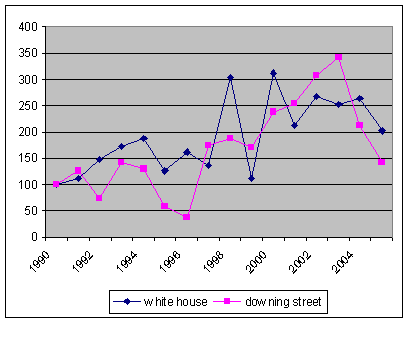
So on the subject of media attention to US and UK politics, these show the number of articles from the Times, FT and Guardian with different words in their headlines, 1990-2005. I rebased so that 1990=100, a dubious procedure because if 1990 was a very high or low year, that will make the subsequent pattern look better or worse. (In particular, take the White House/Downing Street comparison with a grain of salt.) Still, the trends are real enough. As far as I can see the story here is actually that Presidents and Prime Ministers have got more media attention, legislatures less. Country differences are pretty speculative.
Wednesday, 1 February 2006
Papers I would like to write
Whenever I get an idea I scribble it down on a sheet of paper and draw a little thought bubble at the top. This is an ongoing post with a list of papers I would like to write. Some of them are actual viable political or social science ideas. Others are things way out of my field, or ideas that might not be quite worth my time.
- Use "Blink"-style analysis of interviewers' posture, voice etc. when talking to politicians from different parties to provide an objective test of media bias.
- Why do human parents seek to control their children's sexual behaviour? This is AFAIK unique among animals. It is quite hard to understand from a genetic point of view: your children's interest in maximizing fitness is identical to your own (apart from the issue of degrees of relatedness, which might conceivably make a difference e.g. in cultures where people marry their cousins). Is the parental behaviour cultural or is there a genetic component? How did it arise?
- Hobbes' theory of the church in Leviathan Chapter XII seems to foreshadow modern economic theories of religion. He actually mentions the church before he gets to the state. It would be an interesting topic in intellectual history.
- Modelling how a city's size is affected by the size of other nearby cities. You might expect big cities to "drain" the population of near neighbours. The model could be applicable to other phenomena - firms in markets, even countries.
- How to extend formal models of elections to include the spread of information about policy through the population.
- Small churches and political parties seem to suffer more splits than large ones. Why? A formal model invoking control over resources and the ability to buy off potential splitters might help.
- Media analysis of how reporting of US politics has increased in non-US countries. A simple hit count for "senator" and "president" versus "MP" and "Prime Minister" would be a start.
I'll keep posting these as I remember them. There are a lot more!
Wednesday, 4 January 2006
edge.org asked a bunch of scientists for their "dangerous idea"
Not surprisingly, there are a lot of ones about science and religion. Also a lot of ones about minds, brains and genes. Cognitive science is "hot". These ideas are interesting but not so new, at least to me personally. Quite a lot of physicists talk about the idea of a "multiverse". A more political trend is a worry about American decline - there are a lot of grumbles about the lack of US science students.
Here are some of the ones I liked:
Sherry Turkle on the end of authenticity
http://www.edge.org/q2006/q06_8.html#turkle
Steven Strogatz on the end of insight
http://www.edge.org/q2006/q06_8.html#strogatz
Jaron Lanier on homuncular flexibility
http://www.edge.org/q2006/q06_7.html#lanier
Richard Nisbett on not knowing ourselves
http://www.edge.org/q2006/q06_3.html#nisbett
Jeremy Bernstein: the idea that we understand plutonium
http://www.edge.org/q2006/q06_3.html#bernstein
Frank Tipler on antimatter
http://www.edge.org/q2006/q06_4.html#tipler
Gregory Cochran: evolution has taken place within recorded history
http://www.edge.org/q2006/q06_4.html#cochran
Alison Gopnik: the idea of "dangerous ideas"
http://www.edge.org/q2006/q06_4.html#gopnik
Brian Greene on the multiverse (several physicists mention this theme):
http://www.edge.org/q2006/q06_5.html#greene
Diane F. Halpern on choosing your child's sex
http://www.edge.org/q2006/q06_7.html#halpern
Daniel Dennett: not enough minds for our memes
http://www.edge.org/q2006/q06_8.html#dennett
Robert Shapiro on monomers and the search for the origin of life
http://www.edge.org/q2006/q06_9.html#shapiro
Geoffrey Miller: aliens are too busy playing their Xboxes
http://www.edge.org/q2006/q06_9.html#miller
Bart Kosko: we're all using the wrong Bell Curve!
http://www.edge.org/q2006/q06_11.html#kosko
Marco Iacoboni: media violence induces imitative violence
http://www.edge.org/q2006/q06_11.html#iacaboni
Leo Chalupa: give me peace and quiet!
http://www.edge.org/q2006/q06_12.html#chalupa
Tuesday, 20 December 2005
More phone photos





I've had to use my phone since my camera got nicked. The constraints of a tiny image size can be liberating. These are mostly of the Colne estuary, which I walk along regularly. Actually the dog is here too.






Thursday, 8 December 2005
If you believe in expert judgment
... more than mechanical statistical predictions, as I tend to do, this might be interesting.
Monday, 5 December 2005


Subscribe to:
Posts (Atom)