Wednesday, 6 May 2015

So long, Marianne. On bullying and bossing about


Today I completed my online Diversity in the Workplace training. Guess what? It was a fatuous waste of time! These courses exist, I think, to stop the employer being sued when a manager screws up and e.g. tells a female job candidate to stay home with the kiddies.

Luckily they can be clicked through at great speed. In the multiple choice questions, avoid the very silly answer – "she'll probably leave when she gets preggers, so let's save time and not hire her!" – and choose whatever is most self-righteous and/or supine from the rest:

"Your university sends you a survey asking about... your sexual orientation... select TWO options:
(a) Information on sexual orientation will be misused by the university
(b) It's too personal - there is no good reason for the University to ask it
(c) It's important for the University to have this information about staff
(d) It's OK - noone should feel they have something to hide"

(a) and (b) are wrong. No buts. It is inconceivable that anyone at the university would ever misuse this information, now or in future. Also if the question seems too personal, chillax and get over it with option (d).

Last week I saw this sign at French customs, instructing "everyone" (but we all know who) what they can and cannot wear:


You see:

Real oppression, real bullying of the weak, doesn't wear a big ugly mask, or come in a costume marked oppressor or racist. It dresses up in noble images of Republicanism and freedom. It has elegant graphics and well-put slogans: La Rêpublique se vit à visage découvert. It has no laws against it; it is the law.

One cannot fairly say that, if this awful stuff ever comes to the UK, those who designed Diversity in the Workplace will be churning out courses on Integrate yourself into our Grand Old British Society. But someone surely will. Meanwhile: what can make a society freer, fairer, or even kinder? Is it lawyers, regulatory compliance, and compulsory online courses with a multiple choice component?

Monday, 4 May 2015

Guide: when should I use TeX and beamer?

    People often ask me: should I use TeX and beamer? To help find the answer, I have created this useful flowchart.


    Wednesday, 29 April 2015

    R tip: caret error

    If you get the following error when using the caret package:
    Error in tab[1:m, 1:m] : subscript out of bounds
    then ensure that your dependent variable is a factor and not anything else (e.g. a logical TRUE/FALSE vector).

    Dishonesty in the US military

    This paper is a great sourcebook:

    Every contact with the enemy required a storyboard. People did not report enemy contact because they knew the storyboard was useless and they didn’t want to go through the hassle.
    It’s odd that in situations that I’ve been in, it’s never been blatant self-interest. It’s never been, “I’m going to get this money so I can buy myself two couches for my office while I’m in Afghanistan.” [Instead], it’s always like—for us, it was hard as hell to get water heaters.... [W]e had to say we’re using this for this, when in fact it was so our guys could have hot showers when they get back off patrol.
    I falsified the [traumatic brain injury] report that changed a distance from the IED strike [to where] one person was standing. So that way someone didn’t come back down and stick a finger in my CO’s chest and say, “You need to evac that lieutenant right now!” Because in the middle of [a] RIP, that’s not going to happen. If I do that, I’m going to put my boys in bags because they don’t have any leadership. That ain’t happening. I owe the parents of this country more than that.

    R tip: quick functions using dplyr


    How to e.g. find the proportion of NAs in your data by column.

    The old way is:

    sapply(mydata, function (x) mean(is.na(x), na.rm = TRUE))

    This wastes a lot of time typing out function(x) etc., and is hard to read.

    Here's a better way, using the wonderful dplyr:

    library(dplyr)
    sapply(mydata, . %>% is.na %>% mean(na.rm = TRUE))

    The magic is that the dot . before the pipe operator %>% creates a function.


    Tuesday, 28 April 2015

    Linkage

    Tyler Cowen defends the TPP, and reviews Samuel Johnson as a modern blogger.

    Football predicts election results. Octopuses predict football. Draw your own conclusions.

    Engineering thinking versus ordinary thinking. This is also about big, visible events versus chronic conditions – a contrast which pops up in political economy all the time, see this paper by Sharun Mukand for instance.


    Monday, 27 April 2015

    A field experiment at LHR


    At Heathrow Terminal 2, there is an escalator and a lift to take you from the Underground up to departures. The authorities have put a sign up:

    TIME ON ESCALATOR 3 MINUTES
    TIME ON LIFT 58 SECONDS
    TAKE THE QUICK ROUTE – TAKE THE LIFT

    Why has this happened?
    1. Standard economics: the sign was a mistake. People already choose the optimal route. (Public choice theory: the sign was not a mistake but a deliberate conspiracy by the elevator company to wear out the lift and make money from replacements.)
    2. Social preferences: the sign is a nudge to counter travellers' "lift aversion".
    3. Social norms: there is a norm of taking the escalator. People really want to take the lift, but they are afraid what others will think of them.
    4. Social heuristics: people mistakenly assume the escalator is faster, as it usually is in their experience. The sign corrects this.
    This is a biased choice of example. In other situations, the first three explanations might be more plausible. Still, many lab experiments might be cases of 4, mistaken for cases of 2 or 3.

    I first read the term "social heuristics" in this paper.

    Sunday, 26 April 2015

    An experiment on overconfidence


    A nice experiment was presented at NIBS last week – Zahra Murad, "Confidence Snowballing in Tournaments". (No paper available yet.)

    The talk started from a psychological idea: people are sometimes overconfident about their own performance, and get more overconfident after a few successes. This might explain, say, the overweening confidence of CEOs and "Masters of the Universe" bankers.

    In the experiment, subjects competed, in pairs, on a task which could be either easy or difficult. Then winners were matched with other winners and played again – like a football tournament. (Losers were matched with other losers.) The winners of the second round played each other again, and so on.

    Before each round, subjects had to bet on their own performance. Fro this, we can learn what chance they gave themselves of winning the round.

    The beauty of this design is that having won a round tells you nothing about your chance of winning the next one, because you will be playing someone else who has also just won! So, a reasonable person would not get more confident after winning a round.*

    In fact, on easy tasks, winners did get more confident. On difficult tasks, losers got less confident, also wrongly and for much the same reason.

    What's good about this experiment?
    • It is real "behavioural economics"
    It puts an insight from psychology, the hard-easy effect, into a social setting. So, it is not just psychology. But it is theory-driven: it is not trying to draw inferences about a real social situation directly from behaviour in a feeble laboratory pastiche of that setting.
    • It uses the lab to create an elegant simplification
    In the real world, it's hard to judge how much somebody's confidence ought to increase after, say, making millions off a deal. In the experiment's stripped-down paradigm, there's a natural baseline: every time you win, you are rematched against other winners, so you should not get more confident.

    In experiments, just as in formal models, "it's realistic" is a terrible reason to add a feature. These guys put in only what was needed.
    • It makes a nice parable...
    Among the many things lab experiments can do – test theory, estimate psychological characteristics, explore institutions – is to serve as "parables" or "existence proofs".

    Greek parables, like that of Icarus flying too close to the sun, have survived the centuries because they tell us about recurring patterns, helping us to recognize them in life and history. The Icarus myth's pattern is: hubris, insane arrogance, leads to nemesis, divine revenge.  Hubris and nemesis are still all around us (hullo neo-cons! hullo Eurozone!) You would not expect them always to happen – imagine a foolish political scientist estimating the per cent prevalence of hubris in international relations – but it is useful to know that they can.

    Experiments can be modern parables.  Zimbardo's prison guards and Milgram's torturers have entered the folklore. They don't always apply, but they are things that can happen. (Hence "existence proof": an experiment shows, irrespective of external validity, that something has happened at least once.)
    • ... and fleshes it out
    Parables are fine and underrated, but social science must investigate phenomena, not just exhibit them. The experiment shows social interactions can cause overconfidence, and also explores when it happens (easy tasks) and when other things such as underconfidence can happen. This opens up some avenues for real world study. (If only easy tasks make people overconfident, then what explains the presumed overconfidence of very successful people whose work seems quite difficult, like investment bankers?)

    I see a lot of experiments and think either "this was obvious", or "I don't know what behaviour here tells us about the real world". This work passes these hurdles.


    * Nerd note: there could be some set of priors for which a Bayesian updater would get more confident. So, increasing confidence is not necessarily irrational in the technical sense, just "unreasonable" in a common-sense way.

    Saturday, 25 April 2015

    Linkage

    Grimsby is voting UKIP because of Europe, not immigration.

    Ted Jeory goes behind the headlines of the Lutfur Rahman case. (Non-UK readers: Lutfur Rahman was Mayor of a London borough and has recently been found guilty of corrupt practices. Ted Jeory was a  journalist who bravely investigated him.)
    And lastly…I started my spare time blog in 2010 when I realised my former paper, the East London Advertiser, was no longer able or willing to keep an eye on the detail of the council administration. I kept plugging away where it should have been. For that, I received numerous legal threats from the town hall. None succeeded. But the retreat of so many local papers across the UK is deeply worrying. How many other Lutfur Rahmans are there out there?

    Thursday, 23 April 2015

    What nations think of each other: honesty

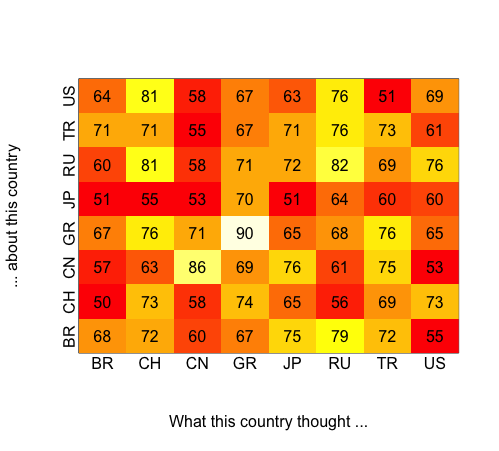
    100 people from each of 8 countries were asked to flip a coin and report the result. They got a cash reward (either $3 or $5) if they reported heads.

    If a group reports completely honestly, we'd expect 50 heads and 50 tails on average. If you get tails, there's an incentive to lie, and if the group is completely dishonest we'd expect 100 heads.

    People were then asked to guess how many people (out of 100) from each nation would report heads. This graph shows average guesses, split by the nationality of the guesser, and the nation they were guessing about. Higher numbers and lighter colours mean that the country was expected to be more dishonest.

    BR = Brazil
    CH = Switzerland
    CN = China
    GR = Greece
    JP = Japan
    RU = Russia
    TR = Turkey
    US = United States


    Some highlights:
    • The Greeks had a poor reputation, especially among other Greeks.
    • Everyone thought that Japanese people would be very honest.
    • Chinese people expected almost every nation to be honest, except the Greeks – and themselves.
    • People tended to expect their compatriots to be more dishonest than average (74% vs 66%)

    Monday, 20 April 2015

    Behavioural should not be behaviourist


    What differentiates behavioural economics from psychology? A common answer is "we are interested in behaviour".

    For example, psychologists studying group identity might use a questionnaire measure, asking subjects "how proud are you to be in your group"? Economists, instead, would test whether they gave more money to their in-group. "Real choices have costs," goes the slogan.

    Costly choices are a great experimental tool. But I had an epiphany recently, when a psychologist remarked that economists are using a theory psychologists gave up fifty years ago – behaviourism, the idea that you could ignore the mind and just study how stimuli affected behaviour.

    Only studying behaviour makes sense as long as the mind has no "state". If stimulus X always causes behaviour Y, then we only need study Y.  But of course the mind has state: for example, our choices depend on our moods.

    We need to study these states directly, so as to improve our theories by clarifying the links in their causal chains. Why are subjects more selfish if the game they are playing is labelled the "Wall Street game" rather than the "community game"? Maybe the market-oriented phrase puts subjects into a materially self-interested mindset. OK, so when does that happen in the real world? For an answer, we will need to measure this mindset directly and learn how it is induced.

    This is doable. Yes, people may lie, or misinterpret their own behaviour; but psychologists have been devising valid, reliable questionnaire measures for decades. (FMRI data seems more easily accepted by economists than questionnaires, perhaps because it seems more like "hard" science – or because it is impressively expensive?) We can use these measures, or create similar ones of our own.

    Without good theory, experimental economics risks becoming a pile of unorganized, uninterpretable results. For good theory, we need to open and study the black box of the mind.


    Sunday, 19 April 2015

    Linkage

    Chimps make spears in the wild. Unnervingly like this (Onion), or Planet of the Apes.

    Ifthekar, a young man from Britain, goes on jihad in Syria:
    His major complaint — which echoed the complaints of many of the foreigners who had come to these battlefields — was that of boredom. Weeks turned into months, and he and many of his fellow fighters had yet to wage jihad. Many manned roadblocks or checkpoints; others performed menial tasks...
    Compare Timothy Corsellis, who joined the RAF at the outbreak of the Second World War, aged 19:
    I was ready for death
    Ready to give my all in an expansive gesture
    For a cause that was worthy of death....
    But I never expected
    The weary hours of waiting while the sun rose and set...
    We sat together as we sat at peace
    Bound by no ideal of service
    But by a common interest in pornography
    And a pride to outdrink one another.
    Both Ifthekar and Corsellis were killed a little later.