Thursday, 19 August 2010

New work in progress up: "Group Reciprocity"

We've got a first draft of the paper on Group Reciprocity up. I blogged about the results from the first experimental session before. The end results aren't quite so strong but are still interesting.

Experimental economists have worked a lot on reciprocity: when you harm (or help) me, I harm (help) you back. Group reciprocity adds a twist: you harm me, so I want to harm somebody else in your group. Group could be almost anything: gender, ethnicity, football team supporters ....

Group reciprocity might be an important cause of things like war, ethnic tension and racial discrimination, so it would be useful if we could study it in the lab. The paper is a first attempt to do that. I think there's still a lot more to be done.

Atlanta Race Riot 1906


Friday, 13 August 2010

Calculating the standard error of marginal effects using the delta method, in R

Here's a little piece of code I used to calculate marginal effects on probabilities in a non-linear (bivariate probit) model, using the Delta Method.

Warning: I am not a proper statistician. Use at your own risk!

# to create the model:
library(VGAM)
mbvp.1 <- vglm(cbind(decision_matrices.1-1, decision_matrices.6-1) ~ defect_other, binom2.rho, data=ds, trace=TRUE)

# needed to compute the gradient of my function numerically
library(numDeriv)
# needed for a multivariate normal distribution
library(mvtnorm)
# bv is a vector of betas
# this calculates the change in predicted probabilities
f <- function (bv) {
    rho <- rhobit(bv[3], inverse=T)
    p <- array(dim=c(2,2,2))
    for (c1 in 0:1) {
        for (c2 in 0:1) {
            for (d_o in 0:1) {
                sgn1 <- 2*c1 - 1
                sgn2 <- 2*c2 - 1
                ############################################
                # the probability of making choice (c1,c2) 
                # when the independent variable
                # defect_other=d_o:
                ############################################
                p[c1+1,c2+1,d_o+1] <- pmvnorm(upper=c(sgn1*(bv[1]+bv[4]*d_o),sgn2*(bv[2]+bv[5]*d_o)), corr=matrix(c(1,sgn1*sgn2*rho,sgn1*sgn2*rho,1), nrow=2))
            }
        }
    }
    # I use the global firstdec so that the function conforms to what grad() expects
    # the total probability of choosing 1 for either the first
    # or the second decision:
    if (firstdec) p[2,2,2]+p[2,1,2]-p[2,2,1]-p[2,1,1] else p[2,2,2]+p[1,2,2]-p[2,2,1]-p[1,2,1]
}


firstdec <- TRUE
pred[1] <- f(coef(mbvp.1))
gradient <- grad(f, coef(mbvp.1))
# ===== this is the delta method ====
predse[1] <- sqrt(gradient %*% vcov(mbvp.1) %*% gradient)

firstdec <- FALSE
pred[2] <- f(coef(mbvp.1))
gradient <- grad(f, coef(mbvp.1))
predse[2] <- sqrt(gradient %*% vcov(mbvp.1) %*% gradient)

margprobs <- cbind(pred, se=predse, Z=pred/predse, p=2*pnorm(-abs(pred/predse)))
print(margprobs, digits=3)

Saturday, 31 July 2010

Very interesting discussion about academia

... over at The Atlantic.

My tuppenorth:

  • at least half the added value of university for undergraduates is the other undergraduates. If you hang around with clever, interesting people, that expands your brain - and most 18 year olds pay more attention to other 18 year olds than their professors, for some reason - plus, if your friends go on to be important and influential, then you have a network.
  • this means that for universities, nothing succeeds like success. (Economic term: multiple equilibria.) No matter how good a community college's teaching, it will be less attractive than Harvard because Harvard has Harvard students.
  • This gives famous universities the chance to extract rents: they can charge a lot more than they actually provide by way of teaching etc. You are paying for the name and the networking.
  • These rents go into research. 
  • The authors are damn right that a lot of research is useless. The problem is, research is like advertising: half of the money spent on it is wasted, but nobody knows which half.

Friday, 23 July 2010

A few tidbits from the pilot experiment

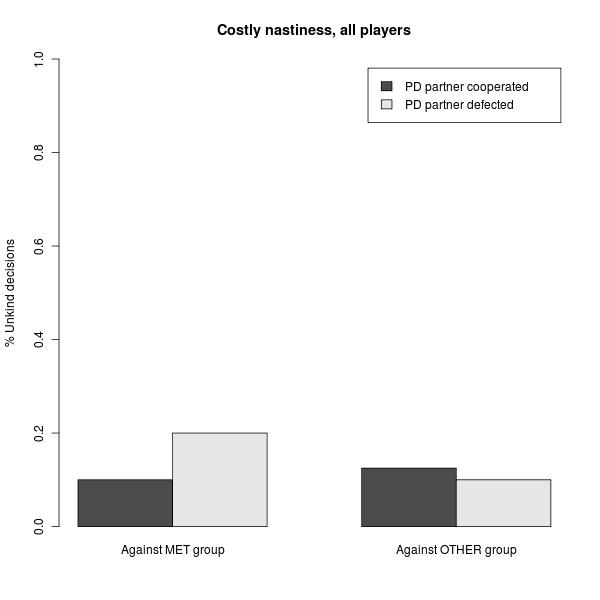
Subjects were divided into three groups. Each played a prisoner's dilemma against another subject from a different group (the "prisoner's dilemma partner" or "PD partner"). Then, each of them made a set of allocations between themselves and other subjects - who were identified by group and player number, but who were not the same as their PD partner.

We call the group of each subject's prisoner's dilemma partner the MET group;  the third group is the OTHER group.

When the PD partner defected, subjects made more allocations that harmed the other player. This difference was larger when making allocations against others from the MET group:
The effect is clearer for subjects who had themselves cooperated in the prisoner's dilemma:
For some decisions, being nasty to the other player actually cost the subject money. Not surprisingly there were fewer of those allocations, but the same pattern is observed:
and again the pattern is even stronger for PD cooperators.
Of course this is just the pilot, and I haven't yet done any rigorous statistical significance tests.

Saturday, 17 July 2010

Why don't evolutionary economists believe in equilibrium?

This is a provocative question for Arianna and others of her persuasion. Much of it goes over similar ground to Paul Samuelson's address to a conference of evolutionary economists a couple of years ago.

Evolutionary economics takes its cue from biology and sees the economy as an ecosystem, with an endless variety of different "species" (firm strategies) competing, right? And as a result EEers reject the rationalistic concept of equilibrium, whether market or game-theoretic. The world is always moving forward, never at rest, and behaviour is never perfectly adjusted between different actors.

I find these claims pretty plausible, and ironically more plausible in my field -- political economy, where straight Nash Equilibrium is completely dominant -- than in the study of markets.

But.

1. Biologists use equilibrium concepts all the time, and these concepts were adapted from game theory by John Maynard Smith. Indeed, instead of being looser than "rational" game theory, evolutionary game theory concepts actually make tighter predictions: an Evolutionarily Stable Strategy is always a Nash Equilibrium, but not the other way round.

2. Equilibrium has been tested in the lab, and holds up pretty well -- e.g. in auction markets. I am not claiming we can naively generalize from the lab to real markets. But if it works well in the lab, doesn't that support the underlying theory?

3. One major use of equilibrium predictions is to generate comparative statics (ie predictions that if parameter X varies, outcome variable Y will vary with it in some specific way). Even if economies never reach equilibrium, the forces pushing them towards equilibrium may still generate the same comparative statics. For example, although the voting behaviour that we observe is not compatible with the main equilibrium voting models -- people vote too much -- still, they vote less when the election is less competitive, as the models predict.

4. Social science is all about the search for surprising insights. Equilibrium concepts -- more fundamentally, the idea that people react to incentives -- are a good way to generate these insights. (One random example: smoking bans in pubs might increase child cancer, because more people stay at home and smoke there.)

So, what's wrong with equilibrium?

Monday, 12 July 2010

New paper

There's a new work-in-progress on my website. It's with Ro'i Zultan and is called "Brothers in Arms: Cooperation in Defence". A poster is here.

We started this paper to try and resolve a puzzle in social science and biology. Often, unrelated individuals help each other when they face an external attacker. For example, an estimated 200,000 people were active members of the French Resistance in World War II. In the laboratory, we can observe a similar phenomenon under controlled conditions: cooperation increases in the presence of an external threat. Non-humans do it too. For instance, musk oxen band together to drive off wolves.

This is a puzzle because, economically, helping others seems to have costs but no benefits. Or, biologically speaking, this behaviour should decrease the fitness of the animals who display it.

We explain this cooperation by invoking signalling theory. Some groups are  prepared to cooperate, for example because they are kin, or because they are in long-term cooperative relationships. Other groups consist of self-interested individuals. Attackers are strategic: they prefer to attack groups who will not help each other. (Think of the bandits in the Magnificent Seven.) If they start to think they are attacking a very cooperative group, they will look for another target. Then, even self-interested individuals have an incentive to help each other during an attack, as this will deter further attacks.

So far you might get with common sense. However, economists and others may be asking "surely the group's reputation for cooperativeness is a public good, just like defence itself, and will be underprovided". Here, our theoretical model shows one possible answer: the series of repeated attacks gives this public good a "weakest-link technology". That is, if you are the first person not to help during an attack, then the attacker immediately recognises that previous helping was fraudulent and can no longer be deterred. This in turn gives a strong incentive to help when it's your turn.

The paper is here.

Saturday, 10 July 2010

At the demo

Arianna persuaded me to go to the anti-Nazi demo in Gera today. The local fascists were having a sort of annual picnic.

Gera is quite pretty, not like the stereotype of a run-down East German town. If I were an artist I'd buy myself 1000 sq m of old warehouse, cheap as chips.

We avoided the Black Bloc, who looked like teenagers out for a fight, and joined the main crowd on the bridge. Tons of police. Some Christians playing samba. A couple of guys doing capoeira. Soon th Nazis come across the bridge, under heavy police escort. They have to cross in single file, accompanied by our chants of "Nazis raus!" Most are big, tough, aggressive-looking guys. A few scrawny girls. They look as if they enjoy the hate, so is it really effective? Maybe the point is to make sure that people who don't enjoy the hate are put off.

We go and eat at the Sächsische Bahnhof, a cool place in a beautiful old run-down building. When we get back, the demo is gone and the Nazis are listening to speeches. The world Volk appears a lot. We must not allow our Volk to be destroyed!

East Germany is really not a multicultural place: I don't know what they are afraid of. As it happens, I think there are some legitimate reasons to worry about immigration. But actual anti-immigration sentiment always seems to be irrational and driven by primal human fear of strangers.

If this is Europe's biggest Nazi-fest as the flyers said, we have little to fear. There were maybe 1000 people there. The event was a bit smaller than Wivenhoe village fête.

The demo was supported by Die Linke, Germany's Left populist party. I think they are a much bigger threat to European democracy than the neo-Nazis. But they play by democratic rules so they have to be tolerated. And the populist threat is not just from the Left. The French assembly is preparing to ban the Burqa. This is a direct assault on liberal freedoms. But some people misguidedly support it because of an ill-thought-out feminism. Have I quoted J S Mill before? Never mind: "His own good, whether physical or moral, is not a sufficient warrant."

Thursday, 8 July 2010

CAP

OMG listen to this vile political gitweasel!

"In looking at the EU budget, Lyon admitted that there would be downward pressure from member states facing their own economic crises but believed that the benefits from a robust CAP far outweighed any reason to reduce the cash in this particular part of the EU budget."

 Screw the CAP, man. It's just a prime example of a policy that benefits nobody. It's like a canker on the rotting corpse of European policy. What the hell are the benefits from it? There are zero Goddamn benefits, except for a few fat-arsed dole-blodging millionaire farmers.

Robust CAP? Gag me with a spoon.


I think it's time for breakfast.

Monday, 17 May 2010

Straight people having gay marriages

Very interesting article here. Interesting comments too. Re my previous blog post... does marriage-lite help or hinder commitment?

Saturday, 8 May 2010

What's good for the goose...

I'm a Thatcherite. I believe in the magic of competition. I just can't help it. When I see an overregulated industry with a few lazy, inefficient incumbents, I instinctively think "tear down the barriers to entry!"

That should apply to politics too. What Britain has had for 60 years is a two-party duopoly. People are now sick of both parties. It would be much healthier if they faced some bracing competition from smaller, nimbler players. We should tear down the main barrier to political entry, which is the First Past The Post electoral system. Demand a referendum on PR now!

Thursday, 6 May 2010

Money well spent?

"The immediate political liability for this lies with Mr. Brown and the Labour Party, which engaged in a spree of epic proportions after taking power in 1997, spending at a rate that has outstripped inflation by 41 percent. The current budget of about $1.1 trillion includes more than $150 billion on the state-run National Health Service, triple the amount when Labour came to power.

One in every four pounds the government spends is borrowed, a pattern that economists say will require the next government to make cuts on a scale not experienced since the Great Depression, as well as painful tax increases."

Wednesday, 5 May 2010

The dilemma

The Lib Dems are loons. Their policies are a mix of the interesting and the bloody silly. In the ordinary course of politics, sometimes the main parties nick their best ideas. I would not be thrilled to experience their worst ones. And Nick Clegg... well, to me he seems like a blank space on to which the electorate are projecting their hopes. Mr Not The Other Two.

But the Lib Dems are loons *because* of the two party system. If you want to go into government, you have to join the Tories or Labour. The Lib Dems get the leftovers. If they had more chance of getting into office, they would attract more talented politicians. Electoral reform would let that happen. And liberal ideas -- the deep underlying ones, not the wacko policy proposals -- are pretty decent ones. Liberalism is more alive as a set of ideas than anything Labour has got.

So, do you vote for the loons now, in the hope of getting something better later?

Saturday, 1 May 2010

Election thoughts 2

Dream: a Tory - Lib Dem alliance. Clegg forces electoral reform on to the agenda and we get a referendum between the status quo and some moderate form of PR like the Alternative Vote system. Vince Cable becomes chancellor instead of that little pink feller Osborne. Tory radicalism on education is tempered with a concern for equality. The Libs' dafter ideas are sidelined.

Nightmare: a Lib-Lab alliance. Labour have austerity for two years, then resume pouring money into the public sector. It doesn't work, of course, and public cynicism extends to include the Lib Dems. We gradually become more like a normal European economy - slow-growing, sclerotic and riven by the populism of an embittered majority.*

In between these I would obviously prefer Tory to Labour.

Quite a tough choice therefore - go for strengthening Clegg's hand or play it safe and vote Tory?... Anyway, I voted by post so now it's up to you lot.

* [purple passage]

Monday, 5 April 2010

Leaving the uk tomorrow

Been weird coming back here. The place feels like it's waking up with a hangover, from a party which turned really sour. Atmosphere of congealed greed and mistrust. (Not wanting to go overboard here. But.)

Wednesday, 31 March 2010

General election

I've been wavering between the Lib Dems and the Tories. (1997: Labour. 2005: Lib Dem.)

The Lib Dems:
+ have Vince Cable who made the right calls before and during the economic crisis. I wish he could be chancellor
+ want electoral reform, which may well be a good idea
- do not seem very coherent
+ have a strain of liberalism
- have a strain of social democracy
+ opposed the war

The Tories:
+ are broadly pro-market, which I think is in general a good thing, despite the financial crisis
- David Cameron has a character issue. I do not get the feeling he has much strength of will or very clear ideas
+ ... but I liked his conference speech, which made devolution of power the central theme
- have too many Old Etonians. Class privilege is bad
- ... in particular George Osborne, who does not seem to know his job
- ... and their response to the financial crisis was not impressive
+ want the Swedish schools reform. Education is the biggest issue for me
+ seem to have some smart people on their team (Hague, Willetts, Gove)

I now intend to vote Tory, after reading the Lib Dems' education policy. (It's incoherent. Their diagnosis is "too much central control", and their cure is "give power back to Local Education Authorities". Gove's plan is much better.)

Saturday, 6 February 2010

A million monkey puns.

Political scientists worry about democracy because voters are rationally ignorant. That is, since you are unlikely to decide any election on your own, it doesn't make sense to learn about political issues which you cannot affect. This theory is supported by a lot of evidence: most people really don't know very much about politics.  (Even hardworking political scientists.)

Democrats respond with an argument that goes back to the Marquis de Condorcet. Even if no individual voter knows much, they are still likely to make the right decision. For example, think of a jury deciding whether to convict someone. Even if every individual on the jury is only a little bit more likely to be right than wrong, when they all vote together, the majority is quite likely to come out on top. And if millions of people were on the jury, then the right decision would almost certainly be made. The famous political scientist Skip Lupia put it like this: unless voters are Dumber Than Chimps, they are likely to make the right decision in the aggregate.

So, by this Condorcet Jury Theorem, democracy should work quite well. It's a bit like one of those stories where a million monkeys (or chimps) bash away at typewriters and one of them eventually produces Hamlet. Voters may not know much, but on average, they'll get to the right decision. The Theorem works for more complicated decisions than simple guilty/innocent choices. Suppose we vote on how much to spend on hospitals. Different people have different views, some of them quite wacky, but on average, the median voter is just right. Half the people want to spend too little, and half want to spend too much. If so, then a proposal to spend exactly the right amount will beat any other proposal. (If the other proposal is lower, at least half the voters will prefer the higher amount; if it's higher, at least half will prefer the lower amount.) And a political candidate who promises to spend the right amount will make a monkey out of any other candidate.

However, I think the Jury Theorem is completely bananas.

First, it depends on the idea that people are right on average. But there is no reason to expect that. Remember, people are wrong because they are uninformed, because informing yourself would be costly. Bob Dylan's The Hurricane is a song about Rubin Carter, a black man wrongly accused of murder:

"To the white folks who watched he was a revolutionary bum
And to the black folks he was just a crazy nigger
Noone doubted that he pulled the trigger" 

Almost everybody thought that Carter was guilty. Of course, a little investigation would have uncovered serious flaws in the case against him. But in a big jury vote, nobody has the incentive to do the investigating - it was left up to a few public-spirited journalists and activists. Uninformed people will not, in general, be right on average.

The other gorilla in the room is that even if people's views are right on average, they may not choose the right policy on average. This is a little subtler, so if maths makes you go ape, you can skip the next bit. Suppose we are deciding how much to spend on defence, and we face a national rival. We aren't sure about this rival's political ideology: is it to the left of us like Soviet Russia? Or to the right like Nazi Germany? (Maybe it's modern China.) The farther it is from us, the more we ought to spend.

In fact, our rival has just the same ideology as us. We need to spend almost nothing. And "on average", people know this. But their views vary - some people think that our rival is leftist, some people think its rightist. So, if we vote on military spending, we would end up spending quite a hairy amount.  The voter with the middle estimate of the other country's ideology, who correctly thinks we should spend nothing, is right at the bottom in terms of the spending he wants.

Of course, if we voted on the facts of the matter, we would get them right. But in practice, most policy decisions depends on hundreds of facts, and there's no practical way we could vote on them all. So, even if people were miraculously right about all the facts - on average - they wouldn't necessarily choose the right candidate, or make the right policy decisions.

To sum up, if you put a million monkeys in a room, you might end up with Shakespeare. But you might just end up with a banana fight and a lot of faeces throwing.

Wednesday, 20 January 2010

Myths

Bryan Caplan surely had bad luck with the timing of his book "The Myth of the Rational Voter", which argues that voters are irrational because they don't think like economists, and that we should trust markets relatively more. (I am caricaturing.) It came out in April 2007. Two years later, economists' credibility has been battered, and the policy of trust in markets has got as much legs as a paraplegic snail. A shame, because he has some interesting points.