Sloes are the little blue-black fruit that grow on the blackthorn bushes by the Colne estuary. They are ripe about now and on Saturday I went and picked about two pounds. They're too bitter to eat in bulk - although one will take the skin off your tongue in an amusing way - but you can make DRINK with them. I had a half-bottle of vodka and one of whisky, so I filled them with sloes and added a bit of sugar. Now they are sitting on the kitchen windowsill, slowly turning deeper red. You have to prick the sloes before you put them in (or freeze them so they burst their skins)... the sloe gin website has more details.
By Christmas or so I'll have some rich red booze. The neighbours (Pete and Sam from IDA) are getting some gin in which is the more traditional base liquor.
Tuesday, 27 September 2005


Wednesday, 21 September 2005
meaningless computer error messages: a collection.
We name the guilty applications.
 Firefox. This pops up while browsing print.google.com. What document contains no data? What sort of data should it contain? What do you mean?
 Copying files in Gnome. What's an invalid parameter?

This one popped up when I tried to connect to a remote server without plugging the network card in. God knows why it suddenly thinks the server is a "file" or a "folder" and starts worrying about security risks.
 Firefox. This pops up while browsing print.google.com. What document contains no data? What sort of data should it contain? What do you mean?
 Copying files in Gnome. What's an invalid parameter?
This one popped up when I tried to connect to a remote server without plugging the network card in. God knows why it suddenly thinks the server is a "file" or a "folder" and starts worrying about security risks.
Tuesday, 20 September 2005
Nice weekend in Paris
... a v cheap trip with me mum around her birthday. We headed over on the bus which was pleasant though long. Awful tour guide. Saturday went to the Louvre and saw some beautiful Michelangelos. Ma is a fan of the very early florentines, the amazing iconic stuff when they are just beginning to paint in three dimensions. I am more into the slightly later high renaissance but we both agree that at Venice it all gets a bit feeble.
Saturday night I see Viv and meet some friends of hers including the vivacious and mega-successful Elena who is an ex-World Banker. I miss the metro home and end up walking for hours through the banlieux of Northern Paris to the hotel. Yikes. Sunday we see Notre Dame and meet Viv again in a caff in front of the Sorbonne. Monday, back, another whopping trip but it gives me a chance to almost finish Shirer's Rise and Fall of the Third Reich. Shirer was a journalist, actually in Germany for a lot of the thirties, with a crackling prose style. The theme of the book is the cowardice of the people around Hitler - both nationally and internationally - and insofar as there is an explanation, at least for the Germans such as the generals who knew they were being led to destruction, he pins the blame on an inadequate political understanding. By understanding I don't just mean political science understanding, as in predicting who will do what, but also understanding of, say, the duties of a citizen or the dignity of man. (And actually these failures then lead the Nazis to make inaccurate predictions also: they cannot understand why, for example, Britain fights on rather than surrendering in 1940. It's a strong example for those who say that in social science, prediction requires understanding, and who therefore make a clear distinction between social and natural science.)
Perhaps Shirer's is a very American approach, but it basically chimes with the attitude of, say, Arendt, and contrasts strongly with the critical theorists who see fascism as the final expression of a social system - capitalism - and hence find rather little comfort in the triumph of the US. I think in this point the "politics" approach is more accurate.
As an aside: in history, I always gain insight from reading the "great" classic texts: professional historians' latest appraisals will change with the whims of academic fashion. Here at least, the judgment provided by an intelligent individual is more important than method, which may improve as the discipline progresses.
Saturday night I see Viv and meet some friends of hers including the vivacious and mega-successful Elena who is an ex-World Banker. I miss the metro home and end up walking for hours through the banlieux of Northern Paris to the hotel. Yikes. Sunday we see Notre Dame and meet Viv again in a caff in front of the Sorbonne. Monday, back, another whopping trip but it gives me a chance to almost finish Shirer's Rise and Fall of the Third Reich. Shirer was a journalist, actually in Germany for a lot of the thirties, with a crackling prose style. The theme of the book is the cowardice of the people around Hitler - both nationally and internationally - and insofar as there is an explanation, at least for the Germans such as the generals who knew they were being led to destruction, he pins the blame on an inadequate political understanding. By understanding I don't just mean political science understanding, as in predicting who will do what, but also understanding of, say, the duties of a citizen or the dignity of man. (And actually these failures then lead the Nazis to make inaccurate predictions also: they cannot understand why, for example, Britain fights on rather than surrendering in 1940. It's a strong example for those who say that in social science, prediction requires understanding, and who therefore make a clear distinction between social and natural science.)
Perhaps Shirer's is a very American approach, but it basically chimes with the attitude of, say, Arendt, and contrasts strongly with the critical theorists who see fascism as the final expression of a social system - capitalism - and hence find rather little comfort in the triumph of the US. I think in this point the "politics" approach is more accurate.
As an aside: in history, I always gain insight from reading the "great" classic texts: professional historians' latest appraisals will change with the whims of academic fashion. Here at least, the judgment provided by an intelligent individual is more important than method, which may improve as the discipline progresses.
Tuesday, 13 September 2005
moved
I am now no longer in Hythe, where the locals shout racist abuse at each other in the streets, but in lovely Wivenhoe, a socialist utopia where the delicatessen is just around the corner, PhD students gather in the pub by the estuary and the folk music club meets once a month. My new house has a fireplace and a dog (and a very nice flatmate). Hooray!
Thursday, 8 September 2005
Cheap talk part 3
I'm going to plunge straight into this. Parts one and two are also available if you are lost.
[ed: as you can see, I end up failing to prove what I meant to prove... also, blogger keeps eating my post.]
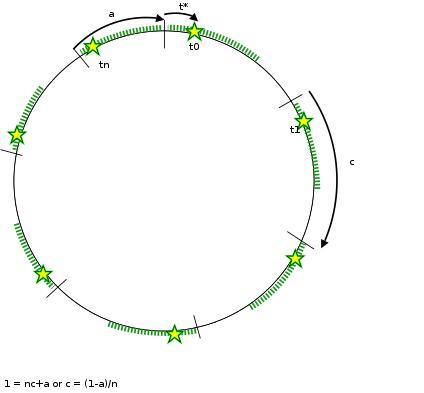
Suppose that c = (1-a)/n where n is an integer and 0 <= a < c. In other words, there are n intervals around the unit circle, plus a remainder of a.
(1) Suppose that n is even, and that Senders of type t send a message m = t* =
t modulo c, when t* < a. Now it's a best response for Receiver to randomize equally over possible values of t in response to this message. Proof:
Let's call the possible values of t, t0 to tn where ti = ci + t*. Take any arbitrary ti. Choose an interval H = (ti, ti+1/2] or (ti, ti-1/2], such that H does not contain the zero point, and therefore does not contain both t0 and tn. (For example, from t0, go clockwise and from tn go anticlockwise.)
The interval H now contains n/2 possible values of t. Proof: ts are evenly spaced along the interval, c apart, with the first one at ti+c or ti-c (as the interval is open at ti itself). Temporarily normalizing ti to zero, the interval (0, 1/2] or (0, -1/2] is of length 1/2 and, as 1 = nc+a, 1/2 = (n/2)c + a/2 where 0 <= a/2 < c. Moving from ti into H therefore moves you towards n/2 equally likely values of t, and away from n/2+1 equally likely values of t. As we are assuming no risk-aversion (Receiver's utility is linear in distance from t), moving away from ti therefore reduces utility. Similarly, moving away in the opposite direction is moving into an interval of size 1/2, excluding ti itself, which also must contain the remaining n/2 possible values of t from the set tj, j ^= i, and away from n/2+1 equally likely values of t.
(Apologies for the HTML notation: ^= means "does not equal".)
Therefore, any a ^= ti, for all i, is strictly dominated by some pure strategy a = ti for some i, and any mixed strategies containing anything other than the tis is strictly dominated by a mixed strategy containing only tis.
Furthermore, expected distance from t is the same at any ti (leaving the proof for now, I am fairly sure) and thus the mixed strategy choosing ti with probability 1/(n+1) is a best strategy.
(2) Given this strategy, Sender's strategy is a best response. Proof: for t = ti, i e {1,2,...,n-1}, the proof is identical to that given above as Sender's ideal point is just the same as to Receiver's ideal point when t=ti+1. When t = tn, ...
ah. No wait. When t = tn Sender's ideal point will be t+c which is strictly greater than t0 = t+a (we are crossing the zero point). If so, this will surely generate an incentive to deceive Receiver by claiming to be a different type. Blast. Perhaps we can remove the interval [nc, 1) from the set of types that sends an informative message? Well, this is obviously not over yet. More pointless fun awaits.
Wednesday, 7 September 2005
Time to ditch that Yahoo! account?
Yahoo! helped jail Chinese journalist (BBC news)
If you are still using Yahoo!, why not try Gmail, Google's free email service. It's extremely easy to use and lets you import contacts from Yahoo!. Google has been accused of censoring its search engine listings for China, but at least it hasn't actually turned into a police snitch. I have several accounts to give away if anyone wants one.
If you are still using Yahoo!, why not try Gmail, Google's free email service. It's extremely easy to use and lets you import contacts from Yahoo!. Google has been accused of censoring its search engine listings for China, but at least it hasn't actually turned into a police snitch. I have several accounts to give away if anyone wants one.
Tuesday, 6 September 2005

Monday, 5 September 2005
car found
So the police found my car about five minutes from where it was nicked. It had swerved off the side of the street. As we went to collect it, an Indian guy came up and told us that he'd seen five kids jump out and run off, about 4am. The exhaust had fallen off completely.
The police, of course, weren't interested in investigating. I don't really expect them to care, but it would be nice if they just pretended, you know? Of the several crimes I know in which I or friends of mine have been victims, not one has been cleared up by the police.
In other news, I just interrupted a couple of guys cottaging in the level 4 loos. Scandalous!
The police, of course, weren't interested in investigating. I don't really expect them to care, but it would be nice if they just pretended, you know? Of the several crimes I know in which I or friends of mine have been victims, not one has been cleared up by the police.
In other news, I just interrupted a couple of guys cottaging in the level 4 loos. Scandalous!
Sunday, 4 September 2005
My car got nicked
I drove down to help Dad move his stuff out of the Economist building: he's finally retiring after twenty-five years or so at the paper. Five minutes from his house the exhaust fell off my crappy grad-student Rover Metro. We tied it on with plastic ties and continued. That night, the car got nicked. Not hard to do as the boot was also only closed with ties.
That has to be the least profitable car theft ever, man. The value of that car was probably negative.
Eventually we persuaded the police to take the crime report, despite them trying to persuade me that the car wasn't registered in my name on their database (it was). I don't expect them to catch the criminals or even recover the car, I just wanted them at least to acknowledge that a crime had happened.
That has to be the least profitable car theft ever, man. The value of that car was probably negative.
Eventually we persuaded the police to take the crime report, despite them trying to persuade me that the car wasn't registered in my name on their database (it was). I don't expect them to catch the criminals or even recover the car, I just wanted them at least to acknowledge that a crime had happened.
Another amazing Katrina-related website
http://www.nola.com/hurricane/?/washingaway/
This is a report from the New Orleans' Times-Picayune on the potential for New Orleans to experience a devastating hurricane. Written in 2002.
This is a report from the New Orleans' Times-Picayune on the potential for New Orleans to experience a devastating hurricane. Written in 2002.
Saturday, 3 September 2005
Friday, 2 September 2005
So, back in Essex...
... and clocking reasonable amounts of work, in between the blog entries.
This one was going to be written on my trendy new PDA phone, the Orange SPV M500. However, the trendy PDA phone is going back to Orange on Monday. I'd never used a PDA before and wanted to see if it's worth the hassle. Nope. Handwriting technology is way too inaccurate, and to do almost anything you need to take the stylus out and tap the screen. This is infuriating for phone features when you just want to hit a button. In general, I think I can see why PDAs have not caught on. The user interface is like an attempt to shoehorn a Windows-style computer into a phone. This just doesn't work. It's far too fiddly and over-complicated. The whole apparatus of scrollbars, popup buttons, different windows, right-clicking etc. is just not suitable. I should have stayed a loyal Nokia customer. Their basic phones have a really simple and elegant user interface, everything is natural. The apps, like the calendar, which holds my entire social life (no jokes), are just more suitable given the screen real estate.
Apart from that... well, the only other thing I wanted it for, apart from quick notes, was to blog. But if I login to blogger, Pocket Internet Explorer crashes. Bah.
This one was going to be written on my trendy new PDA phone, the Orange SPV M500. However, the trendy PDA phone is going back to Orange on Monday. I'd never used a PDA before and wanted to see if it's worth the hassle. Nope. Handwriting technology is way too inaccurate, and to do almost anything you need to take the stylus out and tap the screen. This is infuriating for phone features when you just want to hit a button. In general, I think I can see why PDAs have not caught on. The user interface is like an attempt to shoehorn a Windows-style computer into a phone. This just doesn't work. It's far too fiddly and over-complicated. The whole apparatus of scrollbars, popup buttons, different windows, right-clicking etc. is just not suitable. I should have stayed a loyal Nokia customer. Their basic phones have a really simple and elegant user interface, everything is natural. The apps, like the calendar, which holds my entire social life (no jokes), are just more suitable given the screen real estate.
Apart from that... well, the only other thing I wanted it for, apart from quick notes, was to blog. But if I login to blogger, Pocket Internet Explorer crashes. Bah.
why the internet is good
http://mgno.com/ - live from inside New Orleans.
Any attempt to flag down police results in being told to get away at gunpoint. Hour after hour they watch buses pass by filled with people from other areas. Tensions are very high, and there has been at least one murder and several fights. 8 or 9 dead people have been stored in a freezer in the area, and 2 of these dead people are kids.
The people are so desperate that they're doing anything they can think of to impress the authorities enough to bring some buses. These things include standing in single file lines with the eldery in front, women and children next; sweeping up the area and cleaning the windows and anything else that would show the people are not barbarians.
The buses never stop.
Any attempt to flag down police results in being told to get away at gunpoint. Hour after hour they watch buses pass by filled with people from other areas. Tensions are very high, and there has been at least one murder and several fights. 8 or 9 dead people have been stored in a freezer in the area, and 2 of these dead people are kids.
The people are so desperate that they're doing anything they can think of to impress the authorities enough to bring some buses. These things include standing in single file lines with the eldery in front, women and children next; sweeping up the area and cleaning the windows and anything else that would show the people are not barbarians.
The buses never stop.
Wednesday, 31 August 2005
Frustration, and more about the jolly game
My bastard computer ate 6 hours of work. Then I tried to backup my stuff to CD and whenever I unplug the supposedly hotpluggable CD burner, my computer crashed.
I'm on Linux, as if you didn't know. Bah. I'm sick of having an operating system built by volunteers. I want a professional product that just works. My idealism has run out.
Now, on to more amusing things. That cheap-talk game. (You don't find abstract game theory interesting? Shame on you.)
Although it is true that there is no equilibrium in which types within different intervals along the circle play different messages, there may be an equilibrium with an infinity of messages. For example, suppose that c = 1/3 (recall that c is the difference between Sender's and Receiver's ideal points on the circle). Then, there is an equilibrium in which the message space M is [0, 1/3) and Senders send a message equal to their type, modulo 1/3. For example, senders with types 1/6, 1/2 and 5/6 would all send m = 1/6.
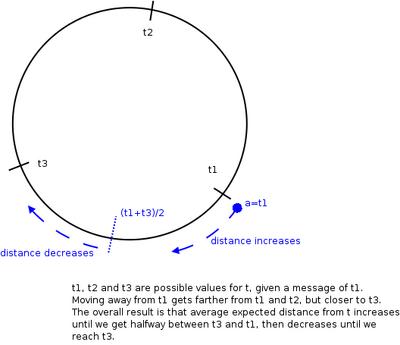
Receiver's best response is then any mixed strategy having as its support only actions with the possible values of Sender's type t. For example, if m = 1/6, Receiver can play any combination of 1/6, 1/2 and 5/6. The expected distance from sender's type of any one of these actions is (1/3 * 0 + 1/3*1/3 + 1/3*1/3) = 2/9. The expected distance from sender's type of any other action a is greater than this. The simplest way to see this is to imagine the three possible values of t. By moving Receiver's action a away from one of these values, two of the values get farther away, while one of them gets closer:
Now we consider Sender's best response to Receiver's strategy. First note that if Receiver plays, say "2/3" with probability 1 on receiving m = 0, but randomizes over all 3 possible types for e.g. m = 1/10, then when t = 1/3+1/10 it will be more sensible to send m = 0 (guaranteeing a response close to her bliss point) than the assumed strategy of m = 1/10. So we focus on the case when Receiver randomizes with equal probability over all 3 types, for all messages m in [0,1/3).
In this case, the logic above also holds true for Sender's utility. By sending a message reflecting her true type, she elicits a best response of one of her three possible types. The logic for Sender is just as for Receiver: this has a one in three chance of being at her bliss point (at t+c, where t+c is one of the three possible types) and a 2/3 chance of being 1/3 away; any alternative message would generate a greater expected distance from t+c. Thus, honesty is a best response to Receiver's strategy, and we have our Bayesian Nash equilibrium.
The same logic holds whenever c = 1/n, and n is odd. Then, any message m in [0,1/n) where m corresponds to t modulo 1/n will generate a best response of choosing one of the possible types: any move away from a possible type moves (n+1)/2 of the possible types away from you, and (n-1) towards you, all by the same distance.
On the other hand, when n is even, the equilibrium remains technically but is much less plausible. Now all Receiver's strategies are equally good, because moving action a away from a possible type brings n/2 possible types closer while n/2 move farther away by the same distance. The case with n=4 is shown below:
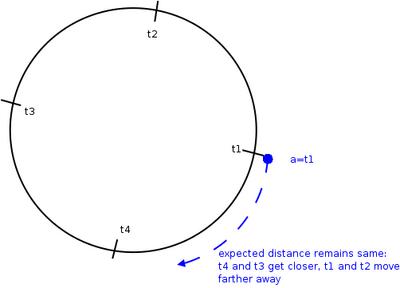
The equilibrium remains, technically, because choosing a equal to some possible value of t is still a best response. But there would be no incentive, in the long term, for Receiver to play this equilibrium. When n is odd, there are plenty of best responses that don't lead to equilibrium (such as mixed strategies where Receiver doesn't always randomize equally between points) but in the long term one might expect Receiver to play "nicely" in order to keep the flow of useful information going. (I don't know if anyone has toyed with repeated cheap-talk games.)
Before moving on to the general case, where c does not "fit neatly" into the circle, it is worth pointing out that here, as c decreases, the potential equilibria are getting less informative rather than more, in the following two senses:
That's all for now. Next post, I'll have a shot at the general case. I suspect this will also have an equilibrium of some kind.
I'm on Linux, as if you didn't know. Bah. I'm sick of having an operating system built by volunteers. I want a professional product that just works. My idealism has run out.
Now, on to more amusing things. That cheap-talk game. (You don't find abstract game theory interesting? Shame on you.)
Although it is true that there is no equilibrium in which types within different intervals along the circle play different messages, there may be an equilibrium with an infinity of messages. For example, suppose that c = 1/3 (recall that c is the difference between Sender's and Receiver's ideal points on the circle). Then, there is an equilibrium in which the message space M is [0, 1/3) and Senders send a message equal to their type, modulo 1/3. For example, senders with types 1/6, 1/2 and 5/6 would all send m = 1/6.
Receiver's best response is then any mixed strategy having as its support only actions with the possible values of Sender's type t. For example, if m = 1/6, Receiver can play any combination of 1/6, 1/2 and 5/6. The expected distance from sender's type of any one of these actions is (1/3 * 0 + 1/3*1/3 + 1/3*1/3) = 2/9. The expected distance from sender's type of any other action a is greater than this. The simplest way to see this is to imagine the three possible values of t. By moving Receiver's action a away from one of these values, two of the values get farther away, while one of them gets closer:

Now we consider Sender's best response to Receiver's strategy. First note that if Receiver plays, say "2/3" with probability 1 on receiving m = 0, but randomizes over all 3 possible types for e.g. m = 1/10, then when t = 1/3+1/10 it will be more sensible to send m = 0 (guaranteeing a response close to her bliss point) than the assumed strategy of m = 1/10. So we focus on the case when Receiver randomizes with equal probability over all 3 types, for all messages m in [0,1/3).
In this case, the logic above also holds true for Sender's utility. By sending a message reflecting her true type, she elicits a best response of one of her three possible types. The logic for Sender is just as for Receiver: this has a one in three chance of being at her bliss point (at t+c, where t+c is one of the three possible types) and a 2/3 chance of being 1/3 away; any alternative message would generate a greater expected distance from t+c. Thus, honesty is a best response to Receiver's strategy, and we have our Bayesian Nash equilibrium.
The same logic holds whenever c = 1/n, and n is odd. Then, any message m in [0,1/n) where m corresponds to t modulo 1/n will generate a best response of choosing one of the possible types: any move away from a possible type moves (n+1)/2 of the possible types away from you, and (n-1) towards you, all by the same distance.
On the other hand, when n is even, the equilibrium remains technically but is much less plausible. Now all Receiver's strategies are equally good, because moving action a away from a possible type brings n/2 possible types closer while n/2 move farther away by the same distance. The case with n=4 is shown below:
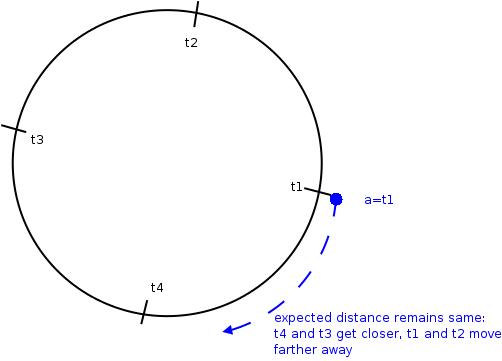
The equilibrium remains, technically, because choosing a equal to some possible value of t is still a best response. But there would be no incentive, in the long term, for Receiver to play this equilibrium. When n is odd, there are plenty of best responses that don't lead to equilibrium (such as mixed strategies where Receiver doesn't always randomize equally between points) but in the long term one might expect Receiver to play "nicely" in order to keep the flow of useful information going. (I don't know if anyone has toyed with repeated cheap-talk games.)
Before moving on to the general case, where c does not "fit neatly" into the circle, it is worth pointing out that here, as c decreases, the potential equilibria are getting less informative rather than more, in the following two senses:
- The message space for e.g. c = 1/5 is [0,1/5), which is a proper subset of the message space for c = 1/3, [0,1/3).
- The expected distance from Receiver's (and Sender's) ideal point, when c=1/n, is (n^2-1)/4(n^2). This increases as n increases, with a limit of 1/4. For example, expected distance when c = 1/3 is just 2/9, when c = 1/5 it is 6/25.
That's all for now. Next post, I'll have a shot at the general case. I suspect this will also have an equilibrium of some kind.
Monday, 29 August 2005
A jolly little cheap-talk game
This is just to show off my newly-acquired skills from ICPSR summer school. If you aren't into game theory it will mean nothing to you - you have been warned!
The standard cheap-talk game, found e.g. in Morrow, has Sender's type t drawn from a uniform distribution on a unit interval: t ~ U[0,1]. Sender sends a message m from some set of possible messages M; then Receiver chooses an action a from that same unit interval. Receiver's utility declines monotonically, continuously and symmetrically with the distance of a from t, e.g. UR(a) = - (t-a)^2. In effect Receiver is trying to guess Sender's type. Sender's utility declines monotonically, continuously and symmetrically with distance of a from some point t+c, where c>0 and measures some conflict of interest. For example, Sender's utiliy might be US(a) = - (t+c-a)^2. So Sender wants Receiver to guess Sender's type, but be a little bit off.
It then turns out that if c is small enough, there are informative equilibria where different ranges of types send different messages (so that Receiver can infer something about Sender's type); and as c shrinks the maximum number of messages in a potential equilibrium increases. It's a nice prediction - communication gets easier when there are common interests to rely on.
But now consider this jolly little variation. (I should warn you at once that I can think of no substantive applications, but it's food for thought in any case.)
Suppose that Sender's type is still drawn from U[0,1], but now we think of it as being defined on a unit circle, with distance defined as the shortest possible way round the circle. So now, for example, choosing a = 1 when t=0 would be a very good action for Receiver, as this would give a-t=0.
Now there is no equilibrium in which Senders with t in different sub-intervals send different messages, no matter how small c is. (I am not sure I can prove that there is no informative equilibrium at all. Perhaps there's one in which a continuum of possible messages are sent, informing R about the value of t modulo c, or something similar.)
Proof
Suppose that there are n different sub-intervals around the circle; Senders with t in any of these sub-intervals send different messages. Let's take an arbitrary pair of adjacent sub-intervals (x,y) and (y,z), sending messages m1 and m2. As usual, since t is uniformly distributed, Receiver's best responses are a1 = (x+y)/2 and a2=(y+z)/2. And, as usual, because Sender's utility function is continuous w.r.t. a, Senders at the boundary where t = y must be indifferent between a1 and a2.
Therefore, it must be the case that the distance from a1 to y+c (Sender's ideal point when t=y) is equal to the distance from a2 to y+c. And so the boundary point y must be closer to the midpoint of (x,y) than to the midpoint of (y,z); and so the interval (y,z) must be larger than (x,y).

But this must be true for all intervals round the circle, which is clearly impossible. (If there is a finite number of intervals, n, then the nth interval must be bigger than the n-1th interval, which itself is bigger than the n-2th interval and so on down to the first; but it must also be smaller than the first interval which is adjacent to it. If there are an infinite number of intervals, then choose an arbitrary selection of 2 or more points on the circle and consider that the size of the intervals containing these points must continue to increase as you move clockwise around the circle. I think this works. Hey, it's a blog, and I'm only writing this to avoid real work.) QED.
Note that nothing here depends on the exact geometry of the "circle". The proof works for any interval with distance defined in an appropriately circular fashion. (But, as I said, what the hell are the substantive applications? A hunter is chasing an elephant, which itself is chasing a bear around a big lake; he wants his friend to slay both elephant and bear, but his friend only wants to tackle the elephant. Oh Lord. Answers on a postcard?)
The standard cheap-talk game, found e.g. in Morrow, has Sender's type t drawn from a uniform distribution on a unit interval: t ~ U[0,1]. Sender sends a message m from some set of possible messages M; then Receiver chooses an action a from that same unit interval. Receiver's utility declines monotonically, continuously and symmetrically with the distance of a from t, e.g. UR(a) = - (t-a)^2. In effect Receiver is trying to guess Sender's type. Sender's utility declines monotonically, continuously and symmetrically with distance of a from some point t+c, where c>0 and measures some conflict of interest. For example, Sender's utiliy might be US(a) = - (t+c-a)^2. So Sender wants Receiver to guess Sender's type, but be a little bit off.
It then turns out that if c is small enough, there are informative equilibria where different ranges of types send different messages (so that Receiver can infer something about Sender's type); and as c shrinks the maximum number of messages in a potential equilibrium increases. It's a nice prediction - communication gets easier when there are common interests to rely on.
But now consider this jolly little variation. (I should warn you at once that I can think of no substantive applications, but it's food for thought in any case.)
Suppose that Sender's type is still drawn from U[0,1], but now we think of it as being defined on a unit circle, with distance defined as the shortest possible way round the circle. So now, for example, choosing a = 1 when t=0 would be a very good action for Receiver, as this would give a-t=0.
Now there is no equilibrium in which Senders with t in different sub-intervals send different messages, no matter how small c is. (I am not sure I can prove that there is no informative equilibrium at all. Perhaps there's one in which a continuum of possible messages are sent, informing R about the value of t modulo c, or something similar.)
Proof
Suppose that there are n different sub-intervals around the circle; Senders with t in any of these sub-intervals send different messages. Let's take an arbitrary pair of adjacent sub-intervals (x,y) and (y,z), sending messages m1 and m2. As usual, since t is uniformly distributed, Receiver's best responses are a1 = (x+y)/2 and a2=(y+z)/2. And, as usual, because Sender's utility function is continuous w.r.t. a, Senders at the boundary where t = y must be indifferent between a1 and a2.
Therefore, it must be the case that the distance from a1 to y+c (Sender's ideal point when t=y) is equal to the distance from a2 to y+c. And so the boundary point y must be closer to the midpoint of (x,y) than to the midpoint of (y,z); and so the interval (y,z) must be larger than (x,y).

But this must be true for all intervals round the circle, which is clearly impossible. (If there is a finite number of intervals, n, then the nth interval must be bigger than the n-1th interval, which itself is bigger than the n-2th interval and so on down to the first; but it must also be smaller than the first interval which is adjacent to it. If there are an infinite number of intervals, then choose an arbitrary selection of 2 or more points on the circle and consider that the size of the intervals containing these points must continue to increase as you move clockwise around the circle. I think this works. Hey, it's a blog, and I'm only writing this to avoid real work.) QED.
Note that nothing here depends on the exact geometry of the "circle". The proof works for any interval with distance defined in an appropriately circular fashion. (But, as I said, what the hell are the substantive applications? A hunter is chasing an elephant, which itself is chasing a bear around a big lake; he wants his friend to slay both elephant and bear, but his friend only wants to tackle the elephant. Oh Lord. Answers on a postcard?)
and on the other hand
7.50 this morning we get dear old Rabbi Blue on Thought for the Day, an exemplar of kindness, humour and good sense.
Sunday, 28 August 2005
2am eternal
It's 2 am. On the world service: "Reporting Religion".
First up, two rabbis discuss the meaning of Zionism. One of them believes that compromise over the status of Jerusalem is impossible, because the Jewish people have a contract with God.
Next: Delhi is being overrun by monkeys, who have been e.g. attacking children. The monkeys cannot be harmed because they are sacred, in fact divine.
And finally, does the Koran contain truths only recently discovered by Western science? A columnist in an Egyptian newspaper thinks so, and has a page of scriptural reinterpretation every week.
The traditional response to idiocies of this kind has been something like "religion and science deal with different, incommensurable kinds of truth". Here's an alternative way to look at it. All the three ideas above involve empirical claims, which are more or less testable... and completely preposterous. Monkey Gods, contracts between God and his "chosen people", quantum physics hidden in the Koran code: what serious person can regard these ideas with anything but contempt?
There are some complex explanations of the "revenge of God", the resurgence of religion over the past fifty years. Here's a simple one, which I'm sure cannot be the whole truth: enlightened, thoughtful people took their eye off the ball. The others got so angry when we disputed their stories, that it became easier just to go along and to pretend that there was no fact of the matter in these areas. So the nutters grew louder, more confident and madder than ever. Now we should learn our lesson. When someone talks nonsense, we should stand up and call it nonsense to its face.
Subscribe to:
Posts (Atom)